October is National Breast Cancer Awareness Month in America. All throughout society, people are wearing pink ribbons and other clothing items of a pink color to show their support for the cause. Organizers hope that such awareness will one day bring a cure to the disease.
There are many different kinds of cancer affecting every type of person, from young to old, black to white, etc. Breast cancer is especially noteworthy since it affects women. In the Vedic tradition, one is taught to view every woman as their mother, except for the wife. The Vedas define seven types of mothers: the guru’s wife, the earth, the birth mother, the wife of a brahmana, the wife of a king, a nurse, and a cow. The importance of a mother is that she provides nurturing and protection to dependents. The cow is considered a mother since it freely provides milk. An infant child can survive simply off the breast milk of the birth mother and the milk of a cow. We would never think of killing our own mother, but society today unhesitatingly sends millions of cows each year to slaughterhouses.


“How can we worship our deities, who are not manifest before us, if we neglect the worship of our parents, who stand right before our very eyes?” (Lord Rama speaking to Sita Devi, Valmiki Ramayana, Ayodhya Kand, Sec 30)
We are all born into ignorance. Though we have God’s expansion as Paramatma residing inside of us, we are still clueless about our previous lives when we first take birth. Our parents guide us through the early years, teaching us how to speak, eat, and walk. As stated before, the mother plays an important role in this education. The “soccer mom” phenomenon is not a myth. Mothers usually play an active role in a child’s development, driving them to and from school, making sure they keep up with their studies, and also seeing to it that they are properly fed. Women of the Vedic tradition especially take in interest in the feeding department. When visiting a Hindu household, mothers usually will force feed their guests until they are completely stuffed. They take the same tack with their children.


Among devotees of Lord Krishna, the Supreme Personality of Godhead, October is also a special month since it celebrates the life and activities of one special woman in particular, Mother Yashoda. Aside from having the holidays of Diwali and Govardhana Puja, the month of October, also known as Karitka in the Vedic calendar which is based off the lunar cycle, is considered very auspicious. In this month, devotees celebrate the famous pastime of Mother Yashoda binding baby Krishna to a mortar with a rope. This form of the Lord is referred to as Damodara. As the Lord states in the Bhagavad-gita, from time to time He personally comes to earth to provide protection to His devotees:
“Whenever and wherever there is a decline in religious practice, O descendant of Bharata, and a predominant rise of irreligion-at that time I descend Myself.” (Bg 4.7)


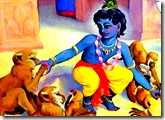
Krishna’s foster parents must certainly have been very pious in their previous lives. Most people worship God in a subordinate relationship, viewing Him as the Supreme Father. The Lord, however, prefers to be served as a dependent by His devotees. For this reason, He gives the most exalted devotees the chance to serve Him as a parent or guardian. Mother Yashoda was one such devotee. In Krishna’s childhood, He was quite naughty, performing many childish pranks. Parents derive so much pleasure from the youthful activities of their children, so Krishna wanted Yashoda to be delighted by His transcendental pastimes. On one occasion, the Lord was being breast fed by Yashoda, when she noticed that the yogurt she had on the stove was about to overflow. She put Krishna aside and went to tend to the pot. Krishna pretended to be angered by this distraction, so He broke a pot of yogurt and then ran away. Yashoda came back to find the broken pot and figured that Krishna had broken it. She went looking for her young child and eventually found Him distributing butter to monkeys.