


Many of the great Vedic texts are often recited in public. People gather round to hear the Ramacharitamanasa or Valmiki Ramayana recited continuously over a set period, usually over several days. While these recitations certainly benefit both the reader and the listeners, the great Vedic texts were written so as to allow us to connect with God on a daily basis.
The books themselves give guidelines for recitation. The Ramacharitamanasa was written by Goswami Tulsidas, who himself gave guidelines on how to recite his work in public. His book and many other Vedic stories declare that anyone who hears them with faith and devotion will have various material rewards bestowed on them. Narada Muni declared that anyone who heard the story of Lord Rama, as told in the Valmiki Ramayana, would enjoy felicity in heaven with all of their relatives.
Other stories found in the various Puranas also make similar statements. There are various kavachas, which are prayers dedicated to various forms of God, which act as shields to the reader. For example, the Sri Nrsimha-kavaca-stotram, as told by Prahlada Maharaja, grants many benedictions to one who recites it regularly:
“(For those who read this kavacha)…Whatever one desires in this world he can definitely attain without doubt. One can have wealth, many sons, and a long life. He becomes victorious who desires victory, and he indeed becomes a conqueror. He wards off the evil influences of all planets, earthly, heavenly, and everything in between.” (Sri Nrsimha-kavaca-stotram)


The various material rewards offered at the end of these stories act as an enticement to the karmi. One who works on the platform of karma, fruitive activity, is known as a karmi. Almost every person is a karmi since we are all working towards advancing different forms of sense gratification. Students are studying hard so that they can have a nice career when they grow older. Workers put in long hours at the office so they can support their family. Having a big house, a nice car, and a beautiful family are all symbols of success in material life. These things aren’t bad, but they are temporary. The material rewards of dharma (religiosity), artha (economic development), and kama (sense gratification) are not the ultimate aim of life. We may be very pious in our current life and thereby ascend to heaven after death, but residence there is not permanent. The great King Yayati had to fall down back to earth after the merits from his good deeds expired.
“Men of small knowledge are very much attached to the flowery words of the Vedas, which recommend various fruitive activities for elevation to heavenly planets, resultant good birth, power, and so forth. Being desirous of sense gratification and opulent life, they say that there is nothing more than this.” (Lord Krishna, Bhagavad-gita, 2.42-43)
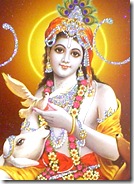

“I am in everyone’s heart as the Supersoul. As soon as one desires to worship the demigods, I make his faith steady so that he can devote himself to some particular deity. Endowed with such a faith, he seeks favors of a particular demigod and obtains his desires. But in actuality these benefits are bestowed by Me alone.” (Lord Krishna, Bg. 7.21-22)
There are many of these karma kanda type rituals prescribed for householders. Lord Rama, an incarnation of Krishna, even performed these rituals Himself during His time on earth. While travelling through the forest with His wife Sita Devi and younger brother Lakshmana, the group would always ask for the blessings of various demigods whenever they would set up a new cottage. Sita Devi was so great that she would regularly pray to the Ganges River, who is known as the demigod Ganga Devi, to protect her husband. She asked the demigods to help Rama, who was God. That is the highest form of demigod worship.


Bhakti yoga, having a pure love for God, is the topmost Vedic discipline, transcendental to all Vedic rituals. All the great books of Vyasadeva, Valmiki, Tulsidas, and others, were written to allow one to connect with God. The Lord isn’t always physically present before us, but through His holy name, He can come to us very quickly. In this age, chanting is the prescribed method for transcendental realization. There are no rules and regulations applied to chanting. One can chant the holy names of the Lord anywhere and everywhere. Reading is just as good as chanting. Knowing this, we should read the great Vedic texts as often as we can, not just once a year. Anyone can start reading at any time of the year, for God is always waiting for us to come to Him.