


The Christmas season is known for gift giving. For retail stores, the time between Thanksgiving and Christmas represents their busiest sales period of the year. The day after Thanksgiving is known as Black Friday since that’s when retailers are expected to earn a bulk of their profits for the year. Over time, Christmas has morphed into almost a secular holiday, with people from all walks of life purchasing Christmas trees and exchanging gifts with their families. This situation presents a great opportunity for the spreading of God consciousness.
Christmas is the holiday celebrating the birth of Lord Jesus Christ, the founder of the modern day Christian religion. The occasion is the equivalent of Janmashtami, the birthday of Lord Shri Krishna, for Hindus. Christ is viewed as the savior, so celebrating his appearance day is only natural, for it marks the day he came to preach God consciousness to society at large. Jesus was extremely kind and forgiving. He struggled very hard to get others to turn to God, and he fought all the naysayers that came along the way. He was so committed to his mission that he even voluntarily accepted crucifixion in order to spread his message.


“The learned brahmanas, who had no other source of income, were completely dependent on the vaishya and kshatriya communities for their maintenance, and they received gifts on such festive occasions as birthdays, marriages, etc.” (Krishna, the Supreme Personality of Godhead, Vol 1, Ch 5)
Brahmanas are those who know Brahman, the impersonal effulgence feature of the Lord. Brahmanas can be thought of as priests, though not of the modern variety. Many people associate Hinduism with the degraded caste-by-birthright system, but the original divisions implemented by Krishna were never meant to be based simply on one’s birth.
“According to the three modes of material nature and the work ascribed to them, the four divisions of human society were created by Me. And, although I am the creator of this system, you should know that I am yet the non-doer, being unchangeable.” (Lord Krishna, Bhagavad-gita, 4.13)


Brahmanas, on the other hand, work simply for the satisfaction of God. In the classic system, they typically didn’t earn a salary. Some brahmanas may have taken to subsistence farming, but in general, brahmanas lived off the charity of others. In today’s world, non-profit organizations have a negative stigma associated with them. A person that works for a non-profit is sometimes viewed as a leech, a person who lives off the hard work of others. Bona fide brahmanas shouldn’t be labeled as such. They don’t take to a life of poverty simply to get out of working. On the contrary, brahmanas actually work hard day and night trying to satisfy God and His devotees. Their main business is to serve God and to teach others how to serve Him. It is actually to the benefit of householders and other money-makers to give generously in charity to brahmanas.
“My dear brahmana, your appearance in a householder’s place is only to enlighten. We are always engaged in household duties and are forgetting our real duty of self-realization. Your coming to our house is to give us some enlightenment about spiritual life. You have no other purpose to visit householders.” (Nanda Maharaja speaking to Gargamuni, Krishna, the Supreme Personality of Godhead, Vol 1, Ch 8)


“A brahmana will never ask about a salary. A brahmana is eager to see that people are educated. ‘Take free education and be educated; be a human being’—this is a brahmana’s concern:” (Shrila Prabhupada, Journey of Self-Discovery, Ch. 6.5)
In Vedic times, householders would regularly invite brahmanas to their home and entertain them. This wasn’t done for the benefit of the sage, but rather for the benefit of the householder. The priestly class wasn’t interested in filling their bellies. They would visit homes in order to preach the glories of the Lord. Today’s situation has made things a little more difficult. Instead of being sought out for advice, it is the brahmanas who must seek out others and beg them to become devotees of God.
The Christmas holiday presents a great opportunity for all of us to become preachers. Lord Chaitanya, Krishna’s incarnation as a brahmana some five hundred years ago, begged everyone to simply chant the holy names of God, “Hare Krishna Hare Krishna, Krishna Krishna, Hare Hare, Hare Rama Hare Rama, Rama Rama, Hare Hare”. Becoming a devotee is certainly good, but it signals only the beginning of spiritual life. Lord Chaitanya asked that everyone become a guru by simply talking about Krishna with others and asking them to take up chanting.
The tradition of gift-giving during the Christmas season can be used to facilitate this request. In general, if we give someone a gift on a whim, that person becomes suspicious. “Why is this person giving me this nice gift? There must be a reason behind this. Even if they are just trying to be nice, what am I supposed to do now? I feel obligated to give them a gift in return.” For this reason, gifts are generally exchanged on special occasions like birthdays, anniversaries, and holidays. The Christmas holiday is especially known for gift giving, making it a time where it is socially acceptable to give anyone a gift. There is usually nothing expected in return. While the majority of the gifts given this year will be on the material platform, devotees can use the holiday season to give the gift of Krishna.
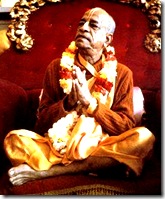

Devotees are happiest when they see other people rendering service to Lord Krishna. Christmas is as good a time as any to ask others to think of God and His blessings. If we dedicate ourselves to serving Krishna and His devotees, we can enjoy peace on earth.