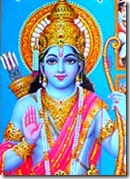
Lord Rama is God Himself. He appeared on earth many thousands of years ago and enacted many wonderful pastimes which are all chronicled in various Vedic literatures, but most notably in the Valmiki Ramayana and the Ramacharitamanasa. Through His kind mercy, the Lord personally delivers all the knowledge required for us to make our lives successful and return back to His transcendental abode. Since God is the most famous, His words automatically inherit that fame; thus His teachings have eternal relevance.


This may represent a deficiency in people’s observatory patterns, but it is a true fact of life. This principle is commonly displayed in the arena of politics. In the 2000 U.S. Presidential election, then Governor of Texas George W. Bush was running for the Republican Party nomination. He had opinions and stances on a wide array of political issues, but he wasn’t taken very seriously due to his relative inexperience in the political arena. His resume consisted only of six years of service as governor. Right before the party convention, Bush chose former Secretary of Defense Dick Cheney as his vice presidential nominee. Almost every major news media outlet, including both television and print, had the same reaction. They all said that the Cheney pick brought gravitas to the Bush campaign. Cheney’s stances on the issues were no different than Bush’s, for they were both considered Conservatives. However, Cheney had many years of political experience, dating all the way back to the 1970s. His words were much more respected than Bush’s.
Different people are afforded varying levels of respect, but no one has more gravitas than God. He is the original person, adi purusham, and the supreme master, maheshvaram.
“My dear friend, mighty-armed Arjuna, listen again to My supreme word, which I shall impart to you for your benefit and which will give you great joy. Neither the hosts of demigods nor the great sages know My origin, for, in every respect, I am the source of the demigods and the sages. He who knows Me as the unborn, as the beginningless, as the Supreme Lord of all the worlds-he, undeluded among men, is freed from all sins.” (Lord Krishna, Bhagavad-gita, 10.1-3)


The great sages of the past were even more God conscious than we are today, so they savored every direct word spoken by God so much, that they desired to put them into writing. For this reason the Vedic literatures are the most voluminous of any religious tradition. Originally all Vedic knowledge was passed down through oral tradition; the hearing process. The Vedas themselves are referred to as the shrutis, meaning “that which is heard”. As people’s brain power gradually diminished, written scripture was required. God’s direct teachings and glorious pastimes are all chronicled in the great texts such as the eighteen Puranas, Mahabharata, and Ramayana.
The Vedas originated from God, thus they contain a wealth of knowledge. Over and above anything else, God’s primary teaching is that we should not get caught up in the temporary aspect of material nature, and that we should rather focus on returning back to His spiritual realm. This represents a complete paradigm shift from our current way of thinking. Upon taking birth, we immediately identify with our gross material body. This is the first mistake we make since the body is constantly changing and is ultimately destined to be given up at the time of death.
“As a person puts on new garments, giving up old ones, similarly, the soul accepts new material bodies, giving up the old and useless ones.” (Lord Krishna, Bg. 2.22)


Animals involve themselves in four primary activities: eating, sleeping, mating, and fearing. By default, uneducated human beings don’t act any different. The exact style of eating or sleeping may not be the same as the animals, but man is nevertheless engaged in similar activities. Since we have a higher level of intelligence, we generally seek out the three rewards of life: dharma, artha, and kama. Dharma is religiosity, artha is economic development, and kama is sense gratification. “I want to be religious enough to have enough wealth to be happy and secure. I need enough money so I can then engage in sense gratification.” This is the sum and substance of karmic life, or fruitive activity. We work hard during the day to procure wealth that can then be used to satisfy our senses.
People who are successful in karmic life, those having no problems eating, sleeping, or mating, then take to fearing or defending. “I have all this wealth, but what do I do now? I’m afraid I will lose this all in a second. I especially don’t want to die.” This is the crux of the lesson taught here by Lord Rama. Once a fruit finally ripens, it has nothing left to do but fall down from the tree and die. In a similar manner, the mature human being who has successfully lived to an old age, has nothing else to do but die.
“As the embodied soul continually passes, in this body, from boyhood to youth to old age, the soul similarly passes into another body at death. The self-realized soul is not bewildered by such a change.” (Lord Krishna, Bg. 2.13)


Luckily for us, the Vedas exist precisely to eliminate this fear of death. This fear can actually be eliminated in one second. We just have to surrender to God.
“Abandon all varieties of religion and just surrender unto Me. I shall deliver you from all sinful reaction. Do not fear.” (Lord Krishna, Bg. 18.66)
We have to change our desires. That is the true definition of surrendering unto God. In our conditioned stated, we crave the temporary happiness brought about by mundane sense gratification. Yet by definition, this happiness must go away. That is the meaning of temporary. Knowing that this happiness won’t last, a fear of loss immediately takes over. However, if we desire to have association with Krishna, or God, then there is no fear of dying. Death merely represents a changing of bodies, so it is actually not anything to fear.
One of God’s names is Mukunda, meaning one who gives liberation. A perfectly God conscious person no longer has to endure the repeated cycle of birth, old age, disease, and death. Going to Krishna’s spiritual realm means leaving behind the material world forever.
“That abode of Mine is not illumined by the sun or moon, nor by electricity. One who reaches it never returns to this material world.” (Lord Krishna, Bg. 15.6)
So how does one surrender and become liberated? One must become God conscious. The events of birth and death happen on their own since they are part of nature. We don’t have to try to check nature since we cannot even begin to comprehend her power. We can’t control the weather, but what we can control is our desire to become God conscious.