


Lord Rama, and incarnation of God, is describing the noteworthy characteristics of the great Agastya Muni. The Vedas, the ancient scriptures of India, provide a genealogy of creation which gives a list of the noteworthy personalities who first appeared on earth. Lord Brahma is the first created living entity. He is often referred to as the self-create, but he actually took birth from the navel of Lord Vishnu, who is Krishna’s expansion. From Brahma, all other living entities were born. The Vedas provide a list of the most notable saints who first took birth, and Agastya Muni is included in that list.


Forest life is quite conducive to the performance of sacrifice and austerity. For this reason, many brahmanas set up hermitages in the forest. The Vedas tell us that one of the greatest benedictions in life is to have association with a saint. This is because the saints know the highest truth, Lord Shri Krishna. God is referred to as Bhagavan in Vedic literature, meaning He possesses all fortunes. He is also described as the Supreme Absolute Truth. This is because truth can be relative depending on the specific circumstance. However, there is no higher truth than God, thus He is the supreme truth which is absolute, meaning it can’t be disputed. Lord Rama was that very same absolute truth appearing in human form. God loves His devotees, so He enjoys personally paying them a visit when He gets the opportunity to.


The brothers had a regular scheme they used to execute. Ilvala would assume the guise of a brahmana. Pretending to be peaceful and kind in nature, he would invite others to a grand feast. Meanwhile, Vatapi would assume the shape of a goat. Ilvala would then cook up the goat and feed it to the brahmanas as remnants of a sacrifice. In days past, sages would perform many grand sacrifices, which often involved the killing of animals. This shouldn’t mistakenly be equated with today’s practice of killing animals in slaughterhouses. In a properly performed Vedic sacrifice, the soul inside the animal is immediately promoted to a higher species in the next life. Meat eating occurred only as part of Vedic sacrifices. In this age of Kali, there are no qualified brahmanas available to perform such sacrifices, so the practice has been abolished.
As the sages were feasting on the goat flesh, Ilvala would call for Vatapi to come out. The demon would then burst out of the stomachs of the sages, killing them all. The two brothers would then feast on the flesh of the dead sages. One day, the great Agastya Muni happened to get invited to one of these feasts. When Ilvala called out for Vatapi, Agastya simply laughed at him. “There is no use in calling for your brother, for he has gone to Yama’s abode (the god of death)”, said Agastya. Angered by the sage’s word, Ilvala then assumed his original Rakshasa form and rushed at the sage. Agastya then burned him with his eyes, killing him instantly.
This wonderful story was narrated by Lord Rama so as to describe the glories of Agastya. He was no ordinary saint. He was so exalted that his hermitage and its surroundings were completely free of enemies. The Rakshasas were too afraid to step foot anywhere Agastya.
Lord Rama made mention of the fact that liars, cheats, and other sinful people could not live near Agastya either. His hermitage was so sanctified that it automatically repelled asuras. This was the case because a saint is the true representative of God on earth. He has only one business; devotional service. Part of devotional service requires teaching others. By nature, the devotee of Krishna is kind and liberal, meaning he will gladly speak about God to anyone who listens with a pure heart.


The lesson here is that one should approach a spiritual master in the same way that Rama approached Agastya. Any pure devotee who voluntarily teaches others about God can be classified as a guru, or spiritual master. Spiritual knowledge can only be acquired through humble submission to the guru. Arguments between friends can be entertaining, but knowledge is never acquired in this way. By the very nature of their relationship, friends view each others as equals. If one friend states an opinion, the other friend will often argue simply for the sake of conversation.
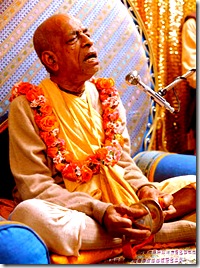

“It is krishna-prasada, Krishna’s mercy, that He sends a bona fide spiritual master to the deserving disciple. By the mercy of Krishna, one meets the bona fide spiritual master, and by the mercy of the spiritual master, the disciple is fully trained in the devotional service of the Lord.” (Shrila Prabhupada, Chaitanya Charitamrita, Madhya, 19.152 Purport)
Even if we approach a devotee by reading their books, true knowledge will not be revealed to us if we are hostile to the guru’s teachings. The great Vedic texts contain ordinary words, but if one is blessed with devotion and respect for God and His devotees, then these words turn into great nectar, relieving one of all material distresses.