


अग्रतः प्रययौ रामस्सीता मध्ये सुमध्यमा
पृष्ठतस्तु धनुष्पाणिर्लक्ष्मणोऽनुजगाम ह
agrataḥ prayayau rāmassītā madhye sumadhyamā
pṛṣṭhatastu dhanuṣpāṇirlakṣmaṇoʼnujagāma ha
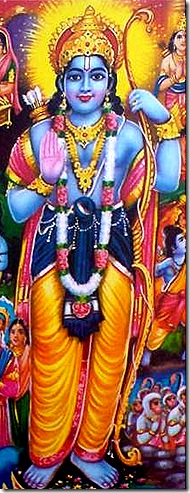
This one passage paints one of the most beautiful pictures imaginable. Simply meditating on this one image can grant liberation from the repeated cycle of birth and death. Lord Rama is God Himself, and Sita and Lakshmana are two of His greatest devotees.

“…prema can be defined as love of God without any expectation of exchange or return. Actually the words prema and love are not synonymous, yet one can say that prema is the highest stage of love. One who has attained prema is the most perfect human being.” (Shrila Prabhupada, Teachings of Lord Chaitanya, Ch 13)
The Vedanta-sutras tell us that the Absolute Truth must be the source of everything. Lord Krishna is the Supreme Absolute Truth, the Personality of Godhead. He resides in the spiritual world, a place which is free of miseries. One of the spiritual planets is known as Vaikunthaloka, which means a place free of anxieties. This entire material universe, with its innumerable planets and solar systems, has its good and bad points, but in the end, everything here is temporary. Some philosophers believe that everything here is false, but it is more accurate to describe all things material as being temporary. This is because pain and pleasure does exist. If we get pricked by a pin, we cannot honestly say that it doesn’t hurt. However, this pain eventually goes away. Pains can be of a greater magnitude, such as diseases, but these are also temporary.
The Vedas tell us that the individual spirit soul represents our identity. Our gross material body is often mistakenly used for identification, but this body is subject to destruction. The only difference between a living body and a dead one is the presence of the soul. When we lament over a person’s death, what actually makes us sad is the departure of the spirit soul. The body remains, but there is nothing inside to give it life.
The original home of the soul is in the spiritual world, where it gets to interact with Lord Krishna in a way that is pleasing to it.
“Being freed from attachment, fear and anger, being fully absorbed in Me and taking refuge in Me, many, many persons in the past became purified by knowledge of Me-and thus they all attained transcendental love for Me. All of them-as they surrender unto Me-I reward accordingly. Everyone follows My path in all respects, O son of Pritha.” (Lord Krishna, Bhagavad-gita, 4.10-11)


In the spiritual world, the spirit souls have a pure love for God. However, upon taking birth in the material world, that love is forgotten. Material life is the antithesis of spiritual life. Deluded by the concepts of “I” and “mine”, the living entity falsely believes itself to be the proprietor of nature. This thinking is essentially a challenge to God. “I can provide for myself. I can work hard and accumulate great wealth and then be happy. I can save the world and also make others happy. I am responsible for my fortunes.” This flawed logic causes the living entity to remain stuck in the material world by repeating the processes of birth and death. God is very kind. If we want to stay here, pretending to be God ourselves, He will gladly facilitate such a desire. The Lord does not stand in our way. That is the true definition of independence. If He forced us to love Him, the resultant love would not be pure. True affection can only come about through independent action.
All hope is not lost however. Due to His causeless mercy, the Lord is kind enough to put stumbling blocks in the way of our karmic actions. This impeding force is known as maya, and she always thwarts our efforts to imitate God. On the surface, this appears to be a bad thing. “Why would God want to torture us? Why would He purposefully put stumbling blocks in place?” The first reason is that every living entity has desires. We may want something very much, but there may also be millions of other people who want the same thing. Thus there is a fierce competition for the accumulation of wealth and material fortunes. This inevitably leads to collisions, resulting in failure for many. In this regard, God is not to blame.
God allows maya to defeat us for another, more important, reason. If material nature kicks us enough, we are more likely to realize that God is the supreme controller, and that we can only be happy by serving Him. In this way, the actions of maya can turn out to be our greatest blessing. The shastras state that one cannot seriously take up spiritual life unless they have become disgusted with material life. The sources for these feelings of disgust can vary, but constant defeat in material endeavors can surely be taken as one of the primary causes. Those who are disgusted with material life are more likely to ask the question, “Who am I? Why did I take birth here? What is the meaning of life?”
This is precisely where spiritual life begins. The first aphorism of the Vedanta-sutras is athato brahma-jijnasa, meaning “Now is the time for inquiring about Brahman, or God.” There are 8,400,000 varieties of living entities, but the human form of life is considered the highest because it represents the greatest opportunity for the spirit soul to return back to its original home. Human beings have a high level of intelligence. Man is so smart that he can figure out very quickly that he is mortal. Realizing this fact means one is more likely to act on it.


The thought is certainly nice, but we see in real life that this type of love doesn’t always last. Often times couples fall out of love, which causes their relationship to end in a breakup or a divorce. The Vedas tell us the aim of life is certainly to love, but that the love must be of the pure variety. The only pure form of love is the one exchanged between God and His devotees.
“Abandon all varieties of religion and just surrender unto Me. I shall deliver you from all sinful reaction. Do not fear.” (Lord Krishna, Bg. 18.66)


During the Treta Yuga, the second time period of creation, Lord Krishna came to earth in human form as the eldest son of the king of Ayodhya. A pious and handsome prince, Lord Rama was an expert kshatriya warrior, known for His pleasing smile and strict adherence to dharma, or religiosity. As part of His pastimes, Rama accepted banishment to the forest for fourteen years. This order was handed down by His father, Maharaja Dashratha, the king of Ayodhya. Rama’s wife, Sita Devi, and His younger brother, Lakshmana, both insisted on accompanying the Lord during His exile. The above reference quote describes how the trio travelled through the forest together.
Rama’s standing in front of both Sita and Lakshmana symbolizes God’s commitment to protecting His devotees. Though it appeared that Rama went to the forest due to the exile order, the real reason for the Lord’s advent was to protect the brahmanas living in the forests at the time. Brahmanas are considered the highest class in society because they are the priests. Their occupational duty is to perform religious activity and teach others how to make the most out of life in a spiritual sense. At the time, the brahmanas were being greatly harassed by Rakshasa demons, headed by their leader Ravana. Rama’s purpose in life was to kill Ravana and thus protect the sages in the performance of their sacrifices.


By taking her to the forest, Rama took full responsibility for her protection. God loves His devotees so much that He never wants them to suffer. For this reason, He always walked in front of her, making sure no one could attack. Eventually Sita would be kidnapped by Ravana, but this was part of the plan of the demigods, which allowed Rama to have an excuse to march to Ravana’s kingdom and take him on in battle.
There are many ways to judge someone’s character, but one of the easiest methods is to simply examine the friends someone keeps. If a person hangs around reprobates and people committed to sinful life, then it means that such a person must have a flawed character. The opposite situation holds true as well. A person who has friends that are of the highest character, must himself be a praiseworthy personality. When studying Lord Rama’s life, we can see that His associates were some of the greatest people who ever lived. Sita Devi was completely sinless. No one could find any fault in her. Though she was a woman who didn’t receive a formal education, her knowledge of dharma was perfect. No one could defeat her in an argument about religion or the proper code of conduct. And yet we see that such a great person completely surrendered herself to Lord Rama. The great saints in the Vedic tradition have also completely surrendered themselves to God. His Divine Grace A.C. Bhaktivedanta Swami Prabhupada, Vyasadeva, Narada Muni, Tulsidas, Prahlada, Janaka, etc. all surrendered themselves unto the Supreme Lord. They viewed Krishna as the ultimate savior. Therefore we can conclude that Lord Krishna is surely great for having such exalted people as devotees.


Lord Rama didn’t require this service from Lakshmana, but He certainly appreciated it. He knows that the bhaktas derive transcendental pleasure from offering their services. For this reason, the Lord is more than willing to encourage the devotees to perform their activities. Some like to chant very loudly, while others enjoy writing books. Some devotees, like Lord Hanuman, love to fight on the Lord’s behalf.
Loving God knows no limits. Unlike with our material relationships which are often checked by forces outside of our control, the pure love exchanged between God and His devotees is unchecked and eternal in nature. Though it is very hard to achieve the same level of devotion as that possessed by Sita and Lakshmana, there is no harming in trying. There are no wasted steps in devotional service. The vision of Rama, Sita, and Lakshmana walking in the forest can be studied forever, since the pastimes of the Lord and His devotees provide us infinite amounts of wisdom. Anyone who keeps this divine image in their mind will surely attain spiritual perfection very quickly.