


Lord Rama was an incarnation of Lord Krishna, the Supreme Personality of Godhead, who appeared on earth many thousands of year ago. Coinciding with Rama’s appearance was that of His younger brother Lakshmana, who was an incarnation of Baladeva, who is a primary expansion of Krishna in the spiritual world. These two brothers served as protectors not only for the residents of their hometown of Ayodhya, but for the entire world. As a direct incarnation of Krishna, Rama can be thought of as God. The Lord is not exclusive to any particular region or group of people. God is for everyone.
Sectarianism is widespread throughout the world when it comes to religion. Aside from the existence of the major religions of the world such as Hinduism, Christianity, Islam, Judaism, there also exist subdivisions of the same religions such as Protestants, Lutherans, etc. Even in India there are many different sects, all ascribing to different beliefs. Because of the variety of religious systems in existence, many people mistakenly believe that God Himself is a man-made creation. “If so many people came up with similar conceptions of God, they must have done so out of their own imagination.” This conclusion may seem plausible, but it is not correct.


“Whatever state of being one remembers when he quits his body, that state he will attain without fail.” (Lord Krishna, Bhagavad-gita, 8.6)
Since not every person has the same level of intelligence or aptitude for spiritual understanding, the Vedas are divided into different sections. The highest form of religion is known as bhagavata-dharma, or devotional service. Though technically considered a method of self-realization, bhagavata-dharma is actually the original occupation of every living entity. The other systems such as jnana-yoga, karma-yoga, and hatha-yoga are all meant to gradually elevate one to the stage of bhakti-yoga, or devotional service. Not every person who attends school will graduate, and in a similar manner, not every living entity who takes birth will take to devotional service right away. It is for this reason that God institutes varieties of religion, each tailored to a specific audience. The idea is that even the demoniac should have a dharma which they can adhere to.
“When the linking up process (of our consciousness with the Supreme Absolute Truth) is predominantly in fruitive activities, it is called karma-yoga, when it is predominantly empirical, it is called jnana-yoga, and when it is predominantly in a devotional relationship with the Supreme Lord, it is called bhakti-yoga.” (Shrila Prabhupada, Bhagavad-gita, 6.46 Purport)


In this respect, pure Vaishnavas are actually better devotees of Lord Shiva than most of his other devotees. The reason for this is that Lord Shiva is generally worshiped by those seeking material benedictions. By definition, Shiva is required to give out boons to anyone who worships him purely. He actually didn’t covet this role, for he wanted to spend all his time meditating on the lotus feet of God. Lord Hari (Krishna) advised Shivaji to get married and to serve as a demigod for those in the mode of ignorance. For these reasons, Lord Shiva is one of the greatest servants of Lord Vishnu. Aside from worshiping Lord Krishna or Vishnu, Vaishnavas love and respect all other devotees of the Lord. Shrimati Radharani and the gopis of Vrindavana are adored for this very reason. The great Vaishnava acharyas and spiritual masters are all shown the highest respect. Since Lord Shiva is such a great devotee, Vaishnavas have great love for him.
“Lord Brahma, Bhagavan Narada, Lord Shiva, the four Kumaras, Lord Kapila [the son of Devahuti], Svayambhuva Manu, Prahlada Maharaja, Janaka Maharaja, Grandfather Bhishma, Bali Maharaja, Shukadeva Gosvami and I myself know the real religious principle. My dear servants, this transcendental religious principle, which is known as bhagavata-dharma, or surrender unto the Supreme Lord and love for Him, is uncontaminated by the material modes of nature. It is very confidential and difficult for ordinary human beings to understand, but if by chance one fortunately understands it, he is immediately liberated, and thus he returns home, back to Godhead.” (Instructions of Yamaraja, Shrimad Bhagavatam, 6.3.20-21)


During Lord Rama’s time, another great demon by the name of Ravana had ascended to power. A Rakshasa by birth, Ravana was also a great devotee of Lord Shiva. Ravana used his acquired boons to defeat many demigods in battle. The whole world was afraid of him, including the brahmanas living in the forest. During those times, many sages took to the woods to perform their brahminical duties. A brahmana is essentially a priest, someone whose full-time occupation is the studying of the Vedas and the performance of yajnas, or sacrifices for Lord Vishnu.
Rakshasas are the opposite of brahmanas. Their full-time occupation is intoxication and meat-eating. They are not particular as to what kind of meat they will eat, for they will even devour human flesh. Aside from living a sinful life, the Rakshasas were staunch atheists who viewed the brahmanas as the greatest threat to their way of life. For this reason, they were constantly harassing the sages living in the forest. The brahmanas could have cast their own spells on the Rakshasas, but then they would lose a lot of their accumulated spiritual merits. A brahmana is supposed to be dhira, or one who is self-controlled and sober. They are also supposed to be extremely tolerant and non-violent. If they were to attack the Rakshasas with their curses, they would be going against their prescribed duties.
“Thus we are being persecuted by the Rakshasas dwelling in the Dandaka forest. You and Your brother Lakshmana are the only ones that can protect us. In this forest, You indeed are our Lord.” (Sages of Dandaka forest speaking to Lord Rama, Valmiki Ramayana, Aranya Kand, 10.15)
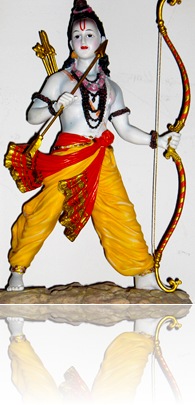

The Lord makes an exception for His devotees. For them, He takes it upon Himself to provide protection. This was the case with the brahmanas of the Dandaka forest. Not only did they ask Rama for help, but they fully surrendered themselves to both He and Lakshmana. The sages declared that Rama and Lakshmana were their masters. In the strict material sense, no one is higher than a brahmana. He is the most respected member of society. A true brahmana does not engage in the service of anyone except God. By voluntarily subordinating themselves to Rama and Lakshmana, the brahmanas gave us the perfect example of how one should surrender to God.
The pure devotee of Lord Vishnu is the wisest person in the world for one simple reason; he knows that God is in charge of everything. Not only does the devotee know that God is the supreme controller, but he has practically realized this fact through the surrendering process.
“Give up all varieties of religiousness, and just surrender unto Me; and in return I shall protect you from all sinful reactions. Therefore, you have nothing to fear." (Lord Krishna, Bg. 18.66)
The brahmanas in the forest fully surrendered to God, and as a result, they were fully protected from the Rakshasas. Both Rama and Lakshmana would go on to kill many demons, including Ravana. Those two pious princes ended the suffering of the sages.
The only legitimate suffering is that which arises from one’s inability to perform devotional service. Material pains and pleasures come and go on their own, so that’s not why the sages petitioned Rama. Their life’s occupation, loving service to God, was what was in jeopardy. From their example, we learn that the only solution to life’s real problems comes from completely surrendering unto God. This surrender can be easily carried out by regularly chanting the holy names of the Lord, “Hare Krishna Hare Krishna, Krishna Krishna, Hare Hare, Hare Rama Hare Rama, Rama Rama, Hare Hare”, and executing devotional service in full faith. Rama and Lakshmana are eternal, and they always protect the devotees in every part of the world.