


Kausalya was the mother of Lord Rama, the incarnation of Krishna or God during the Treta Yuga many thousands of years ago in Ayodhya. Lakshmana was Rama’s half-brother, born to the same father as Rama, Maharaja Dashratha. During those times, the kings ruled not only India, but the entire world, and thus others often addressed them as mahipati. Dashratha had three wives as was customary during those times, and Lakshmana was born to Queen Sumitra, thus he is often referred to by the name Saumitra.


As the eldest son of the king, Rama was the rightful heir to the throne. The king, however, decided to install one of Rama’s other younger brothers, Bharata, as the new king. This was quite out of the ordinary and took everyone by surprise, for all the arrangements had been made for Rama’s coronation. The change of plans only happened as a result of a request by Dashratha’s youngest wife, Kaikeyi. She was Bharata’s mother, and a fit of jealously overtook her upon hearing the news of Rama’s impending coronation. The king granted her two boons as a reward for helping him out during a battle with the asuras many years prior. She used the occasion of Rama’s coronation to cash in on those boons.
Bharata’s ascension to the throne was her first request. Dashratha didn’t like the idea, but he nevertheless went along with it. Kaikeyi’s second request was the kicker; the pièce de résistance. She asked for Rama’s banishment to the forest for fourteen years. Dashratha was so horrified by such a prospect, that he immediately lost consciousness and fell to the floor. He was never actually able to personally give these orders to Rama, for the mere utterance of the words would cause the king to lose his life. Rama came to know about the orders upon visiting the dejected king, who was watched over closely by Kaikeyi. “Oh Rama, Your father is too afraid to give You the bad news. He realizes that a king’s orders can never go in vain, and for this reason he’s unwilling to tell You that You have been banished to the forest”, were the words uttered by Kaikeyi.
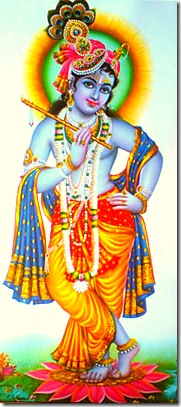

Though God may not always be personally present before us as He was with Lakshmana, He is still kind enough to appear in the form of His archa-vigraha, or the deity. Those who are ignorant of the Vedic traditions mistakenly take deity worship to be idol worship, some pagan ritual concocted by the mind. In reality, worshiping the Lord’s deity is merely a way to serve Him in the same way that Lakshmana served Rama. It is a great practice followed by millions of devotees around the world for centuries. It fosters love for God in the heart, which is really the most important kind of love one can develop.
Lakshmana even threatened to enter a fire if Rama was so ordered. This was in reference to the practice known as the Sati rite, which has since been abolished. In the ancient Vedic tradition, it was generally considered a good thing if the wife died before the husband, for then she wouldn’t have to suffer the separation pains. In situations where the husband died first, the wife would often voluntarily ascend the funeral pyre of her husband as a way of showing her love and devotion. The husband and wife are considered one person, representing the tightest of bonds. By declaring that he would follow a similar tradition, Lakshmana showed how much he loved Rama. To completely tie your happiness and fortunes to another person represents the highest form of love. Lakshmana was a younger brother, so He required nothing from Rama. He was a servant, meaning He gave service to the Lord, never taking anything.

