


Quite a few transcendentalists have as their goal to one day see God. They perform rigorous austerities and deep meditation in the hopes of one day meeting the Lord face to face. There are others who wish to one day meet a yogi or an advanced transcendentalist who has seen God. In fact, many saintly people advertise the fact that they have seen God through their meditation. In a similar manner, there are others who want to see God simply because they want others to believe in Him. “Why doesn’t God just come and make everyone His devotee? This way He can remove all doubts relating to His existence.” The truth of the matter is that God is all around us and that anyone can see Him, provided they have the proper set of eyes.


A good way to illustrate this point is to analyze the disciplines of reading and mathematics. For young children the symbols of any alphabet appear to be just jibberish. Adults can read signs, books, newspapers, etc. because they can understand what words are and what they mean. People who don’t know how to read get no use out of words and sentences. In essence, illiterate people don’t have the eyes to understand written language. It takes years of learning before someone can read properly. Even if we read a book for the first time, we may have trouble understanding it. It sometimes takes us two or three reads before we can really start to grasp concepts and find out the true meaning behind passages and phrases. Mathematics works the same way. At first there are just numbers, but they don’t mean anything by themselves. When we learn how to add, subtract, multiply, and divide, the numbers take on a whole new meaning.
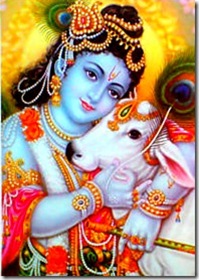

In the spiritual world, these dualities don’t exist. God is the controller of everything, so we have no need to falsely think ourselves to be proprietors. On a spiritual level, everything is related to Lord Krishna, the Supreme Personality of Godhead, thus there is no concept of good or bad. Generally speaking, the mode of goodness, sattva-guna, refers to things that are good or beneficial. However, since it is still part of material nature, even the mode of goodness is flawed. This is because those associating with the mode of goodness can, at best, ascend to the material heavenly planets after death.
“O sinless one, the mode of goodness, being purer than the others, is illuminating, and it frees one from all sinful reactions. Those situated in that mode develop knowledge, but they become conditioned by the concept of happiness.” (Lord Krishna, Bhagavad-gita, 14.6)
Residence on these planets is temporary, meaning one is forced to return to the material world. Thus the mode of goodness itself cannot grant liberation. Sudda-sattva, pure goodness, does not have this defect. The mission of human life is to rise to the platform of sudda-sattva so that we can permanently remove ourselves from this material world full of miseries.
Many people realize the flawed nature of material life. Thus they seek out God, and more importantly, they desperately want to see Him face to face. However, things aren’t that easy. Since we are so accustomed to conditioned material life, there are a few steps required before we can actually see the Lord. The most important thing we have to change is our desire. Desire itself can never be eliminated. Even people who sit in quiet meditation all day still have some sort of desire, for they want to merge into the impersonal effulgence known as Brahman or simply block out all activity. Instead of renouncing activity, the Vedas recommend that we shift our desires to spiritual things.


The guru hasn’t necessarily seen God face to face. Rather, he engages in devotional service all the time, chanting His name, and worshiping His deity. This is actually better than seeing God face to face, because in this way, the guru never stops thinking about Krishna for a second. Seeing God face to face is certainly a nice achievement, but then what do we do after that? Do our desires stop? Do our activities stop? No, those must go on. So it is far better to adjust our activities in such a way that we see God all the time, wherever we turn. This can be achieved by following the instructions of the great acharyas.
The Vaishnava gurus for this age all recommend that we regularly chant the maha-mantra, “Hare Krishna Hare Krishna, Krishna Krishna, Hare Hare, Hare Rama Hare Rama, Rama Rama, Hare Hare”. God’s original form is that of Lord Krishna, but He can expand Himself into unlimited forms. For this age, God incarnates in the form of His holy name. There is no difference between God and His name. This may seem strange to us at first, but through sincere and steady chanting, one can quickly realize this fact. The same holds true with the Lord’s deity. The archa-vigraha, God’s worshipable deity form made out of wood or stone, is just as good as God Himself. There are many instances where deities have actually talked to great personalities. Madhavendra Puri was one such saint who had the distinct honor of talking with Krishna’s deity.
The Lord is all around us. Many parents even see God in their children. This is very easy to understand because birth itself is a miracle. In an instant, a brand new person appears in our world. This person moves, sleeps, and talks all without anyone’s help. A spirit soul entering a new body is certainly a miraculous event which proves the existence of God.


Lord Krishna personally advented on earth in human form as Lord Rama to do away with Ravana and to give relief to the demigods. As part of His pastimes, Rama spent fourteen years roaming the forests of India with His wife, Sita Devi, and younger brother, Lakshmana. On one occasion, Ravana sent 14,000 Rakshasas to the forest of Janasthana to attack Rama. The Lord easily defeated the demons all by Himself. One of the demons, Akampana, managed to escape and return to Lanka to tell Ravana what had happened. He told Ravana that Rama couldn’t be defeated in battle, but that He had a beautiful wife who Ravana should kidnap. Ravana had an insatiable sex desire, so he was immediately intrigued upon hearing of the beauty of Rama’s wife, Sita. Ravana went to his confidante Maricha to ask for help.
In the above referenced statement, Maricha is describing Rama’s glories to Ravana. He is openly declaring that Ravana is not worthy to even look at Rama. This was most certainly true. Ravana had evil motives, for no one is worthy of enjoying God’s wife except God Himself. Maricha is advising Ravana to stay away from Rama, for raising hostilities with Him would only lead to destruction. As events would play out, Maricha would end up helping Ravana kidnap Sita. This was preordained by the demigods, for they wanted Rama to have an excuse to battle Ravana and kill him. Eventually, Rama would march to Lanka and personally defeat and kill Ravana in battle.
The lesson from this passage is very clear. God can be easily seen, provided we have the proper eyes to view him. Ravana was an avowed enemy of the devotees of God. He thought himself to be the most powerful person in the world, thus he couldn’t recognize that God himself was before him in the form of Rama. Still, by unintentionally thinking of God at the time of death, Ravana was granted sayujya-mukti, or the liberation of merging into the body the Lord.

