


God can be equally merciful through the use of violence or nonviolence. The dualities of the material world do not apply to Him, for He is the very definition of virtue and purity. We cannot apply our mundane morals to Him.
“Intelligence, knowledge, freedom from doubt and delusion, forgiveness, truthfulness, self-control and calmness, pleasure and pain, birth, death, fear, fearlessness, nonviolence, equanimity, satisfaction, austerity, charity, fame and infamy are created by Me alone.” (Lord Krishna, Bhagavad-gita, 10.4-5)
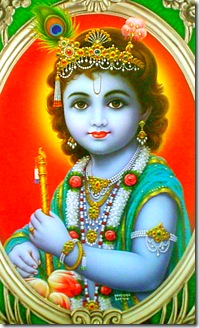

By understanding that we are all part and parcel of Krishna, we see that there is no need for us to be unkind to our fellow man. To go one step further, there is no reason for us to be violent towards others. The mode of passion can sometimes get the better of us. Lust leads to anger, and anger leads to violence. This type of violence is in the mode of ignorance, so one who can control his anger by acting in a non-violent manner is considered virtuous. Unnecessary violence is certainly deplorable, but this doesn’t mean that non-violence is the only path to take under all circumstances. This is where the concept of ahimsa has been misinterpreted. Every one of us possesses the three qualities of material nature (goodness, passion, and ignorance) to varying degrees. For this reason, we see that people have different demeanors, temperaments, and ethical standards. Not every person is nice, with some people being downright dangerous. In order to give protection to the innocent, a class of people is required who can fight off enemies.


“Therefore, Arjuna, you should always think of Me, and at the same time you should continue your prescribed duty and fight. With your mind and activities always fixed on Me, and everything engaged in Me, you will attain to Me without any doubt.” (Bg. 8.7)
According to the Vedas, a warrior who dies while fighting on the battlefield immediately ascends to heaven. This is because fighting on religious principles is not an easy thing to do, so such acts of bravery are duly rewarded. If a society lacks a strong kshatriya presence, then anarchy will ensue since the innocent will have no one to protect them. The miscreants will run hog wild and atheism will run rampant.
God comes to earth from time to time in human form to personally provide us protection from such miscreants. Many thousands of years ago, appearing as the eldest son of King Dasharatha of Ayodhya, God assumed the guise of a pious prince named Rama. Lord Rama had three younger brothers who were all virtuous and dedicated to His welfare, but Lakshmana was especially close to Him. On one occasion, Rama was banished from the kingdom for fourteen years by Dasharatha. This was not due to any fault of Rama’s, but rather to promises that Dasharatha had made to one of his queens. This made Lakshmana very angry. He couldn’t stand to see Rama treated this way. In the above referenced statement, he is trying to persuade Rama to ignore Dasharatha’s order and ascend the throne by force.


By nature, God is very nice and equally disposed towards all living entities. The name Rama actually means one who gives pleasure to others. That was Lord Rama’s nature. He was loved and adored by all the citizens of Ayodhya. Even Dasharatha loved Him very much. Violence wasn’t required in this situation, but Lakshmana suggested it anyway out of love for his brother. Though God is neutral towards everyone, He makes an exception for His devotees. If they are put into trouble, He takes special care to give them protection. Sometimes He sends His authorized representative, or He even personally appears to offer that protection.
“In order to deliver the pious and to annihilate the miscreants, as well as to reestablish the principles of religion, I advent Myself millennium after millennium.” (Lord Krishna, Bg. 4.8)


“When Shishupala was abusing the kings who were about to attack him, Lord Krishna took up His disc, which was as sharp as the blade of a razor, and immediately separated the head of Shishupala from his body.” (Krishna, The Supreme Personality of Godhead, Vol 2, Ch 19)


Rama and Lakshmana used their bow and arrows for their weapons. More than just wielders of ordinary weapons, the pair were expert in chanting mantras which augmented the power of their arrows. Rama’s arrows would also return to His quiver after going through His enemies.
Ordinarily, this sort of violence can be very off-putting, but since it is a display of God’s causeless mercy to His devotees, such activities are quite beautiful. That is the secret behind God and His actions. The four items of Lord Vishnu are equally beautiful to the devotees. It may be a difficult concept to grasp at the beginning, but one who follows the path of devotional service will gradually come to understand this.
By the same token, if a devotee uses sanctioned violence to protect God and His interests, it is equally as beautiful. This was displayed by Lakshmana as well as the Vanara army, headed by Hanuman. In this age of Kali, the best weapon we can use to defeat the miscreants is the sword of knowledge. That sword can be easily acquired by one who constantly chants the Lord’s names, reads His books, and humbly serves His devotees.

