


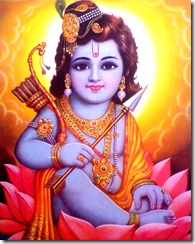
Among all the major religions of the world, Hinduism is especially known for its beautiful artwork. Since there are so many famous demigods and saints, we see that many of them are depicted in beautiful statues and paintings. More importantly, the Supreme Personality of Godhead Himself, Lord Krishna, and His primary expansions are also seen in famous pictures and other works of art. If one visits stores in India, they will see pictures of God everywhere. These depictions of the Lord aren’t based on the imagination of the mind, but rather come from the authorized statements of the Vedas.


The Vedas were originally one doctrine known simply as the Veda. The information contained within was passed down through an oral tradition. As time passed, man’s mental capabilities diminished, therefore requiring a written form of scripture. Lord Krishna, the original personality of Godhead, partially incarnated as a great sage by the name of Vyasadeva, who not only divided the Veda into four separate branches, but also further explained Vedic knowledge in the form of stories. These ancient stories became known as the Puranas. Each Purana is quite lengthy since it chronicles the life and pastimes of the Supreme Lord and His various incarnations. Vyasadeva’s most famous work is the Mahabharata, which is also sometimes referred to as the fifth Veda. Literally meaning “Great India”, the Mahabharata contains the entire history of the world up until around five thousand years ago. Lord Krishna’s pastimes on earth are also detailed in this book, along with His great discourse on religion known as the Bhagavad-gita.


A common trait of the major religions of the world today is that they describe God in an impersonal manner. The Vedas tell us that we are spirit souls at our core, and that our constitutional position is that of servitor to the Supreme Lord Shri Krishna. This material world is a flawed replica of the spiritual world, and thus is not meant to be our permanent home. Due to the pure nature of the soul, most living entities inherently recognize the existence of a God. Since this is the case, most of the major religions of the world acknowledge the existence of a God, but they don’t go into much detail regarding His name, form, or attributes. Religious leaders generally prescribe adherence to a set of rules and regulations. They ask people to be God conscious, to pray, and to act in a righteous manner. Nevertheless, their depiction of God is that of an impersonal spirit.
“And I am the basis of the impersonal Brahman, which is the constitutional position of ultimate happiness, and which is immortal, imperishable and eternal.” (Lord Krishna, Bhagavad-gita, 14.27)
The Vedas definitely do acknowledge an impersonal aspect of God. This feature is known as Brahman, which is also referred to as the Absolute Truth. Brahman is typically defined as the sum and substance of all things material and spiritual in this world. However, Brahman is a limited realization of God. The Vedas tell us that the Supreme Lord can be realized in three distinct features: Brahman, Paramatma, and Bhagavan. A higher realization than Brahman is Paramatma, which is God’s expansion as the Supersoul residing in the heart of every living entity.
“Although the Supersoul appears to be divided, He is never divided. He is situated as one. Although He is the maintainer of every living entity, it is to be understood that He devours and develops all.” (Lord Krishna, Bg. 13.17)


“Fools deride Me when I descend in the human form. They do not know My transcendental nature and My supreme dominion over all that be.” (Lord Krishna, Bg. 9.11)
God has a personal form. We see that many famous conversations and instructions of the Lord are chronicled in the Vedas. These statements typically start with the words “Shri Bhagavan uvacha”, which mean “The Supreme Lord said”. We also see that Krishna uses possessive terminology such as “Mine” and “I am”. For the living entities, this type of thinking is flawed, for God is the actual proprietor of everything. We really have no claim on anything since our most prized possession, our body, must be given up at the time of death. Since God is the source of everything, His use of the words “Mine” and “I am” is completely justified. This terminology also proves without a doubt that God is a distinct person. Sometimes foolish scholars or atheists study the Bhagavad-gita and write commentary on its teachings, and still take Krishna to be an elevated form of Brahman or, even worse, an ordinary human being. Krishna is the ultimate authority on Vedic knowledge, so when He says “I” and “Mine”, He is referring to Himself as God, and not as some impersonal energy.


“The worshipers of the demigods will be promoted to the respective planets of the demigods, but devotees of the Supreme Lord will go back home, back to Godhead.” (Lord Krishna, Bg. 9.25)


Lord Rama specifically appeared on earth to grant protection to these sages. He and His younger brother, Lakshmana, were expert defenders, well versed in military science. On one occasion during Rama’s younger days, a particular demon by the name of Maricha came to harass the venerable Vishvamitra Muni. To his surprise, Maricha found that Vishvamitra was guarded by an exquisitely beautiful and powerful prince. Not knowing that this person was Rama, Maricha proceeded to attack, an act which caused Rama to soundly defeat him in battle. In the above referenced statement, Maricha is describing the features of Lord Rama, as he saw them, to the Rakshasa leader Ravana.
From this description, we see just how beautiful God is. Since Rama is a qualified incarnation, there is no difference between Himself and Krishna. He is God, and His body is completely spiritual and exists eternally. Maricha was very fortunate to see God face to face. He was no ordinary soul, for he surely had performed many pious deeds in his previous lives. In fact, as events would play out, Maricha would be killed by Rama, and would thus have the benefit of seeing and thinking of God at the time of death.
Most of us don’t have the good fortune of seeing God face to face. There is no need to worry, however, as Maricha and other great personalities have described the Lord’s features in great detail for us. Maricha’s statement is by no means the only description of Lord Rama found in the Ramayana. In fact, Lord Krishna’s beauty is described in great detail in the Bhagavata Purana and other famous texts. These descriptions are not only statements of fact, but they serve as a benefit to us. Great devotees have used these descriptions to paint pictures of the Lord and to construct beautiful sculptures of Him.

