


Comment: “I believe serving humanity is the best way to serve God.”
Response: Sometimes those who are unfamiliar with the true meaning of the Vedas, or those don’t believe that God has a name or a personal form, will take to philanthropy and other charitable work as a way of life. Viewed as service to humanity, this kind of welfare work seems appealing on the surface, but the Vedas tell us that the best way to serve all of mankind is to directly serve the Supreme Lord.
“A person engaged only in ministering to the physical welfare of human society cannot factually help anyone. Temporary relief of the external body and the mind is not satisfactory.” (Shrila Prabhupada, Bhagavad-gita, 5.25 Purport)


“Know that which pervades the entire body is indestructible. No one is able to destroy the imperishable soul.” (Lord Krishna, Bg. 2.17)
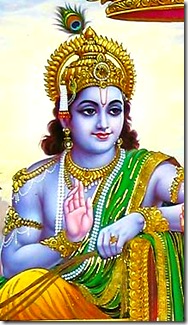

If we study some of the common welfare activities of today, we’ll see that they primarily address the animalistic concerns of the human body. Feeding the hungry and the poor is a very common welfare activity. In America, some people are homeless and in need of a good home-cooked meal. Soup kitchens and food banks do their best to try to make sure that no one in America goes hungry. These are very noble intentions, but what is the result of such activities? If a hungry person is given food, it will certainly give their body pleasure and relief for a brief period of time, but then what? Are all of their problems solved? The animal kingdom actually has no worries for food since God provides everything they need to eat. Human beings are supposed to have a higher level of intelligence, so why would they worry so much about eating?
Another factor to consider is the type of food that is given in charity. The Vedas tell us that every activity done on the material platform, including eating, has karma associated with it. The material platform refers to the material world in which we live. It is classified as material because it has gunas, or qualities, associated with it. Also it is a temporary place full of miseries. The spiritual world is just the opposite since it is composed of God’s superior energy. Spirit is superior to matter because spirit is eternal, whereas matter is not.
“Yet there is another nature, which is eternal and is transcendental to this manifested and unmanifested matter. It is supreme and is never annihilated. When all in this world is annihilated, that part remains as it is.” (Lord Krishna, Bg. 8.20)


Material activities refer to anything that keeps one attached to this temporary material world. At the time of death, our work and our desires are measured, and we are given a new body in the next life. Performing material activity means doing things which cause us to take birth again in the material world. By default, all activity is considered material if it is done to satisfy our senses. Eating is included in this category. Therefore everything we eat has karma associated with it. If we feed the hungry with meat and other animal flesh, there is a negative karma that follows. Meat eating involves unnecessary violence towards animals. This naturally has negative karma associated with it, for one must suffer the consequences of the sin of unnecessary violence. These negative consequences don’t just attach to the killer of the animal, but also to the distributor and the eater of the animal flesh. Thus by feeding the hungry with meat, we are actually doing a disservice to them. Other activities such as opening hospitals, helping the poor with money, and searching for cures to common diseases also fall into the material category since they aim to please the body.
“It seems that all welfare activities are bad? What should we do with our time then? How do we help people?” The Vedas tell us that this human form of life is meant for understanding God. The consciousness at the time of death determines the next type of body for the spirit soul. If one elevates their consciousness to the spiritual platform, they are guaranteed to assume a spiritual body in the next life. Spiritual bodies reside in the spiritual world, i.e. God’s home. Once a spirit goes there, it never returns to the temporary material world.
“That supreme abode is called unmanifested and infallible, and it is the supreme destination. When one goes there, he never comes back. That is My supreme abode.” (Lord Krishna, Bg. 8.21)


“If we engage in religious activity all the time, how will we maintain our lives? Don’t we have to work to maintain our families?” The beauty of devotional service is that it doesn’t require renunciation of activity. Bhakti yoga is very comprehensive and can entail many different processes, but the recommended method for this age is the constant chanting of the maha-mantra, “Hare Krishna Hare Krishna, Krishna Krishna, Hare Hare, Hare Rama Hare Rama, Rama Rama, Hare Hare”. Krishna and Rama are names of God and Hare refers to His energy potency; Radharani, Sita, Lakshmi, etc. Chanting is so nice because anybody can do it, at any time, and at any place. Thus we can continue our occupational duties and still remain fixed on the transcendental platform.


“The rewards of your service to humanity can only be seen in the afterlife, which is something we can’t even be sure of. Ordinary service to humanity, such as charity and feeding the poor, produces immediate results that we can see.” Actually, we don’t have to wait for the afterlife to see the benefits of bhakti yoga. Since God is the creator of everything, He is the source of the humanity that we aim to please. By serving God, we automatically serve all things related to Him. It is similar to how we feed plants. We pour water on the roots of a plant since this means that all the branches and leaves will automatically be fed. To serve the body, we must supply food to the mouth, which transports the food to the stomach. The stomach then evenly distributes nutrients to the rest of the body. Our arms and legs are certainly parts of our body, but we would never think of trying to intake food through these body parts, for they wouldn’t know what to do with the food we were giving them. In a similar manner, the material creation, which includes humanity, the animal kingdom, plants, and aquatics, can only be properly served by bhakti yoga, or devotional service.


Service to God automatically addresses these issues. The Vedas consist not only of religious sentiment, but are themselves a comprehensive intellectual pursuit. Great scholars and academics have studied important Vedic texts for thousands of years. Vedic guidelines recommend that a person get married as soon as there is any inkling for sex life. Instead of the misery that results from free intermingling between men and women, getting married early on in life under religious principles ensures a happy and successful marriage. Householder life is actually referred to as a spiritual institution, the grihastha-ashrama, in the Vedas. The husband and wife are advised to focus their attention on God, and to perform all religious activities together in the hopes of advancing in spiritual life. Married couples are advised to only have sex for procuring children. In this way, we see that following the regulative principles of bhakti yoga can help people avoid the major problems of the day.


“The total material substance, called Brahman, is the source of birth, and it is that Brahman that I impregnate, making possible the births of all living beings, O son of Bharata.” (Lord Krishna, Bg. 14.3)
Paramatma is God’s expansion as the Supersoul residing within the hearts of every living entity. The Supersoul acts as an impartial witness. Since it is a direct representation of God, it is not subject to the bewilderment or illusion caused by material nature. Paramatma is an expansion of God, meaning it has a source which expanded to create it. This source is Bhagavan, or the Supreme Personality of Godhead. Bhagavan is God; the supreme person who has forms, pastimes, and spiritual qualities. The beauty of chanting Hare Krishna is that it directly addresses Bhagavan in a loving way. Impersonalists love to recite om instead of Hare Krishna because they refuse to believe that God has a name or a form. Om is certainly a spiritual vibration, but it also was created by God to be used in Vedic mantras and hymns.
“O son of Kunti [Arjuna], I am the taste of water, the light of the sun and the moon, the syllable om in the Vedic mantras; I am the sound in ether and ability in man.” (Lord Krishna, Bg. 7.8)

