


Download this episode (right click and save)
Passion can be a very tricky thing. It serves as an impetus for work, but at the same time, if it is left uncontrolled, it can lead to our downfall. Therefore, in the Vedic tradition, those who can keep their passions, which are driven by the senses and mind, under control are considered praiseworthy. This especially holds true with passions relating to sex life.
In the modern culture, men and women freely intermingle, thus relationships are formed based off of free will. A boy is attracted to a girl and vice versa, and the two eventually decide to form relationships. The religious institution of marriage is now mostly based on romantic attraction between men and women. The love that results from this attraction can be quite passionate. Since relationships are determined by free will, the art of seduction holds more importance in society. Men who can seduce or attract a lot of women are considered powerful and strong, whereas those who are awkward around beautiful women are considered weak and unintelligent. Many Hollywood films are based around this concept. A young teenager will be deemed a loser or a geek at the start of the movie, and he’ll slowly work his way towards being able to speak to the girl of his dreams and hopefully have a relationship with her.


“Material nature consists of the three modes-goodness, passion and ignorance. When the living entity comes in contact with nature, he becomes conditioned by these modes.” (Lord Krishna, Bhagavad-gita, 14.5)


“I am the strength of the strong, devoid of passion and desire. I am sex life which is not contrary to religious principles, O Lord of the Bharatas [Arjuna].” (Lord Krishna, Bg. 7.11)
The Vedas tell us that sex life can be very dangerous, and thus should be kept in check as much as possible. This doesn’t mean that all sex is bad, but that the act should only be performed when one intends to beget progeny. On a material level, we all accumulate debts at the time of birth, with one of them being to the pitrs, or the forefathers. We would never take birth were it not for sex life, thus we have a responsibility to our forefathers to beget sons as a way of paying them back. Every person is born with different qualities, with some people being more passionate than others. For those in rajo-guna, the mode of passion, gambling and playing sports are allowed. This is because passionate people need an outlet, and competition is one way of acting out one’s passions. The modern day sports athlete is an example of a person in the mode of passion. In previous times, the kshatriya kings were also considered to be in the mode of passion, thus they were allowed to marry more than one woman. Sex desire is very strong in passionate people, so in order to avoid illicit sex, kings were allowed to marry more than one wife provided that they could guarantee the protection and happiness of each and every wife. So when we see today’s athletes engaging in illicit sex life, it is not surprising considering that they are in the mode of passion.


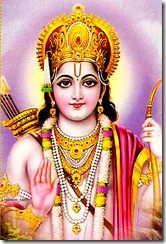
In response, Sita openly declared that she was a devotee of Lord Rama, and that she would never be devoted to anyone else. In addition, she provided details into Rama’s characteristics and personal attributes. In the above referenced statement, we see that Sita is listing Rama’s control over His mind and senses [jitendriyam] as a character trait. This statement is very important, for it serves two purposes. First, it stresses the point that God is the all-powerful and the most renounced. Sex life in the material world is a perverted reflection of the pure form of love that exists in the spiritual world between God and His pleasure potencies, hladini-shakti. By declaring that Rama had His passions under control, Sita also took a direct jab at Ravana and his character.
Rakshasas are demons by nature, meaning they take to adharma, or irreligion, as a way of life. Ravana was very powerful and materially opulent. He had hundreds of beautiful wives. Having multiple wives was surely allowed for a king, but Ravana still engaged in illicit sex. He and his queens were always drunk, eating meat, and enjoying sex life. He was very proud of his playboy lifestyle. Yet we see that Ravana’s passions were anything but under control. Simply upon hearing of Sita’s beauty and bodily features, Ravana was drawn to her. Like a moth to a flame, Ravana sealed his demise by approaching Sita and forcibly kidnapping her. Lord Rama was God Himself in human form, and He would avenge Sita’s kidnapping by marching to Ravana’s city of Lanka and killing him in battle.


Ravana thought of himself as beautiful and famous, but his opulences paled in comparison to Rama’s. Ravana performed austerities that secured him ten heads; something he viewed as a benefit. Sita Devi, the most beautiful woman to have ever graced the earth, didn’t find Ravana attractive at all. Ravana was proud of his beauty, but Sita directly insulted him by extolling the beauty of her husband, Lord Rama. Ravana also thought he was very famous, for he had defeated many great fighters in battle. In fact, God only appeared on earth as Lord Rama at the request of the demigods, who were all afraid of Ravana. Sita, of course, wasn’t impressed by Ravana’s fame. She was married to God, so she knew who was the more famous of the two.


No one was more committed to dharma than Lord Rama. We too should commit ourselves to dharma by controlling our passions and devoting ourselves to God’s service. In this age, the easiest way to honor Sita and Rama is to constantly chant the holy names of God, “Hare Krishna Hare Krishna, Krishna Krishna, Hare Hare, Hare Rama Hare Rama, Rama Rama, Hare Hare”. God is beautiful, praiseworthy, and famous throughout the world, and so are His devotees.