


Download this episode (right click and save)
Comment: “For me Lord Narayana will be always the supreme God. But it is your ignorance that you don’t know anything about Lord Shiva. My Lord Krishna is only the first and the greatest devotee of my Lord Shiva…”
Response: One of the side-effects of offering praise to a particular person or entity is that faithful followers of other great personalities may get offended. This makes sense because people are so strongly attached to their particular object of worship that if they see another entity being praised more, they will feel slighted. Looking to correct the situation and stop the neglect, these devotees may even take to criticism. Amongst followers of the Vedic tradition, one of the more common clashes occurs between devotees of Lord Vishnu [Vaishnavas] and followers of Lord Shiva [Shaivites]. There is actually no need for such conflict since the objects of worship, Lord Vishnu and Lord Shiva, are best of friends and completely respectful of one another. Lord Shiva spends all his time meditating on the lotus feet of Lord Vishnu, and Vishnu harbors eternal affection for Shiva.


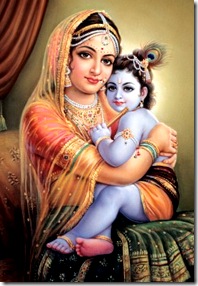

Not every person will initially be attracted to Krishna due to different proclivities towards offering service to the Lord. Therefore, in the Vedic tradition, Lord Vishnu plays as prominent a role in worship as Lord Krishna does. The two forms are essentially interchangeable. When a person refers to Lord Vishnu, they are also referring to Lord Krishna, and vice versa. Lord Krishna and His direct expansions are referred to as vishnu-tattva, and the separated expansions are referred to as jiva-tattva. We living entities are jiva-tattva, so we can never be equal to God.


The first thing we’ll notice is that Lord Vishnu is listed as a demigod in this group. In reality, Vishnu can never be considered a demigod, for as mentioned before, He transcends matter. These three deities are referred to as guna-avataras, or incarnations of the Lord in charge of gunas, or material qualities. Though this form of Lord Vishnu is the avatara in charge of sattva-guna, or the mode of goodness, He is still nevertheless the same Supreme Personality of Godhead. The same can’t be said for Lord Brahma and Lord Shiva. Brahma is in charge of the mode of passion, rajo-guna, and Shiva is in charge of the mode of ignorance, tamo-guna. Material creation is made up of these three modes, with the bodies of the living entities consisting of varying combinations of these three ingredients. For example, the human beings are mostly in the mode of passion, while the demigods are mostly in the mode of goodness. The animal species are mostly in the mode of ignorance. Goodness is knowledge, those activities which are in line with revealed knowledge, or scriptures. Those who act in the mode of goodness thus possess bodies which are in goodness. Passion is any fruitive activity, any work performed which has a result, with the results usually being used for the satisfaction of the gross senses. The mode of ignorance is any activity which lacks both goodness and passion.
One thing that we should note is that even though Lord Brahma is in charge of the mode of passion, it doesn’t mean that he lives in passion. The same holds true for Lord Shiva. Both of them are highly exalted personalities put in charge of the modes of passion and ignorance by Lord Vishnu Himself. One should never make the mistake of thinking that these two great demigods are on the same level as the conditioned living entities.


Is it bad to be a devotee of Lord Shiva? Well, there are generally two kinds of devotees of Lord Shiva, each of which worships a different aspect of Shankara Bhagavan. Since Lord Shiva is in charge of the material mode of ignorance, one of his tasks involves destruction. He is known as the destroyer because he is in charge of destroying the material creation at a specific time. The Vedas tell us that the world we live in constantly goes through cycles of creation, maintenance, and destruction. We are currently in the maintenance phase, but eventually everything will be destroyed. Since Lord Shiva has the ability to destroy the entire creation, he must be very powerful. Since he has great powers, many people take to worshiping him. Lord Shiva, acting as a demigod, has the ability to grant boons to his devotees. He is known by the name of Ashutosha, which means that he is easily pleased. By rule, anyone who worships him properly gets whatever they want, regardless of their motive. Lord Shiva wants to meditate all the time, so he pushes through people’s requests for boons as quickly as possible.

Also due to his father’s curse, Ravana did not have a very good character. He had the form of a demon and also the demeanor of one. Vishrava had another son named Kuvera who was born through a different mother. Kuvera performed great austerities and was rewarded by the demigods with great opulence and strength. Ravana’s mother, being jealous of Kuvera’s position, asked her son to also perform great austerities in hopes of rivaling Kuvera’s strength. Ravana followed suit, and after performing great penances, he was rewarded with tremendous fighting strength by Lord Brahma.

What did Ravana do with his newfound strength? He went on the rampage of course. After routing Kuvera out of his home on the island of Lanka, Ravana went on a world tour, taking on and defeating anyone in battle that was willing to fight him. One day, Ravana made his way to a mountain where Lord Shiva was meditating. Ravana wanted to fight with Shiva, so he tried to agitate the Lord’s meditation by moving the mountain he was on. Shiva of course was way more powerful than Ravana, so he simply brushed the demon aside by shaking the mountain with his toe, crushing Ravana’s fingers in the process. Ravana let out such a terrible scream that Shiva decided to then give him the name “Ravana”, which means one who terrifies others. While his fingers were still being crushed, Ravana offered kind words to mollify Lord Shiva. Eventually Mahadeva relented and removed the pressure. Ravana then became a devotee of Lord Shiva and was rewarded with several boons.
There are many other similar incidents in history of demons taking to worshiping Lord Shiva simply for receiving material benedictions. This type of worship is certainly second class and it brings up several larger issues. Lord Vishnu, or Krishna, is never beholden to devotees in this way. A demon can certainly worship Lord Vishnu, but the Lord is not obliged to answer anyone’s prayers. Many times Lord Vishnu will take away a person’s wealth and possessions in order to help them progress in spiritual life. Lord Shiva and other demigods are duty-bound to bestow gifts on anyone who worships them properly, regardless of the person’s motive.


More than anything else, Lord Shiva is a great devotee of Vishnu. He is often considered the greatest devotee, for he agreed to break his meditation and take charge of material affairs. Not many of us would be willing to do this, but Shiva loves Vishnu so much that he never goes against His orders. Since Lord Shiva is a great devotee, he is certainly worthy of our highest respect and worship. People who worship Lord Shiva, taking him to be a great devotee, are certainly engaged in first class worship. Vaishnavas are especially fond of Lord Shiva since he is a great spiritual master. The Padma Purana states that in this current age, there will be four bona fide Vaishnava sampradayas, or disciplic successions of gurus. Each of these sampradayas has a founder, with Lord Shiva being one of them. Since he is the founder of a Vaishnava line of gurus, certainly Lord Shiva is an object of worship for devotees of Lord Vishnu.


“If we learn how to love Krishna, then it is very easy to immediately and simultaneously love every living being. It is like pouring water on the root of a tree or supplying food to one’s stomach.” (Shrila Prabhupada, The Nectar of Devotion, Preface)


If this is all true, why is there fighting between Vaishnavas and Shaivites? The primary reason is that people have so much love for their particular deity that they get offended when they see others neglecting them. This phenomenon is even seen amongst Vaishnavas. For example, if a person sees that only Lord Krishna and Lord Rama are being worshiped, while Lord Chaitanya isn’t shown as much attention, they will get offended. They will think that such worshipers are offending Lord Chaitanya, who is also an incarnation of Krishna, by not giving Him attention. So in one sense, these kinds of complaints actually show great love and devotion from the part of the worshipers. But as mentioned before, all vishnu-tattva forms are essentially the same and Lord Krishna is the fountainhead of all exalted personalities, so there is no reason for people to feel offended if their particular deity is neglected.


The lesson here is that we should never disrespect Mahadeva, for he is very dear to Lord Krishna. This fact alone is enough to make Mahadeva an object of worship. We certainly can’t imitate Lord Shiva’s extraordinary activities, but we can follow his teachings and show him respect. Lord Shiva spends all his time meditating on the lotus feet of the Lord, so we can do no wrong by following in his footsteps. By praising Krishna and concentrating our minds on His lotus feet, the whole world becomes satisfied.