


Question: “Those who really love God, they should not be egoists since their whole personality is enveloped by the Lord’s as they surrender to the Lord. Could you please tell me the difference between ego and self-respect?”
Answer: According to Vedic information, the difference between the spiritual world and the material world is that the spiritual world is free of gunas. Gunas are material qualities, also known as modes. These gunas take shape through the gross material elements of earth, water, fire, air, and ether, along with the three subtle elements of mind, intelligence, and false ego. We see here that the term “ego” has a prefix: false. When one reassumes their original spiritual position, the influence of their material qualities [gunas] is removed. While this mitigation occurs upon returning to the spiritual world, one can also become free of the effects of material nature while remaining in their present body. This state of bliss is achieved when one develops full Krishna consciousness, a state of mind where all thoughts are directed at God. When one achieves this consciousness, the “false” part of the ego is removed and true self-respect is acquired.
Why does the living entity assume a false ego? Our constitutional position is that of a spirit soul, part and parcel of the Supreme Personality of Godhead, Krishna. Lord Krishna is the same God that everyone worships, irrespective of faith or lack thereof. Even if one doesn’t believe in God, it doesn’t mean that the Lord doesn’t exist. While learned scholars, transcendentalists, philosophers, and mathematicians can ponder the various truths of life, there is one truth that is superior to all others. Since this truth explains every other truth, it is referred to as Absolute. The Vedas, the oldest scriptures in existence, tell us that the Supreme Absolute Truth is God, and that He has an ever-blissful form, full of sweetness. This original form of God has a name: Krishna. The living entities, the individual spirit souls, are part of Krishna, so they are the same in quality as God. Yet at the same time, their quantitative powers are far inferior; hence they have no business pretending to act like God.


So where does the material world fit into all of this? Why are we living apart from Krishna right now? The living entities, at some point in time unknown to them, decided to separate from God. This reemphasizes the inconceivable aspect of the ultimate conclusion. Why would the living entities want to separate from the Lord? To imitate Him of course. That imitation is a sort of affront to the Lord’s authority, a challenge. Since God is always God, no one can imitate Him in the spiritual world. In order for there to be competing “gods”, a world separate from the Supreme Lord is required. Ironically enough, Krishna is so kind that He Himself created a flawed replica of the spiritual world to serve this veyr purpose. This place, known as the material world, is where we currently reside. Here we are forced to go through the cycle of birth and death, reincarnation, for as long as our desire to imitate God continues.
Upon reaching the material world, aside from assuming a body composed of material elements, the soul assumes a subtle body composed of mind, intelligence, and false ego. At this point, the false ego should be quite easy to understand. This ego is deemed false because it is not real; there is no justification for it. Ego refers to supremacy, pride, or the notion of “I am God.” At the time of birth the mind is not consciously aware of this desire to be the God of mankind, but little by little we work our way towards that end. For example, the living entity is the master of the body, or at least we think. Since we decide when to wake up, sleep, eat, talk, move around, etc., we feel like we have control over our body and all its parts. In this respect, we can be deemed as the supreme controllers of the body, ishvara.
“The Supreme Lord is situated in everyone’s heart, O Arjuna, and is directing the wanderings of all living entities, who are seated as on a machine, made of the material energy.” (Lord Krishna, Bhagavad-gita, 18.61)


“The bewildered spirit soul, under the influence of the three modes of material nature, thinks himself to be the doer of activities, which are in actuality carried out by nature.” (Lord Krishna, Bg. 3.27)
Why do these differences exist? As great and powerful as we may take ourselves to be, we are not responsible for the results of our actions. The results are doled out by the Supersoul, who is the master of the administrators of the material world, the demigods. Karma, or fruitive activity, is completely fair. We may take a certain action and hope for a desired result, but others also take to fruitive activity. Once all these actions and reactions collide, the results vary. Karma is completely fair, so whatever results we have coming to us eventually will be realized. They may not come to us in this lifetime, but they certainly will manifest in a future one.
These facts alone are enough to shed us of the false ego. We may be the controller of our own body, but the Supersoul resides inside of everyone. In this way, God is much more powerful than we are. The point of human life is to recognize God’s supremacy and think of Him at all times. Those who think of Him all the way up until the time of death get to return to the spiritual world, never having to assume a material body again. The false ego gets removed, and the real ego takes over.


So what role does self-respect play in all of this? If we become humble devotees, does that mean we just sit around and avoid criticizing others, taking ourselves to be lesser individuals? The key component of self-respect is the “self”. When enveloped by the false ego, this “self” is taken to be the individual soul. But based on the philosophy of Lord Chaitanya, this self has a source, a supreme master. Lord Krishna, or God, is really the Superself, the basis of our identity. If we base our self-respect off of Krishna, then there is no reason to avoid self-confidence. Devotees of Krishna are extremely confident in the instructions of the Lord and His bona fide representative, the spiritual master. While the goal of human life is to achieve Krishna consciousness at the time of death, this mindset cannot be adopted without the help of a spiritual master.
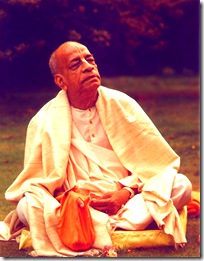

Since God is non-different from the living entities, He is able to expand Himself into other forms which are similar in quality to His original form. Lord Krishna’s names are also expansions of the Lord, except that they are equally as powerful as the Lord Himself. Therefore the Vaishnava gurus advise everyone to chant, “Hare Krishna Hare Krishna, Krishna Krishna, Hare Hare, Hare Rama Hare Rama, Rama Rama, Hare Hare”, as often as possible. For those who are serious about making progress in spiritual life, it is advised that they perform at least sixteen rounds of chanting this mantra daily on a set of japa beads, along with abstaining from meat eating, gambling, illicit sex, and intoxication.


The Vaishnava saints are actually the most humble individuals. When they take others to task for their way of life, there is an underlying purpose. The guru’s mindset is essentially this: “Oh such and such person: you are very intelligent in material subjects. You are so dedicated to maya, the illusory energy of Krishna which has fooled you into adopting a false ego. If you simply shifted your efforts towards Krishna’s service, you would be much happier. Not only would you be happier, but you could end up being a much greater devotee than me. I am a humble person simply doing my small part by trying to faithfully follow the teachings of my guru. If you were to follow these same teachings, you could become a much better devotee and thereby make Krishna very happy.”
The Vaishnava saints have a very kind attitude, even if it manifests through words that may offend others from time to time. Their intention is certainly not to anger others. Anyone who has studied the great Vedic texts like the Ramayana and Shrimad Bhagavatam knows that Vedic philosophy, because it emanates from Krishna, is the sum and substance of all philosophy. It is such a comprehensive spiritual discipline that one who understands it properly will actually understand every other philosophy that has ever existed, currently exists, or will ever exist in the future.


