


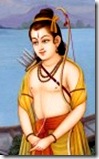

This one statement by Lakshmana, the younger brother of Lord Rama, is so profound that there is no limit to the number of lessons one can derive or explanations one can give. This is the benefit of taking instruction from the highest authority, a pure devotee of God. In the Vedic tradition, Lord Rama is considered an incarnation of Godhead who appeared on earth many thousands of years ago. His three brothers are also considered partial incarnations, thus Lakshmana is not only a devotee, but one who possesses divine qualities as well. One concept that this verse explains is that of cause and effect. There is a root cause for every event or result that we see. Though this may be hard to understand at first, a quick study of our own lives can help us better grasp the concept.


The downside of owning your own home is that you are now responsible for all the maintenance. Ask anyone who owns a home and they will tell you that managing it is a full-time affair. Problems with plumbing, roofing, water leaks, landscaping, etc. creep up all the time. There is no building manager you can call to help you out, for you are now responsible for everything. Just by examining the ins and outs of a house, we can learn so much. Though we work hard at our jobs to earn enough money to pay the rent or mortgage, the house actually doesn’t get built with money alone. Houses don’t just appear out of nowhere. It takes great work and detailed planning to get all the intricacies of the structure in place. The lawn in the front yard is the result of a person planting seeds and managing the growth of the grass. The pavement in the driveway is the result of someone putting down gravel and cement and making sure it was laid out smoothly. The bathrooms and kitchen result from laying down tile and making sure that pipes get put into the right places. The heating and cooling systems require intricate knowledge of the vents and ducts, etc.


Why is karma important to understand? Because not only does karma explain how physical objects around us are built, but it also points to how our current body was acquired. The Vedas tell us that our current life is certainly not the only one we’ve had. “You only live once” is a common saying, but it is not completely accurate. If we identify strictly with our current body, then it is indeed true that we only live once. Once death comes our bodies start to rot and decay. A corpse can never be revived or brought back to life due to the fact that the soul has exited the body.
Though the body is ultimately destroyed, the soul, which represents our true identity, never does. It immediately accepts a new body after death, signaling a new life or rebirth. So what determines where the soul will end up next? The answer is karma. Just as we currently make so many preparations for the future – such as where to go on vacation, what to eat for dinner, or where to attend college – in a similar manner, the sum total of all our activities performed over the course of our lifetime determines where the soul will end up after death.
“Whatever state of being one remembers when he quits his body, that state he will attain without fail.” (Lord Krishna, Bhagavad-gita, 8.6)


Just because the results of action aren’t immediately visible, it doesn’t mean that there aren’t root causes to the effects that currently are visible. This concept helps us understand the the circumstances of our birth, which were determined by activities taken in previous lives. This is not a myth or a belief, but a scientific fact. In a similar manner, if we expand this thinking even further, we can see that everything in this world has a root cause. This is a belief shared by everyone, even the scientific community. Scientists have for centuries tried to study the history of the universe and how it came into being. Today, there is purportedly a consensus of scientists who believe that mankind has an effect over the climate of the earth. The belief is that through the activities performed by man, the ecology of the earth is altered, and thus the climate as a whole changes.


The Vedas refer to a person as purusha, which means a controller, enjoyer, or spirit. Purusha is what forms the basis of our identity, for the gross body is prakriti, or matter. Prakriti is incapable of doing anything on its own; it is dull matter. For any activity to take place there must be purusha. Spirit always dominates matter. Thus the Big Bang Theory falls flat simply because matter itself has no energy or intelligence. Matter is incapable of performing work, so it cannot be the root cause of anything.


“God” is a generic term which doesn’t really speak much to the Supreme’s features, attributes, and appearance. Therefore the Vedas give us thousands of names for God, each describing His limitless attributes and potencies. In His original form, however, God is known as Krishna, meaning one who is all-attractive. Lord Krishna is also described as sarva-karana-karanam, the cause of all causes. As the greatest person, He is the original cause of everything. It is He who enters into the grand spiritual whole and causes life to be generated.
“It should be understood that all species of life, O son of Kunti, are made possible by birth in this material nature, and that I am the seed-giving father.” (Lord Krishna, Bg. 14.4)


The real benefit of understanding that Krishna is the cause of all causes is that we will realize that our life is meant for serving Him. Currently we believe that we are the doers; we are the cause of all the good and bad things that come to us. This is true in some respects, but at the same time, we see that other living entities play a role as well. They too are performing activities and serving as the cause of various results. When these activities collide, what results is a jumbled mess of outcomes which are hard to predict and control. Therefore the wise take to devotional service, or bhakti-yoga.


“That abode of Mine is not illumined by the sun or moon, nor by electricity. One who reaches it never returns to this material world.” (Lord Krishna, Bg. 15.6)
Though the rewards of fruitive activity are unseen and short-lived, they nevertheless require some work to be performed. Fruits don’t grow on their own; they require the actions of planting, watering, and maintaining. In a similar manner, we can’t achieve the ultimate reward of spiritual salvation without performing spiritual work. If we work hard in devotional service, the results will surely come.