


There is little doubt that we live in an insurance conscious society today. While the Vedas declare that thinking of God is the ultimate aim of life, due to innate fears of separation from our friends, family, and possessions, our consciousness gets shifted towards security and protection. With the advent of insurance, one would think that mankind would be more at ease and peaceful as a result of knowing that their possessions are secured and that their family members are taken care of should an emergency situation arise. Yet we see that just the opposite occurs; the anxieties and fears only increase with the more insurance we acquire. The reason for this is that only Krishna, or God, can supply peace of mind and an ease to our fears of losing our possessions. No material arrangement can do so.

The example of the house isn’t the only type of material arrangement aimed at providing protection. The entire insurance industry is built around the concept of safeguarding against calamity. Since we live in a economically advanced time, people have the disposable income to spend on protecting their possessions. Aside from homeowners insurance, there are insurance policies for health, automobiles, jewelry, and life. The term “life insurance” is a little deceiving, for it doesn’t protect a person from dying. As most sober people eventually realize, everyone dies at some point. Death and taxes are the two things guaranteed in life. Life insurance pays out large sums of money to the family members of the departed. In this way, if the breadwinner of the family should pass on, the dependents aren’t left to fend for themselves; they are ostensibly given insurance against financial hardship.


Insurance is considered a material adjustment. At its foundation, it is simply a business run by those who are interested in turning a profit. The ultimate objective for an insurance company is to take in as much money in premiums as possible and to pay out as little as possible in the form of insurance claims. Therefore if a calamity should occur, the insurance company does not readily step up to pay the bill. They will carefully assess the situation to see if the policy holder is eligible for a payout. For homeowners insurance, there are often exceptions in the policies relating to damage caused by natural disasters. A natural disaster is considered an act of God, so it is something that many insurance companies don’t want to indemnify. According to the Vedic definition, a natural disaster belongs to the category of adhidaivika miseries, meaning those which are caused by the divine intervention of the demigods, God’s chief deputies in charge of the material creation. In this way, we see that the material adjustment of insurance falls short of providing protection from one of the primary sources of misery in life.


Aside from the inherent flaws relating to insurance payouts, there is a larger issue to contend with: paying for the premiums. Let’s think of it this way: We start with the fear of losing our home, car, or source of family income. This fear leads us to purchasing insurance policies. But then we have to pay the premiums on these policies. Hence a new burden is introduced, a new cause for anxiety. Aside from having to pay for the mortgage, groceries, and utilities each month, a person has a new obligation introduced in the form of an insurance premium. This means that the same person has a new fear to deal with, and has to take new actions to alleviate that fear. A higher paying job is now required, which again brings on a new set of worries. “What if I lose my job, or what if my salary gets cut? How will I afford my insurance policies? What if I lose my employer provided health insurance? How will I go to the doctor?”
If we did a quick compare and contrast of the same person’s outlook when they didn’t have any insurance versus when they had all the insurance they thought they needed, we’d see that the person was likely much better off in the beginning stages when they had no insurance. In fact, this is how society functioned for thousands of years. Even as recently as one hundred years ago, there was no such thing as car insurance or health insurance. If a person got sick, they called the doctor, and after treatment was provided, they would pay him. The issue of indemnification was handled by the common sense technique of saving money.


“As a ripe fruit has no other fear than to fall, so a man who is born has no other fear than death.” (Lord Rama, Valmiki Ramayana, Ayodhya Kand, 105.17)
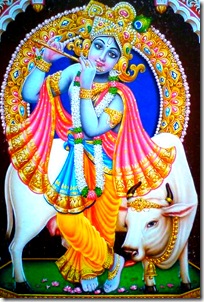
So it seems that we are in a pickle. We can’t really live without insurance nowadays due to lawsuits and the excessive costs of service, but we see that buying more insurance doesn’t get rid of our anxieties in any way. Though material arrangements can’t protect us from calamity or death, Lord Krishna, or God, certainly can. Since He is completely spiritual, only arrangements made through Him or one of His direct representatives can deliver peace of mind. An example of this was seen with the cowherd boys of Vrindavana. Lord Krishna kindly appeared on earth around five thousand years ago. Of all His activities, those performed during His youth in the town of Vrindavana are the most celebrated. Vrindavana means a forest where the presence of Vrinda Devi, the maidservant of Krishna, is prominent. During Krishna’s time, the cowherd population had taken refuge in Vrindavana to escape the attacks of the King of Mathura, Kamsa.


The cowherd boys felt safe with Krishna many thousands of years ago, but how does this information help us today? How can Krishna save us from death and other calamities? The secret is to adopt the same mindset as the cowherd boys of Vrindavana. Krishna’s presence isn’t only felt when the Lord is standing next to us in His personal form. One simply has to always think of Him, being confident of His unflinching protection. This will allow a person to always have peace of mind and transcend the fears of loss and death.


So were the cowherd boys of Vrindavana fearless around Krishna because they knew He would stop reincarnation for them? For such exalted devotees, there was no fear of birth, death, or anything else. They were simply happy in Krishna’s association. This is the result of surrender. Surrender means giving up one’s fight to be happy in any way devoid of Krishna’s association. If one only looks for happiness through Krishna’s association, then there is no fear of anything. The Lord takes charge of those who surrender unto Him, alleviating all their fears and worries.

