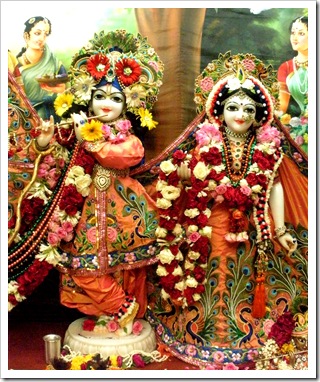
The common misconception posited by neophyte transcendentalists and enemies of the Supreme Lord is that Krishna and His various expansions appear on earth in material bodies. Material refers to matter, and body refers to the outer covering of the soul. For the individual conditioned living entity, there is a difference between matter and spirit, body and soul. For the Supreme Absolute Truth, there is no such difference. While our bodies constantly change, with the soul repeatedly appearing and disappearing through the processes of birth and death, such changes do not take place for the Supreme Lord. Everything attached to the Lord is always transcendental, so if we are to give any attention to vanity and outward appearance, it should be directed towards Him.

While beautification is also important in other aspects of life, if we were to study every area where vanity plays a role, we’d see that the ultimate objective usually relates to sex life. The woman wants to attract the attention of the man, so she makes sure to wear nice clothing, makeup, and jewelry. Similarly, the man wants to attract the woman, so he pays special attention to his hair, shirt, and cologne. The objective is to connect with an attractive partner and enjoy the resulting relationship.


Krishna’s teachings, which are based on the Vedas, the ancient scriptures of India emanating from Krishna Himself, touch on a wide range of topics, but the first instruction imparted to the new student, an opening salvo if you will, is the difference between the body and the soul. Individuality comes from the spiritual spark residing within the body. The soul can be thought of as the owner, the chief resident of the material dress. The body can be thought of as the house. This house is composed of material elements, so it cannot be taken as superior. We may reside in a giant high-rise building, but we could never say that the building is superior to the human beings who constructed it or those who reside within it. If not for their tireless efforts and expert planning, the building would have remained in the form of scrap metal and raw materials. The living entity, whose actions are driven by the internal spirit soul, is the master of matter.


Even if one is unaware of the difference between the material and spiritual worlds, the changing of the bodies should still be evident to them. We see that famous movie and television stars of the past look completely different when we see them in newer movies and shows. Since the activities of their youth were recorded on tape and DVD, it becomes easier to see the difference in the appearances of their bodies. The aging process takes hold and it causes the facial features to lose their beauty. This is only natural since everyone is working their way towards death, a time when the body is completely discarded.


“Unintelligent men, who know Me not, think that I have assumed this form and personality. Due to their small knowledge, they do not know My higher nature, which is changeless and supreme.” (Lord Krishna, Bhagavad-gita, 7.24)
How can Krishna’s body be unchanging? While the rules of material nature affect all living entities equally, they don’t apply to God. When Krishna was on the battlefield of Kurukshetra and delivering His spiritual discourse to Arjuna, He was over one hundred years of age. In reality, Krishna doesn’t have an age, but in terms of the amount of time that had elapsed since His appearance in the womb of Mother Devaki, Krishna was over one hundred years old. Though He was old enough to have great-grandchildren, He didn’t look aged at all. You will never see any paintings or pictures of Krishna depicted as an old man. Though He is the oldest person, adyam-purusham, He is always youthful and blissful. The non-devotees have a hard time understanding this fact. They take the laws of nature to be absolute, so even if they think of Krishna as a manifestation of the Supreme Truth, they take His body to be material.
“Although I am unborn and My transcendental body never deteriorates, and although I am the Lord of all sentient beings, I still appear in every millennium in My original transcendental form.” (Lord Krishna, Bg. 4.6)


The name is the best way to connect with God, especially for the people of this age. But again, we have material elements all around us, so it would be nice to find a way to use them to serve the Lord’s transcendental body. This is where the archa-vigraha, or deity, comes in. Though the earthly elements such as wood, stone, and resin are considered dull matter, when used in the construction of a deity, they become spiritualized. This is a little difficult to understand at first, since we are basically introducing an exception to the rules of nature. We can think of it this way: matter is inferior and the cause of bondage only as long as it is not used for Krishna’s service. When matter is used for our own beautification or for purposes of sense gratification, it has no relation to Krishna. In one sense, matter can never be separated from Krishna since it is something that He created, but when we say that it has no relation to God, this is according to the vision of the living entity. After all, Krishna is not looking for salvation or release from the cycle of birth and death. Separation and association are important concepts only for the conditioned living entities.