


Shri Lakshmana, the younger brother of Lord Rama, is the emblem of loyalty. We can dig deep through the pages of written history and scour the earth, but we will never find a more loyal and praiseworthy figure than the beloved younger brother of the Supreme Personality of Godhead. His loyalty and dedication to Rama shows us not only how to behave towards our own loved ones, but also how we are to attain the ultimate objective in life. Through unflinching loyalty to the Supreme Divine Entity, we can acquire all praiseworthy characteristics, while simultaneously advancing to the topmost platform of spiritual understanding.


For these reasons, true loyalty is seldom displayed. In the world of sports, it is rare nowadays to see players play for the same team throughout their careers. In days past, free agency was limited, so a player didn’t have much of a choice as to which team he could play for. Whichever team drafted him in the beginning of his career was the team he would likely play for throughout. Teams could always trade a player to another team, but the player had no say in this, so there was no dent made in their perceived loyalty.


In recent history, no one was more maligned for his free agency transition than the baseball player Alex Rodriguez. A star shortstop for the Seattle Mariners franchise, Rodriguez signed a deal with the Texas Rangers franchise which was, at the time, the most lucrative contract ever offered. Obviously the driving force behind the decision to switch teams was money, so many in the sports media took to criticizing him for his lack of loyalty. The Mariners couldn’t come close to offering the same salary as the Rangers, so there was really no choice for Rodriguez, who was simply acting in his self-interest.


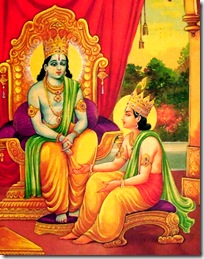
Lakshmana’s loyalty was put to the test on many occasions, all of which were opportunities the great warrior prince looked forward to. Rama and Lakshmana roamed the earth many thousands of years ago during the Treta Yuga. During that time period, royal orders took charge of the governments, and one of the most famous royal dynasties was the Ikshvaku. According to Vedic information, the original system of knowledge for the world, Maharaja Ikshvaku was one of the first kings on earth, so he was the emblem of chivalry, honor, and good governance. Those following in his line took it upon themselves to live up to his standard. Rama and Lakshmana appeared in this dynasty as sons of Maharaja Dasharatha. Rama was the eldest son, and He had three younger brothers: Bharata, Lakshmana, and Shatrughna. As is natural in many families, the siblings sort of grouped together at a young age. Bharata and Shatrughna took a liking to each other, while Rama and Lakshmana were inseparable. All three younger brothers were equally as pious and dedicated to Rama, but Lakshmana couldn’t live without Him. He refused to eat or sleep unless Rama had done so first.
“O Lakshmana, do you rule this earth with Me. You are like My second self, so this glorious opportunity has been presented to you as well. O Saumitra, do you enjoy all the pleasures you desire and the fruits of the regal life. My life and this kingdom I covet for your sake alone.” (Lord Rama speaking to Lakshmana, Valmiki Ramayana, Ayodhya Kanda, 4.43-44)

While in the forest, Sita would one day be kidnapped by a Rakshasa demon named Ravana. The Rakshasa devised a plan which temporarily lured Rama and Lakshmana away from Sita. Making the most of this short time period, the demon swooped in and took Sita back to his island kingdom of Lanka. Upon returning to their cottage, Rama realized that Sita was missing. Giving way to lamentation and grief, Rama lost His senses for a moment. Luckily for Him, His younger brother, the emblem of loyalty, the fearless fighter and defender of the innocent, Shri Lakshmana, was with Him.

Dharma is a Vedic term that is often translated as religiosity, duty, piety, or plain religion. The idea behind dharma is that of an essential characteristic. This definition is more appropriate because whatever a person deems as their essential characteristic is what they will adopt as their way of life, or occupational duty. Thus the characteristic, or dharma, leads to the perceived prescribed duty. One’s primary occupational duty can manifest through religion, piety, or religiosity; hence dharma is often equated to these terms. Vedic information states that every person assumes a different nature based on their karma, or the work they performed previously. Based on this nature, which unfolds in the form of consciousness, each person takes their essential characteristic to be something different. For instance, one person may deem themselves to be very scholarly. They feel that their essential characteristic is that of intelligence, so they take the acquisition of knowledge to be their dharma. Another person feels that their essential characteristic is one of a shrewd businessman whose aim it is to procure and enjoy as much wealth as possible. Thus they take to business as their occupational duty.
“Abandon all varieties of religion and just surrender unto Me. I shall deliver you from all sinful reaction. Do not fear.” (Lord Krishna, Bhagavad-gita, 18.66)


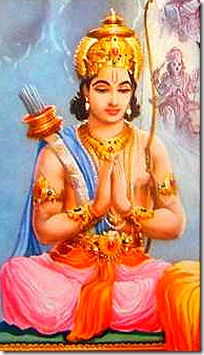
Lakshmana was a great warrior who was equally as powerful in battle as Rama. Lord Rama had previously killed 14,000 attacking Rakshasa demons in one sitting so to speak. In this way, He proved to be more than an ordinary man. Others might be tempted to challenge the notion that Rama is God, but simply based off His activities we can understand His divine nature. This doesn’t even touch on the fact that the Vedas mention in many different places, in many different books, that Shri Rama is the same original Divine Being who happens to appear on earth in the guise of a human being. Moreover, Rama was of the topmost character, someone who never openly claimed to be God. We know He is the Supreme Lord based off His activities, and also based on the loyalty shown to Him by Lakshmana. While others may take shelter of their own concocted dharmas, which result in the deification of various fallible entities and objects, the bhaktas, or devotees, are more than happy “taking their chances” worshiping Rama. Simply put, if someone as loyal, noble, and wonderful as Shri Lakshmana tells us that Rama is God, we will believe him. The gods created by the sense demands are always letting us down, but Shri Lakshmana never does. We will gladly follow him to heaven or hell, for simply hearing of his love and devotion to Rama is enough to keep us satisfied in any and all situations.


Lakshmana is the embodiment of the spiritual master, or guru. In order to succeed in reconnecting our spirit with the Supreme Spirit, we need someone to instruct us and show us the way in life. This shouldn’t be a foreign concept to anyone. In order to learn how to read, write, and do arithmetic, we need a good teacher. To regain our essential characteristic of loving servant of the Supreme, we need the greatest teacher, one who himself is already attached at the hip to the Supreme Lord. No one is more attached than Lakshmana, so his example is the one to follow. The bona fide spiritual master is one who is as loyal towards the Supreme Lord as Lakshmana. In this way, when looking for a guru, it is quite easy to tell the pretenders from the contenders. If a spiritual master is not loyal to the Supreme Personality of Godhead, and instead takes himself to be God or their own interests to be supreme, they will never successfully rescue anyone from the perpetual cycle of birth and death brought on by karma. On the other hand, one who is loyal to the Supreme Lord – one who believes in His ever-existing, transcendental form – will save anyone they teach, even if their teachings aren’t presented in an erudite manner.

