


The wise never act on whims. Rather, they carefully study the results of potential actions and then decide whether the reward is worth the effort and the risk associated with the undertaking. Every action carries some risk to it, even something as simple as standing up. This is because every action performed on the material platform has a commensurate reaction. The fruits of action, karma-phalam, sometimes manifest immediately, while at other times they come to us in a future life. There is risk in every action because the results of our karma are unknown to us, and sometimes the results don’t last very long. Thus we never know exactly what might happen when we take on a certain task. To decide what should be done and what shouldn’t, we must carefully study the desired result and then also evaluate whether the resulting fruit is worth having.


In the paradigm of warfare, the people perpetrating the violence are hoping to achieve the end-goal of victory. Victory signals the defeat of the enemy, with their will to fight being removed. Surrender from the other side then hopefully leads to a peaceful condition for the victors, an end to hostilities. On the flip side, there are those who are in favor of nonviolence. The result of nonviolence is the absence of warfare. When there isn’t war, there will be peace. At the same time, however, aggressors will be let off the hook for any nefarious activity. For example, if one side wants to wage war in order to gain control over a certain tract of land, if the other side chooses nonviolence, naturally the aggressive side will claim victory and take the land for themselves. In this scenario, nonviolence, though saving lives, results in surrender, with the enemy taking over land that might not rightfully belong to them.


So how do we rate results? This material world is full of dualities. One person may enjoy spicy food, while another person may abhor it. One person may prefer the winter months due to the cold weather, while another person may enjoy the summer months for the bright sunshine and warm temperatures. How do we decide which viewpoint is correct? Is this even possible? It seems like everyone has different desires, and thus we see so many different kinds of work performed. Is there really a way to judge which action is virtuous and which isn’t?
“Those situated in the mode of goodness gradually go upward to the higher planets; those in the mode of passion live on the earthly planets; and those in the mode of ignorance go down to the hellish worlds.” (Lord Krishna, Bhagavad-gita, 14.18)


The mode of passion brings about neutral results. For example, working hard simply for the acquisition of money and wealth can be thought of as an act of neutrality. Money is certainly required to maintain our lifestyle, but it quickly runs out, thus forcing us to repeat the cycle of work again. The mode of passion eventually leads to a neutral state in the afterlife. If a living entity is currently in a human body, through action in the mode of passion, they remain in an earthly body in the next life.
The mode of ignorance can be equated with “bad” karma. What we would characterize as “stupid” behavior is what the mode of ignorance consists of. Unnecessarily killing others, stealing, sleeping too much, constant intoxication, etc., all lead to demotion to a lower species in the next life. Thus one should avoid the mode of ignorance at all costs.
“When they have thus enjoyed heavenly sense pleasure, they return to this mortal planet again. Thus, through the Vedic principles, they achieve only flickering happiness.” (Lord Krishna, Bg. 9.21)


“The branches of this tree extend downward and upward, nourished by the three modes of material nature. The twigs are the objects of the senses. This tree also has roots going down, and these are bound to the fruitive actions of human society.” (Lord Krishna, Bg. 15.2)
So does this mean that we all should do whatever we want because it doesn’t matter in the end? Beyond the material nature is a spiritual nature. Though the spiritual nature is free of gunas, or material qualities, there are still activities performed within it. Spirituality is full of variegatedness. The material world is simply a perverted reflection of the purified realm. The various actions and reactions of material life can be thought of as emanating from a tree which has its roots upwards. This inverted situation is the result of the perverted reflection. The spiritual world contains the actual tree, the purified version of activity and enjoyment. This means that our real business is to take up spiritual activities, those actions which transcend the modes of material nature. Why is it important to rise above the three modes of material nature? As mentioned before, when deciding on whether a particular action should be taken, we need to study both the desired result and its importance. So what are the results of taking to spiritual activity? Lord Krishna, the Supreme Personality of Godhead, states that anyone who acts towards pleasing Him, i.e. doing those things which will make God happy, will never have to take birth again. Such devotees will ascend immediately to Krishna’s spiritual realm after death. In this way, spiritual activity brings about the highest gain.


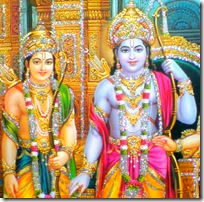
A person who is in the renounced order of life will naturally look at material activity as being second class. They will see people engaging in activities like drinking, gambling, and eating meat and think that such people are simply wasting their time. A bona fide sannyasi is a pure devotee of Krishna, so they don’t simply criticize people for engaging in mundane activity; they view everything with respect to Krishna. A pure devotee puts forth suggestions on what should be done to correct improper behavior. An example of this benevolence was seen with Lakshmana, the younger brother of Lord Rama.


Nevertheless, God is the ultimate renunciate, so He had no problem roaming around like a hermit for fourteen years. Unfortunately, during the exile period, Sita would be kidnapped by the Rakshasa demon Ravana while Rama and Lakshmana were not by her side. Returning to their cottage, Rama saw that Sita was missing and gave way to lamentation. It is the duty of every husband to protect their wife under any and all circumstances. There is a great responsibility that comes with marriage; it is not simply a license to have sex. In the Vedic tradition, every institution and regulation is intended to provide spiritual wisdom and act as a gradual progression towards the end-goal of Krishna consciousness. Though Rama was God, He was playing the part of a human being, so He abided by all the Vedic samskaras, or reformatory processes.


Rama was also disappointed because He had failed to protect His wife. God can never fail in providing protection, but Rama was playing the part of a human being and thus acting like someone who commits mistakes from time to time. What did Rama do next? First, He started wandering through the neighboring woods, asking all the trees and flowers if they had seen Sita. His sadness then quickly turned to anger. The sweet and gentle Lord decided He would destroy the whole world as revenge for its allowing Sita to be kidnapped. At this moment, Lakshmana stepped in to offer some sound words of advice.
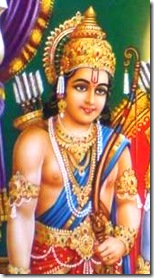

In the above referenced quote, Lakshmana is asking what would be gained by destroying the world. Killing every living entity certainly wouldn’t bring Sita back, so the intended result itself was flawed. Lakshmana advised Rama to find out who took Sita and to then destroy them. The results of such activity would be the deserved punishment of the enemy and the hopeful rescue of Sita. Thus the intended results were in accordance with what Rama wanted. Moreover, by rescuing Sita, Rama would be performing His prescribed duties as a husband and prince. The Lord very much appreciated Lakshmana’s counsel, and in the end, He would do exactly what Lakshmana advised. Ravana would be found and defeated in battle, and Sita would be rescued.
We should apply the same criteria prior to taking up any activity. We should ask ourselves a series of questions. “What will the result of this action be? Is the result even something that I want? Can I choose a different course of action and achieve a more beneficial result?“ Luckily for us, we know that our ultimate objective is reconnecting with God, thus we can juxtapose the results of all activities with the ultimate result of returning back home, back to Godhead. For instance, if we apply this criterion towards the violence issue, we’d see that meat eating is completely unnecessary. Simply to satisfy the taste buds, we are sending innocent cows by the millions to the slaughterhouses each year. The positive result of satisfaction to our taste buds is short-lasting and also cancelled out by the negative reactions to our violence. In addition, meat eating does nothing to bring us closer to God.

