


Question: “Though Lord Chaitanya is often considered the most merciful incarnation of Godhead, I cannot find references in the scriptures to His inclusion of women. How did Lord Chaitanya’s mercy extend to women? ”
Answer: Lord Chaitanya Mahaprabhu is considered the most merciful incarnation of Godhead by those who have associated with Him in one form or another. This opinion is reinforced by the fact that His divinity is only hinted at in a few scriptures, thus keeping His fame and glory limited. This was the wish of Lord Chaitanya, for He wanted to give glory and importance to Lord Shri Krishna, the Supreme Personality of Godhead. Lord Chaitanya is the only reputed incarnation of Godhead in recent times who openly told others not to worship Him and to instead worship Krishna, Rama, or any other non-different form of Lord Vishnu. Due to His extreme kindness, generosity, and tireless efforts to spread the holy names of the Lord around India, He was recognized for who He was: Krishna Himself. His mercy extended to everyone in the world, including countless generations who never met Him or were never alive during His time. This mercy most certainly extended to women as well.


According to Vedic information, the original name and form for God is Krishna. Lord Shri Krishna is the most-attractive and most-opulent; hence He is also known as Bhagavan. We individual souls are part and parcel of Krishna, but we always remain inferior to Him. Part of our constitutional makeup consists of free-will and independence. Though we are inferior to God, we have full independence in our choice of association. Those wanting to remain in the company of the all-attractive Lord are allowed to do so in the spiritual world. Those desiring separation also have their wishes fulfilled. The seed of this desire for separation is the flawed premise that God is equal to the individual soul. With the false premise comes the false conclusion of the individual being able to accurately imitate and hopefully surpass the Lord’s abilities in the areas of creation, maintenance, and destruction.


“Whenever and wherever there is a decline in religious practice, O descendant of Bharata, and a predominant rise of irreligion-at that time I descend Myself.” (Lord Krishna, Bhagavad-gita, 4.7)
For the living entities, achieving this pure state is not very easy, so the Lord kindly descends to the temporary realm periodically to reinstitute the principles of religion and to aid the sincere souls in reclaiming their lost relationship with the Supreme. Dharma, in its context as the eternal spiritual occupational duty, was instituted in the material world by the Supreme Lord so as to allow the individual souls who mistakenly wished for separation to return to the spiritual realm. In this way, we see the real meaning of religion. When adherence to this dharma is absent, the individual soul is tossed around from one body to another through the laws of karma, which are enforced through the workings of nature. Possessing a contaminated consciousness, the individual soul can transmigrate from one body to another, from that of a fish to a dog, or even to a human being. Dharma only applies to the human being since only man can understand the difference between matter and spirit and the existence of a God. Therefore the human form of life is considered the most auspicious; it represents the best chance for the conditioned soul to become liberated from the cycle of birth and death.


“I envy no one, nor am I partial to anyone. I am equal to all. But whoever renders service unto Me in devotion is a friend, is in Me, and I am also a friend to him.” (Lord Krishna, Bg. 9.29)
The Lord is usually neutral towards all forms of life because everyone has, as their original sin so to speak, the desire to imitate Him. Since this desire is based off a false premise, the Lord has no liking or disliking of any particular conditioned entity. The devotees, however, ultimately realize the flawed nature of the material world and thus take to devotional service. Through this sincere desire they become endeared to the Lord, who then takes it upon Himself to ensure that their devotional practices go on uninterrupted. Around five hundred years ago, the practices of the Vaishnavas were being tainted by the onset of Kali Yuga, or the dark age of quarrel and hypocrisy. Followers of the Vedas were mostly taking to the monist philosophy known as Mayavada. This philosophy concludes that the individual souls are God themselves, but that they are simply unaware of it. Mayavada actually represents the nadir of material existence, the lowest stage of thinking that a person can descend to. Even an animal life is considered more beneficial than a human life which is mired in the mindset of Mayavada. The animals, in all their ignorance, would still never dare think themselves to be God. “God is me” is an accurate statement, but “I am God” certainly is not. If we are God, how did we end up in a conditioned state where we had to wear diapers in our early years of life? The monist thinking is surely foolish, yet due to the influence of Kali Yuga, the Mayavada philosophy became quite prominent in India around five hundred years ago.


Lord Chaitanya was unique in that He openly preached His philosophy to anyone who would listen. He taught the truth of simultaneous oneness and difference through the congregational chanting of the holy names of God, “Hare Krishna Hare Krishna, Krishna Krishna, Hare Hare, Hare Rama Hare Rama, Rama Rama, Hare Hare”. In order to expand His preaching efforts, Lord Chaitanya took to the renounced order of life, sannyasa. He left His wife and mother at home and roamed around India as a mendicant to give His mercy to anyone who was willing to hear the holy name. As a sannyasi, Lord Chaitanya strictly forbade Himself from associating with women. The sincere women who wanted to associate with Him were advised to offer their obeisances from afar. Lord Chaitanya’s sannyasi associates were also prohibited from having intimate association with women. Does this mean that Lord Chaitanya wasn’t merciful to women?
“Shri Chaitanya Mahaprabhu never even joked with others’ wives. As soon as He saw a woman coming, He would immediately give her ample room to pass without talking.” (Chaitanya Bhagavata, Adi-khanda, Ch 15)


Sannyasa is the last stage of life. It is the spiritual institution where a person renounces everything except for service to Krishna. We can think of it as a purified form of retirement. When one is advanced in age, it means that death is coming closer. Therefore it becomes vitally important to adjust one’s behavior at this time to increase God consciousness. Strict sannyasa life can involve many different facets, but the most important regulation is the abstention from association with women. It is not divorce per se, but the husband separates from the wife permanently, leaving her in the care of the adult-aged children. This way the dependents are taken care of, leaving the man free to devote all his time towards pleasing Krishna.


The first benefit to sannyasa is that of mobility. Who among us wouldn’t like to travel the world and visit different places? What keeps us from doing this? Obviously, our jobs, livelihoods, and family life keep us tied down. These three things bind us to our current location and limit our mobility. By taking to sannyasa, one gives up their mundane work and attachment to family and home. In this way, sannyasis are free to roam about the world. To meet the basic demands of the body, they must beg. It is strange in a sense that the highest stage of spiritual enlightenment involves begging for a living. Again, this facilitates the mobility aspect and also maintains the humility of the devotee. If we are humble at the time of death, we are more likely to think of the maintainer, the true provider for our sustenance: Shri Krishna.


The other more important benefit to sannyasa is gravitas, or reputation. A first class sannyasi is a preacher. He goes door to door begging for food, and in exchange he offers the householder sound words of advice from the Vedas. The ultimate instruction in the Vedas is that one should be attached to God instead of material nature. This message is so powerful and rooted in logic that anyone can preach it. Krishna consciousness is not dependent on any outward dress or position in life. Whether a person is a man, woman, child, sannyasi, or householder, they are equally as eligible for returning back home, back to Godhead. Yet as we all know, anyone who takes to preaching or teaching is bound to be up for scrutiny. Leeches, naysayers, and the lowest of mankind don’t want to surrender unto the Supreme Lord. Since their ultimate conclusions are not based on any logical truths or reality, they have no way to cut down the arguments of the bona fide preachers. Therefore they will take to ad hominem attacks, going after the character of those preaching the message of universal love and respect for Krishna.
Ad hominem attacks are most prevalent in the arena of politics. Such tactics are deemed fallacies because they don’t tackle the issues in question. For example, if Person A says “Be devoted to Krishna”, and Person B counters with, “Person A is fat and thus can’t be trusted”, they haven’t really addressed the claims made by Person A. In the same way, the message of the Vedas is pure and uncontaminated, so anyone who teaches it to others surely is doing the greatest service to mankind. Yet others will undoubtedly take to attacking their character as a way of cutting down arguments.


Sannyasa gave Lord Chaitanya gravitas amongst the other sectors of society. Lord Chaitanya obviously didn’t need to renounce anyone or anything for His own salvation, but since He wanted to teach others about Krishna consciousness, He wanted to establish a good reputation. Goswami Tulsidas’ wife sternly rebuked him one time for being too attached to her. Taking her words to heart, Tulsidas immediately accepted the renounced order of life and never looked back. A sannyasi is strictly prohibited from having intimate association with women, for adherence to this restriction is the greatest source of their gravitas, next to the actual message they are preaching. Lord Chaitanya associated with many other devotees and granted them His mercy. Though He stayed away from women in public, He still encountered a few every now and then. Most of them were wives of His close friends and associates. The Vedas instruct us to view every woman, except our own wife, as our mother.
“Shri Chaitanya Mahaprabhu said to Govinda, ‘O adi-vasya [uncivilized man], do not forbid this woman to climb the Garuda-stambha. Let her see Lord Jagannatha to her satisfaction.’” (Chaitanya Charitamrita, Antya 14.26)
What’s ironic is that a woman actually once touched Lord Chaitanya by accident when He was a sannyasi. She was in the temple of Lord Jagannatha, and since she was so eager to see the deity, she climbed on top of a column to get a better view. In so doing, her feet accidentally touched Lord Chaitanya. The Lord’s associates thought that He would get angry over such an offense, but instead, He appreciated the woman’s level of devotion. This shows that Shri Gaurahari certainly didn’t exclude women from the practice of devotional service.

Even though every living entity is embodied, they take on different material qualities based on past work and desire. Therefore each person has natural activities they are suited for, and if these activities are performed in accordance with dharma, one remains completely on the liberated path. For women, their dharma is to stay under the protection of their father, husband, or eldest son. For the men, their duty is to provide complete protection to their dependents, which include wives and children.
At first glance, this seems like a sort of slavery or forced dependence. As mentioned before, there is no such thing as independence in an embodied form. Rather, true independence can only come from dependence on the right entity. Society is at peace when the brahmanas, the priestly class, are completely dependent on Krishna for everything. The king is then dependent on the brahmanas, the male head of the family on the king, the wife on the husband, the child on the mother, etc. In this way, there is an intricate chain of dependency that has at its root the Supreme Lord.
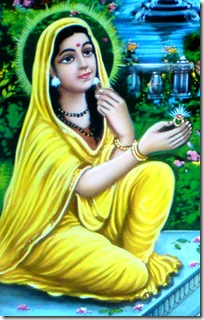

Goswami Tulsidas states that when the servant properly serves the master, they actually surpass the master in stature. As an example, he points to the fact that Lord Hanuman leaped over the ocean to Lanka, while Lord Rama walked across a bridge. Lord Rama, a famous incarnation of Krishna, had to rescue His wife Sita Devi from the island kingdom of Lanka. Enlisting the help of a band of Vanaras, Rama was able to have a bridge constructed, which allowed Him to cross the ocean and take on Sita’s captor, Ravana, in battle. Shri Hanuman, the most faithful and dear servant of Rama, had previously leapt his way to Lanka and found Sita’s whereabouts. Since Hanuman was the most sincere servant, Rama allowed him to become more exalted than Himself.


