


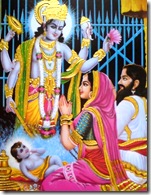
Though the ancient scriptures of India, the Vedas, are quite complex as far as teachings go, there is one truth that stands above all others. This truth is known as the ultimate conclusion, the definitive explanation of the relationship between the individual and the higher reality, the divine person in the spiritual sky. This ultimate conclusion is known as achintya-bhedabheda-tattva, which stipulates that the living entities are part and parcel of the Supreme Lord. They are simultaneously one with and different from the Absolute Truth. More important than this conclusion is the relationship derived from it. As part and parcel of the Supreme Energetic, the original Absolute Truth, God who has an ever-blissful form, the fragmental sparks are meant to be constantly in association with their superior “twin”. This connection is achieved through worship of the divine in His original form as the Personality of Godhead, who is addressed as Krishna.


“…Due to the great variety of desires and natures among human beings, there are many different theistic philosophies of life, which are handed down through tradition, custom and disciplic succession. There are other teachers who directly support atheistic viewpoints.” (Lord Krishna, Shrimad Bhagavatam, 11.14.8)
Since the sentimentalists and sectarians hold steadfast to their one or two scriptures, the intelligence they acquire from studying such philosophical doctrines often peaks at a level below the summit. As a result, instead of merely focusing on their own business and the recommendations given to them, they take to criticizing others, especially the followers of the Vedic tradition. One of the more commonly lodged complaints about devotees of Krishna is that they spend their time worshiping a personal form of God. Moreover, they carve out images, turn them into deities, and then worship by prostrating before them and chanting various hymns. The narrow-minded sectarians cannot fathom ever taking up such activity, for they claim that their scriptures strictly prohibit such practices.


This is certainly a lot to digest. If we cover the basic components, however, we’ll see that the restrictions imposed actually prevent one from achieving the desired aim, i.e. that of worshiping God. As a result, the restrictions and the ultimate conclusion end up contradicting one another. Since the aforementioned viewpoints are held by the sentimentalists and the sectarians, not much thought is given to the statements contained within. Rather, everything is accepted blindly, without much attention given to the justification and effectiveness, or lack thereof, to such procedures. A quick analysis of each one of the above mentioned stipulations can help clarify the similarities and differences that exist between the sentimentalists and the purified devotees of a personal God.
“Abandon all varieties of religion and just surrender unto Me. I shall deliver you from all sinful reaction. Do not fear.” (Lord Krishna, Bhagavad-gita, 18.66)


Are followers of the Vedic tradition violating this principle of surrender by worshiping Krishna instead of other notable personalities? Are the followers of other faiths guilty of the same crime through their own religious practices? In order to understand what it means to not worship any other God, the term “God” itself needs to be defined. Every person in this world is religious. This is because every person, whether they believe in God or not, has an ultimate object of worship. They may not be able to identify this object with ontological certitude, but they most certainly act in a reverential attitude towards it. This speaks to the fact that the acknowledgment of something as the ultimate object of worship occurs through acts of devotion, not merely statements of allegiance or professions of faith.


In the realm of spirituality, simply professing a faith is not enough. In order to accept someone or something as God, we have to make them our ultimate object of worship. Therefore if one simply pledges allegiance to a specific notable divine personality, but then still treats other people and entities as their ultimate objects of worship, their worship of God becomes meaningless. This is actually the case with many so-called religious followers around the world. During the weekdays, they engage in meat eating – which is facilitated through the killing of innocent animals – illicit sex, intoxication, and gambling, and then on Sundays they will attend some religious function and feel as if everything is alright. It must be said that every living entity has freedom in how they choose to act. If someone chooses to eat meat, devote time and money towards leisure activities, or profess their love to their significant others, they have every right as free people to do so. At the same time, such activity certainly violates the tenet of not worshiping any other God. Worship is facilitated through activity and, more importantly, consciousness. If a person’s consciousness is focused on material life, it must be said that their main object of worship, their “God”, is matter. In this way, they are violating the primary rule of the doctrine they are so fond of quoting.


So how does remembering contradict the restriction on deity worship? In order to remember, we have to have something to focus the mind on. This object of focus cannot be nothing. If something is void or formless, by definition, it cannot be remembered. In this paradigm, the concept of worship immediately becomes null and void. The sentimentalists will counter with the argument that the mind should focus on the specific divine personality that one goes to for salvation. Yet this argument actually further enhances the contradiction. If we are to worship God through remembering a divine personality, a great prophet of the past, are we not fixing our minds on a specific form? Did these prophets not have a physical form when they roamed the earth?


This brings us to the next restriction: prostration. Not only are the sentimentalists against carving out worshipable forms of their divine figures, but they are against offering prayers to such images. The prostration before the deities of Krishna, Vishnu, and the spiritual masters are seen as great sins by outsiders and neophytes. Ironically enough, people are already offering their obeisances to other “Gods”, prostrating themselves in different ways. Prostration simply means acknowledging the supremacy of the object of worship. This is already occurring in the areas of sports, politics, and entertainment. Though the prostrations can take on different forms, the end-result is the same. In the world of sports, the bowing down occurs through the buying of tickets to events, the screaming in jubilation, the purchasing of memorabilia and apparel, and the overall love and adoration directed at the sports figures. In entertainment, a similar style of worship is seen through the attendance of movies and the following of the day-to-day happenings of favorite actors and actresses. Politics sees the greatest form of worship, with the prostration occurring through attendance at campaign rallies, political donations, and the dedication to showing up to vote for particular candidates. In the realm of romantic love, men even kneel before their significant others when making marriage proposals. Pet owners regularly bow down to pick up the waste that their pets leave on the ground. There is even a popular saying, “Dogs have owners and cats have servants.” So if we are already bowing down to other gods, other people that we have turned into our ultimate objects of worship, what is the harm in prostrating before the real God?


“While contemplating the objects of the senses, a person develops attachment for them, and from such attachment lust develops, and from lust anger arises.” (Lord Krishna, Bg. 2.62)
In order for God to be angry, He must be fallible. Anger is a result of frustration, the inability to satisfy one’s lusty desires borne out of attachment to material objects. By definition, this emotion can never apply to God because there is nothing that He is incapable of doing. The Supreme Lord can never be frustrated in any effort or endeavor. He especially has no reason to be angry with the living entities, for their powers are insignificant and puny when compared to the great energy of the energetic Supreme Lord. Jealousy is an emotion that results from insecurity, the worry that someone else will surpass us in beauty, wealth, strength, fame, renunciation, or wisdom. Since God is known as Bhagavan, He already possesses all of these opulences simultaneously and to the fullest extent. Therefore He has no reason to be jealous of anyone.

“For those whose minds are attached to the unmanifested, impersonal feature of the Supreme, advancement is very troublesome. To make progress in that discipline is always difficult for those who are embodied.” (Lord Krishna, Bg. 12.5)
For surrender to truly occur, one must worship God in His original, personal form. This is because surrender, salvation, and the elimination of sinful reactions can only occur through a change in consciousness. Worship starts and ends with the mind. The mind is always working, so whatever it chooses to spend the most time thinking about is what constitutes the ultimate object of worship. Moreover, the mind can only contemplate on things that it has experienced or seen. If a person spends all their time in material pursuits – not giving credence to the subtle laws of nature, the plight of their fellow man, and ignoring the equality of all forms of life – the mind will focus on maya, or not God. Therefore such a person can never truly surrender to the Supreme Lord. In order for one’s consciousness to be changed, the nature of their activities must also be altered.


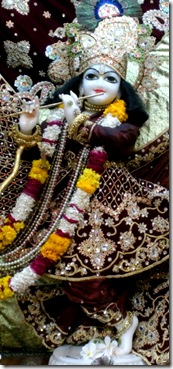
The deity plays a central role in this worship, for it allows a devotee to back up their claims of religiousness. By carving out a deity based on the specifications provided in the authorized scriptures, a devotee can worship a non-different form of the Lord. This form is completely transcendental and vital towards achieving advancement in spiritual life. A devotee can offer prayers, dress the deity, and prepare nice food preparations to be given in sacrifice. More than anything else, the devotee should regularly chant, “Hare Krishna Hare Krishna, Krishna Krishna, Hare Hare, Hare Rama Hare Rama, Rama Rama, Hare Hare”, in front of this worshipable form. If God wants us to think of Him, why not use all the tools at our disposal to ensure that such remembrance continues uninterrupted?

