Service paid to the spiritual master and worship of the Supreme Personality of Godhead run on parallel lines. By worshiping both parties simultaneously, one achieves the greatest reward of liberation from the repeated suffering brought on by contact with the temporary world. Only in the afterlife, the realm where spirituality reigns supreme, can the agonies brought on by gain, loss, birth, death, happiness, and sadness be permanently eradicated. In order to enter this realm, one must be stripped of all egoism and false pride. One must be a complete adherent to the dictates of the Divine Being, whose instructions are carried out in this world by His purified servants, the spiritual masters who embody virtue, kindness, compassion, and deference to the laws of the Supreme Master. While service to the guru brings pleasure to the Supreme Lord, the reciprocal benedictions bestowed on the sincere servant by God also bring pleasure to the spiritual master. This truth was stressed by the exalted female sage Shabari when she had the wonderful opportunity to meet the Supreme Personality of Godhead face to face.


“O Raghava, if I am in Your company, even Shakra [Indra], the lord of the demigods, with his great strength would not be able to overpower me.” (Sita Devi speaking to Lord Rama, Valmiki Ramayana, Ayodhya Kand, 29.6)
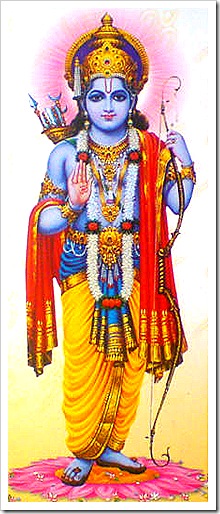
Lord Rama, an expansion of the original, all-blissful, ever-existing Personality of Godhead, roamed this earth many thousands of years ago in the guise of a pious, kshatriya prince. We can think of a kshatriya as the most honest and capable defender of the innocent. This honesty and dedication to righteousness doesn’t exist only in theory. Rather, there are many occasions when a defender is put to the test. As the saying goes, “When the going gets tough, the tough get going”, Shri Rama proved His mettle on many occasions, the most notable of which related to His exile from His opulent kingdom of Ayodhya.
When Rama was still a young man, He was on the precipice of coronation; He was to succeed His father on the royal throne. Yet through a series of unfortunate events, the kingdom was snatched away from Him at the last moment. To make matters worse, He was ordered to leave the community and not return for fourteen years, during which time He would have no ties to the regal life. God is atmarama, meaning one who is self-satisfied, so such an order didn’t phase Shri Rama one bit. But He was married at the time, and as is custom in a marriage, the husband often has to deliver unpalatable news to the wife. A married man can’t just stay out late all the time without telling his wife first. A good husband will not leave home without at least telling someone where they are going.


In order to convince Rama of her position, Sita pointed to His extraordinary abilities in the area of defense. Rama tried to dissuade Sita from going by reminding her of the dangers of forest life. Sita not only countered this argument by saying that Rama was strong, but she emphatically pointed out that not even Indra, the king of the heavenly planets, could harm her if she was in Rama’s company. Comparisons to Indra are quite commonplace in Vedic literature. He is the strongest of the suras, or the devoted living entities possessing heavenly bodies. Therefore if someone is stronger than Indra, it means that they must be one of the most capable fighters in the universe.


This speaks to the truth that our teachers and role models make us who we are. In the Vedic tradition, the first objects of worship are the parents. They take care of us in the early years of life and give us a basic understanding of right and wrong. In the absence of this care and affection, we easily could be led off the straightened path. In adulthood, the object of worship is the guru, or spiritual master. The parents give us our first birth, but in order to achieve success in a spiritual sense, we need a second birth. The spiritual master gives us this reawakening of divine consciousness through the initiation process. When one is properly educated in a spiritual sense, they no longer see bodily designations; they see only spirit and its relationship to an ever-changing matter.


A spiritual master is not chosen on a whim, but rather is sought out based on their qualifications. Of all the characteristics of a guru, his most endearing qualification is his ability to liberate his disciples from the repeated cycle of birth and death. If our consciousness is not purified by the time we die, we will be forced to take birth again to a new set of parents and repeat the same knowledge-acquiring process. If we can find a bona fide spiritual master and follow their instructions wholeheartedly, we can avoid this unnecessary rebirth.


By satisfying the guru with our service, the chain of causation eventually finds its way back to God. When the guru is pleased, the guru’s guru is pleased, the guru’s guru’s guru is satisfied, and so on. What’s often overlooked, however, is the end-result of such service and its effect on the parties involved. We know what the initial act of service to the guru will lead to, but what effect does the result of this action bring? For example, say that we please Krishna by pleasing the guru. If the Lord offers us a nice benediction in return, are we the only ones benefitted? According to the opinion of the most exalted associates of the Lord, those liberated souls who properly served their gurus, the benedictions received from God directly affect the same chain of spiritual masters. This fact was reiterated by the female sage Shabari.


In the above referenced statement, Shabari is responding to Rama’s questions. We see that she states that the service she offered to her guravah, her spiritual masters and respectable elders, has most certainly borne fruit. She not only stipulates that the service was successful, but she also provides a reason. Shabari states that by having Rama’s darshana, seeing Him face to face, her gurus have been duly honored. This speaks to the truth that the spiritual master and the Supreme Lord are always linked. You cannot serve one and neglect the other. No one is dearer to Krishna than His sincere servant.
Shabari’s kind words also reinforce the fact that a person’s greatness and accomplishments are a reflection on their teachers. By meeting Rama, which is the highest benediction one can achieve in life, Shabari honored herself and her spiritual masters. After all, it was her gurus who taught her about spiritual life and how to perform tapasya. They taught her how to control her anger and her eating habits. Not only Shabari, but every one of us has to be taught how to live a regulated life. In the absence of this instruction, we would most certainly take to nefarious behavior or those activities which would end up harming us.