


One of the more controversial aspects to the spiritual traditions emanating from the Vedas is demigod worship. The impersonalists, those who don’t believe in a God with a form, or those who take the Supreme Absolute Truth to be a giant energy composed of the aggregate total of all spirit, feel that worship of any “god” is on the same level, regardless of the personality in question. The ultimate objective of the impersonalists is to free themselves from attachment, lust, anger, greed, and desire. So whatever method one can adopt to achieve such an end is justified. To this end, they take the worship of various divine figures to be simply a way to understand the impersonal energy known as Brahman. The impersonalists label the practice of meditating on the formless Absolute Truth as nirguna worship and the practice of offering obeisances to and concentrating on a specific qualified divine figure as saguna worship. In this way they take every individual living entity to be God. They believe that every person is an equal part of the divine, but that the presence of this quality is forgotten.

“Men of small intelligence [alpa-medhasam] worship the demigods, and their fruits are limited and temporary. Those who worship the demigods go to the planets of the demigods, but My devotees ultimately reach My supreme planet.” (Lord Krishna, Bhagavad-gita, 7.23)

Though these instructions given by Krishna were comprehensive and intricate, He made brief mention of the demigods and those who take to worshiping them. In one section, Krishna mentions that sacrifice to the demigods is important, for through this practice, one can achieve all necessities in life such as rain, food, shelter, etc. At the same time, the Lord downplays the results achieved from worshiping the demigods, calling them temporary and providing of fleeting happiness. He also says that those who are less intelligent, those with less brain substance, take to worshiping the demigods.
“In charge of the various necessities of life, the demigods, being satisfied by the performance of yajna [sacrifice], supply all necessities to man. But he who enjoys these gifts, without offering them to the demigods in return, is certainly a thief.” (Lord Krishna, Bg. 3.12)
Yet from Krishna’s activities, we see that He even took to worshiping various devatas during His time on earth. Moreover, the same can be said of Lord Rama, Vishnu’s avatara who appeared on earth thousands of years before Krishna. Formerly, man was generally more pious than he is today, so most people spent the majority of their time engaged in religious affairs. Worship of the demigods was a central part of religious life, so everyone who was pious took to such activity.

An example would be helpful in understanding this distinction. While Krishna or Vishnu is the original form of Godhead, Lord Shiva and Lord Brahma are very close runners up. They are guna-avataras of Vishnu, or expansions of the Lord who manage the material affairs. Since they come under the subjection of the laws of nature, they cannot be considered the same in quality as Vishnu. Since God creates material nature, He cannot be subject to her stringent laws. This fact remains true even when the Lord personally appears on earth. For example, the sun offers its rays and light to all of creation, regardless of the cleanliness or impurity of the objects it touches. The sun can suck up moisture from an ocean or from a puddle of urine and still remain pure throughout. In a similar manner, the Supreme Lord can contact material nature yet still remain free from any laws of karma.

These facts highlight the intimate relationship that exists between the devatas and Vishnu. The two entities are always in line with each other, with one providing the orders, and the other following them. Yet not every person will take to worshiping Vishnu. The result of Vishnu worship is liberation, or the end of the cycle of birth and death. Many don’t want this liberation, for they would rather continue to enjoy material nature. For such people, worship of the demigods is recommended as a way of maintaining a connection with spiritual life. The devatas can grant material benedictions to anyone who pleases them. This is the power granted to them by Lord Vishnu. The Supreme Lord is the most munificent entity after all. He has no desire to take people away from their happy place. He grants the conditioned souls complete independence in this regard. The caveat, however, is that if one wants to remain in the material world, they are forced to live by its rules. These rules are governed by the system of karma, which is completely fair and just. One person may act in a certain way to meet a certain desire, but others have a similar right to act in their own self-interest. When these interests collide, as they most certainly will, chaos, despair, defeat, rejection, lamentation, anger, and so many other undesirable side effects will result.

So if this type of demigod worship is not recommended, then what kind is? The Brahma-samhita, one of the most concise and powerful Vedic texts, provides the answer. The demigods are most certainly acknowledged in this wonderful book of devotion to Krishna, but they are described in the proper context. Lord Ganesha is described as the powerful entity who removes obstacles from the path of those who worship him. This boon-giving power is obtained through the mercy of Govinda, which is another name for Krishna. If we worship Lord Ganesha to help remove the obstacles in the path of our spiritual pursuits, then this most certainly must be considered an intelligent activity.
“O Mother Ganga, protected by you, may this son of the intelligent and great King Dasharatha honor the order of His father. After having completed fourteen years of living in the forest, He, along with His brother and myself, will certainly return here again. Then, O beloved Devi, having safely arrived here again, I will joyfully worship you, O Ganga, who are capable of fulfilling every desire [sarva-kama].” (Sita Devi praying to Mother Ganga, Valmiki Ramayana, Ayodhya Kand, 52.83-85)
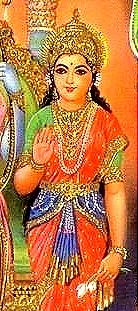
If we already have family traditions relating to demigod worship, there is no need to give them up. These traditions can be thought of as family heirlooms, magical keys which are passed down from generation to generation. For those who don’t grow up in this tradition, acquiring this type of key is not necessary, for worshipers of Krishna are bestowed the master key which unlocks every door, including the one to the spiritual world. In the performance of all of our activities, we should keep Vishnu’s satisfaction at the forefront of the mind. The demigods are the Lord’s closest aides and servants, so showing respect to them certainly will please Vishnu as well. In this age of Kali, there isn’t much time for religious practice, so whatever devotional efforts we do take up should be aimed directly at Krishna. Since devotional service satisfies the Supreme Personality of Godhead, the demigods automatically become satisfied as well. Goswami Tulsidas, the wonderful saint and exalted author of beautiful poetry devoted to Lord Rama, would often invoke the names of Lord Shiva, Mother Parvati, and Lord Ganesha at the beginning of his poems. He asked them not for any personal benefit, but rather to help him in his pursuit to please Rama.

