It’s quite understandable that we would pity our condition in this world from time to time. Sometimes things get so out of hand that we just can’t help wallowing in our misfortune. During these times, even the staunchest of atheists will have an inclination towards prayer and a higher power. “O God, why did you put me in this miserable condition? What can I do? It is out of my hands; I hate my life.” In these situations, or in any situation actually, pleading for help from the Supreme Divine Entity is always the way to go. Instead of sitting idly by and allowing our condition to own us, it is better to ask for aid from the only person capable of alleviating any situation. That person is Lord Krishna, the Supreme Personality of Godhead.


The highest stage of knowledge is that which informs us of our constitutional position and the primary cause of our current condition. This cause will indeed explain the reason for all of our conditions, including the initial event of birth. Though there are various religious systems in existence today, none is more complete than that emanating from the Vedas, the ancient scriptures of India. Though Vedanta, or the ultimate knowledge, can be quite complicated, the reason for our birth and the type of body we occupy can be explained simply by saying that we desired our current condition. God is one, and He has His own realm where He resides. The soul represents our identity, and it is unchanging. Any soul which desires God’s personal association is allowed to have it. By the same token, any individual who wants to live separately from God and imitate His activities of creating, maintaining, and destroying is also allowed to do so. Hence the souls that reside in the perceptible world all fall into the latter category. It shouldn’t surprise us that this sort of desire can only lead to misery; no one can perform activities in the same way that God can. Therefore, the solution to all of our problems is to change our desires from wanting to have our little problems fixed, to having our original negative condition, the cause for all our problems, remedied.
“Whether one is without desire, or is desirous of all fruitive results, or is after liberation, one should with all efforts try to worship the Supreme Personality of Godhead for complete perfection, culminating in Krishna consciousness.” (Shrimad Bhagavatam, 2.3.10)


For those who are on the highest platform of knowledge – those wanting an immediate stop to their imitation of Krishna – are known as bhaktas, or devotees. A devotee simply wants Krishna’s association and nothing else. This association unfolds through interactions in one of several different transcendental mellows, or rasas. While transcendental scholars have carefully analyzed and prioritized these mellows, in the grand scheme of things, there is no difference between them. If one person wants to associate with Krishna eternally as a friend, and another wants to be His sincere servant, there is no difference in their desires. After all, both individuals want Krishna’s association, a condition which automatically brings liberation from the cycle of birth and death.
Yet for those who are not on the level of the devotees, the Lord still kindly lends a helping hand. These individuals generally fall into one of two classes: jnanis and karmis. The jnanis don’t necessarily believe in a personal God. The analogy given to explain the mindset of the impersonalist is to that of a giant ocean of water. The jnanis, those who take to studying the differences between spirit and matter as their primary occupation, believe that the Supreme Absolute Truth, God in a sense, is represented by a giant ocean. The living entities are then created when this ocean is divided up into separate containers of water. Therefore, the ultimate aim becomes the merging back into the ocean. When one is on the highest platform of knowledge, which can only be reached through devotion to Krishna, they see the folly in this mindset. Under the giant ocean model, the Supreme Absolute Truth would have to be flawed since He allows Himself to become divided and trapped in individual containers. If the Lord is flawed, He cannot be considered God. Additionally, the individual is taken as God under this model, which is silly in and of itself. If we are God, how did we become trapped in a miserable condition? If we are God, how are we not able to remember our previous lives?
There certainly does exist a giant reservoir of spiritual energy, with the individual souls being part and parcel of this effulgence. This impersonal energy is known as Brahman, and since we are tiny sparks emanating from Brahman, we too are blissful and full of knowledge. Yet Brahman is simply the outer energy emanating from the transcendental body of Krishna. If one remains stuck on argument, logic, and reasoning devised from strict interpretation of the words found in scripture, they will never be able to see past this glaring effulgence. There are other classes of transcendentalists who have similar conclusions, namely that of eliminating individuality and pain through the cessation of activity. Merging into Brahman, or its similar counterpart of nirvana, represents the loss of individuality. It is akin to spiritual suicide. Yet Krishna is so kind that He even grants these rewards to those who approach Him in earnest.


Yet even if we want to enjoy opulence, we are advised to approach Krishna in a humble way. He does not force anyone to change or purify their desires. Rather, He is satisfied just seeing that people think of Him and ask Him for help. The benefit to approaching Krishna over other entities is that not only will Krishna likely give us what we want, but He will purify our desires as a result. Dharma is our essential characteristic, something that never changes with time. Therefore through constant association with Krishna, we are guaranteed of eventually reawakening from our spiritual sleep and reconnecting with our long lost lover.
If we find ourselves in an unpalatable situation, which will occur many times throughout our lifetime, we should always look to Krishna instead of just lamenting our condition. If we take action by worshiping Krishna, the chances of our rescue are increased, whereas simple lamentation and self-pity will guarantee a perpetually miserable state. One great devotee, a divine figure and manifestation of the Goddess of Fortune, proved the validity of this theory during one especially troubling time in her life. Her prayers and subsequent rescue by Krishna show us that the Lord will always hear our sincere callings for His association.


It shouldn’t surprise us that those who are not very intelligent, those lacking information about the ultimate conclusion of life, will find this sort of marriage system horrifying. Movies produced in India very often focus on the theme of arranged marriages, with the typical plotline involving a girl who is in love with another man but who is then forced to marry someone else by her parents. It must be said that in the classic Vedic system, this rarely occurs because men and women aren’t allowed to freely intermingle. In the modern age, the forced marriage has become a problem due to the fact that men and women meet up and spend much time together before marriage arrangements are made by parents.


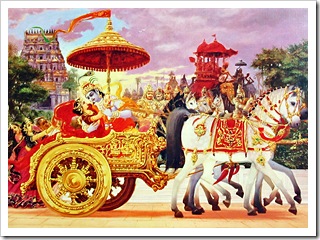
Not surprisingly, Krishna wholeheartedly accepted Rukmini’s desire for marriage. Rukmini was so intelligent that she not only proposed marriage, but she also outlined a plot which Krishna could follow to facilitate the new plan. During those times, kshatriyas, or those in the royal order, often married women through a kidnapping fashion, something known as the Rakshasa style of marriage. Rukmini proposed that Krishna come and take her while she and her family would be visiting the temple of Goddess Durga on the day of the wedding to Shishupala. No one would suspect any chicanery during this holy time just prior to the marriage, so it would be ideal for Krishna to perform the kidnapping then. This is precisely what would happen, as Krishna would swoop in just like Garuda, the faithful servant and bird-carrier of Lord Vishnu, and snatch Rukmini away from the onlookers, which included Shishupala and other rival kings. Krishna would fend off the attacks that followed and eventually return home safely to Dvaraka with Rukmini. The two would then be married formally and live happily ever after.