


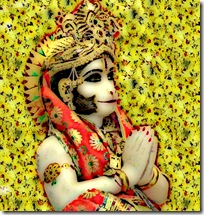
This is quite a brilliant statement from Shri Hanuman, an expert on devotional service, scholarship, Sanskrit, virtue, and every other noteworthy field of activity. It is not surprising to hear such words of wisdom emanating from the lotus mouth of Shri Rama’s greatest servant. This one passage can be studied daily, as it serves as a reminder, a jolt to the brain so to speak, of the futility of lamentation and grief. This reminder is helpful because man is generally prone to hankering and lamenting. It is a common practice to lament the plight of others, viewing them as pitiable. From Shri Hanuman’s statement, we see that any individual remaining within a body which is like a bubble is not justified in pitying any other person who is in a similar condition.
“While speaking learned words, you are mourning for what is not worthy of grief. Those who are wise lament neither for the living nor the dead.” (Lord Krishna speaking to Arjuna, Bhagavad-gita, 2.11)


Since argument and philosophy can only take the mind so far, they eventually need to be renounced. When associated with study of spiritual matters, dry philosophy and mental speculation can lead to the conclusion that the ultimate feature of the Absolute Truth is voidness. The impersonal energy, technically known as Brahman in Vedic parlance, is void of any enjoyment, pleasure, and interaction. When one attains the platform of Brahman understanding, their ultimate destination is the impersonal energy that is situated at the outskirts of material existence. As the great acharya Shrila Bhaktivinoda Thakura states, when there is a merging into Brahman, there is no benefit to either party. The soul is not benefitted because its consumption by Brahman only results in the end of individuality, the loss of feeling, sensation, pleasure, etc. Brahman is not benefitted either, for if something is unmanifested, it cannot have any stimulation, enjoyment, or happiness.


The first order of business was Sugriva’s feud with his brother Vali. Sugriva was previously driven out of his kingdom by Vali, and in order to gain it back, he would need to fight him in battle. Since Vali was too strong for him, Sugriva wanted Rama to kill Vali for him. The Lord obliged by shooting Vali in the back while he was fighting with Sugriva, and as a result, Vali’s wife Tara became a widow. Upon seeing Vali’s body lying on the ground, Tara gave way to lamentation, feeling pity for her departed husband. In the above referenced statement, Hanuman is offering some cogent words of advice aimed at alleviating Tara’s suffering. While these words were directed to a grieving widow, they serve as some of the most profound teachings known to mankind. One can study the components of Hanuman’s statement over and over again, day after day, and find new applications to their meanings.


All of this speaks to the natural propensity for lamentation. From Hanuman’s statement, however, we see that if we were to accurately apply this mindset to ourselves, we’d see that even we would be worthy of pity. For example, let’s say that we feel bad for someone who is going through a messy divorce. The divorced person will now have to be alone, split time with their children, and fork over monthly payments to their former spouse that they now loathe. If we look at our own situations, many of us are also alone, forced to divide up the time we spend with our loved ones, and obliged financially to so many different things. We may or may not be married or have ever suffered through a divorce, but the feelings of distress will always be there, in one form or another. Therefore, if we are lamenting the condition of others, we should also lament our own predicament.
Hanuman next asks Tara why she is lamenting for the poor, when she herself has now been made poor? This is a very interesting question. Tara is feeling sad over her husband’s death, so she feels that her husband is poor now that he has lost his life. Hanuman’s point is that Tara is the one who has been made poor, for she is now a widow. Tara was a very faithful and chaste wife, so she viewed her husband as her foremost deity. Now that her worshipable object was gone, her life and soul had left her company. In this way, she was much poorer than Vali, whose soul continued to survive. Vedic information states that the soul never dies and that death is merely the changing of bodies. One set of clothes gets old and worn out, and a new set gets put on. The nature of the clothes is determined by karma, or the activities performed during one’s lifetime.
“As the embodied soul continually passes, in this body, from boyhood to youth to old age, the soul similarly passes into another body at death. The self-realized soul is not bewildered by such a change.” (Lord Krishna, Bg. 2.13)


The point to understand is that we all live in one of these bubbles. This means that if we see someone else die prematurely, there is no reason for great lamentation because the same thing will happen to us eventually. One bubble may survive longer than another, but the final outcome is still the same: destruction. Since everyone is residing in one of these fragile establishments, how can any person pity another? According to the advanced transcendentalist’s angle of vision, such sentiments are silly and not based on sound logic and reasoning.
This theoretical knowledge seems all well and good, but for people who are in the eye of the storm, those who are suffering through the untimely death of a loved one, it’s difficult to maintain rationality. We may have daily studied the facts relating to the body and how no one is worthy of pity, but during times of difficulty, the feelings of attachment and loss outweigh those borne of logic and understanding. So what can we do? How do we reach the point where we can truly realize the truths that Shri Hanuman so eloquently describes?
“And whoever, at the time of death, quits his body, remembering Me alone, at once attains My nature. Of this there is no doubt.” (Lord Krishna, Bg. 8.5)


While remaining in a bubble-like body, one cannot associate with Krishna’s original feature without being subject to the influence of time. There may be temporary association, but the final destination of the bubble will still be the same. The key is to develop an attachment to God, a change in consciousness. One who thinks of Krishna at the time of death certainly does discard their shell-like body, but instead of assuming a new covering, they get sent directly to the spiritual world. In that realm, the liberated soul is allowed to enjoy Krishna’s association in the mood of their choosing. Moreover, the soul is given a spiritual body, similar to that of Krishna’s. In this way, not only does the individual permanently remove their fragile material body, but they assume an indestructible and imperishable spiritual body; a form which provides all the pleasure and bliss that one could ever hope for.

