


vyavasāyaḥ ca te vīra sattva yuktaḥ ca vikramaḥ |
sugrīvasya ca saṃdeśaḥ siddhim kathayati iva me
Herein we get a concise list of the qualities of a faithful servant of the Supreme Lord. Every individual, in every sphere of life, is serving something or someone. Though we are all servants, not all objects of service are equal. The nature of the serviced entity determines the praiseworthiness of the individual performing the service. Those who are slaves to their senses and those who view the immediate satisfaction of the tongue and genitals to be the primary engagement in life are certainly viewed as low class. As we climb higher up the chain of pious individuals, we see that the objects of service shift from the personal self to the downtrodden, friends, family and fellow countrymen. The most praiseworthy individual, however, is he who serves that one entity who is eternally worthy of service and whose influence crosses all boundaries and barriers created by sense perception. That all-pervading entity is the Supreme Personality of Godhead, and since He is the most deserving of our humble service, He also in turn provides the greatest amount of pleasure to the praiseworthy individuals dedicated to such noble activity.


In the Treta Yuga, the second time period of creation, the Supreme Personality of Godhead descended to earth in the form of a prince named Rama. God is indeed a person; otherwise He would be inferior to human beings. If human beings, considered the most advanced species, have hands, legs, arms and a brain, the Lord can certainly possess similar features. Since He is the original person, adi-purusham, His transcendental attributes are not limiting in any way. He can walk with His hands, eat with His legs, see with His ears, etc. The length and breadth of His features are also unlimited. There is no way to properly measure His height or the reach of His arms. To allow the individual souls to gain an understanding of His transcendental form, the Lord comes to earth and assumes various guises that resemble material bodies. These forms are considered guises because the Lord can never associate with matter. With the conditioned souls, there is a difference between body and spirit; thus the first instruction taught to aspiring students of the Vedas is aham brahmasmi. Individuality comes from Brahman, or spirit. The body is transforming at every second, though these changes aren’t necessarily perceptible unless we make comparisons of states between sufficient time intervals. Throughout the development of the body, the soul remains intact. When we go to sleep at night and wake up in the morning, our body has changed. When we wake up, we may feel a tad bit slimmer, our breath will emit a foul odor and our hair will be disheveled. In the eyes of time, we have also gotten one day older. Yet our identity hasn’t changed at all. Moreover, the demarcation of a day is merely an interval of time, a measurement which is understood relatively. If we were to stay awake all night instead of sleeping, the next morning we can still say that we have lived another day, even though there is no point of turnover according to the mind. The soul’s condition remains the same regardless of what time interval we apply to it. The term “life” represents a variable duration of time, a measurement of the time elapsed from when the soul enters a material body to when it exits the same form.


The question may arise as to why Rama, as God, would need monkeys to help Him. The greatest happiness comes from service; hence the serving attitude exhibited by all human beings. The purer the object of service, the more concrete and substantial the happiness that results. No one is purer than Shri Rama, the Supreme Pure, so anyone who offers Him service will be engaging in the highest occupational duty. The soul has several essential characteristics. It is eternal, blissful and knowledgeable. These qualities remain unchanged, but in the conditioned state, the soul accepts a body which partially shields its self-illuminating energy. In order for the true position of the soul to become the predominant guiding force within the body, a certain set of activities must be taken up. When activities are adopted that lead to the further clouding of the soul’s qualities, the engagement is deemed conditional. When actions lead to the shedding of the covering of the self-illuminating soul, they are deemed constitutional. Therefore constitutional activities should be accepted and conditional activities renounced.
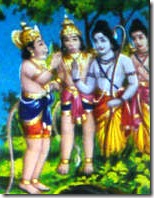
The foremost constitutional activity, or one’s dharma, is service to the Supreme Lord. Therefore Rama’s enlisting the help of the Vanaras was an act of mercy more than anything else. The leader of the Vanaras was King Sugriva, who had millions of monkey soldiers that were ready, willing and able to help Rama. Sugriva divided this army into groups and sent them to the corners of the earth to find Sita. Prior to their departure, Sugriva specifically addressed Hanuman, his chief warrior, and informed him that he was the most capable in the upcoming endeavor. After hearing Hanuman’s praises from Sugriva, Rama pondered the matter over in His own mind. The Lord didn’t have to think for very long. He knew exactly what Hanuman was capable of, so He rightly concluded that success was already achieved. Knowing that Hanuman would find Sita, the Lord gave him a ring inscribed with His name on it to give to the princess.


Shri Rama states that Hanuman also has sterling prowess, or a pure ability or influence specific to the task. This quality couples with the requirement of determination previously mentioned. Ravana was a Rakshasa, and thus a master of illusion. He was also very powerful in battle, so whoever would find Sita would have to deal with a formidable opposing force consisting of many great fighters. Since Hanuman was firm in resolution and possessing of great prowess, he would be able to handle such onslaughts without meeting defeat.


As if these qualities weren’t enough to foretell success, Lord Rama also mentions that Sugriva has fully vouched for Hanuman’s abilities. Sugriva was the king of the monkeys living in Kishkindha, so his praises of Hanuman had the weight of authority behind them. The chief deputy for any leader is one who has proven themselves on previous occasions. For the most important tasks, we’ll always turn to those we have the most confidence in. Additionally, Hanuman had displayed all of these wonderful qualities in Rama’s presence. Lord Rama and His younger brother Lakshmana formed an alliance with Sugriva through Hanuman’s efforts. Through personal dealings, Rama was intimately acquainted with Hanuman’s character.


From Rama’s judgment of Hanuman, we see that the Supreme Lord is keenly aware of who will be able to successfully serve Him and who won’t. We certainly can never possess the necessary attributes to the same degree as Hanuman, but we don’t have to in order to return to the spiritual world. Moreover, Shri Hanuman is so kind and benevolent that he will help any sincere soul who is willing to go the extra mile for Rama. The key to success in devotional service is to be courageous, capable and resolute. In this age, the simplest and most effective way to serve the Lord is to regularly chant His names, “Hare Krishna Hare Krishna, Krishna Krishna, Hare Hare, Hare Rama Hare Rama, Rama Rama, Hare Hare”. Everyone is capable in this regard. Courage should also be shown in chanting this mantra; one should not worry about the constraints of time, circumstance and the opinions of others. Our dedication to performing devotional service, and chanting in particular, should be strong. Devotional service is performed perfectly when it is unmotivated and uninterrupted.
“I was born in the darkest ignorance, and my spiritual master opened my eyes with the torch of knowledge. I offer my respectful obeisances unto him.” (Gautamiya Tantra)
We also need the blessings of a representative of the Lord, a spiritual master. Sugriva was Rama’s trusted ally. Since Sugriva recommended Hanuman, the Supreme Lord knew that success was guaranteed. Following in this tradition, all important activities in devotional service begin with obeisances to the guru. This is done not only to show respect to the spiritual master who has given us so much, but also to kindly ask him to recommend us for service to the Personality of Godhead. When vegetarian food in the mode of goodness, flowers, water, etc. are offered to a deity or picture of the Lord, the items are actually first presented to the spiritual master, who in turn offers them to his spiritual master, and so on. Eventually the offering reaches Bhagavan and becomes purified and then returned to us as prasadam. The recommendation of the guru is certainly a requirement, as we are not advised to directly approach the Supreme Lord. In the conditioned state, wherein material activities are adopted, it is difficult to decipher who is worthy of worship and who isn’t. When our judgment remains clouded, we have no way of even finding God, let alone offering service to Him. The bona fide guru knows God’s names, forms and address, so if he is pleased with our service, he will kindly help us in our sincere devotional efforts.

