


Brahma, Vishnu, and Mahesha are the three most notable figures of the Hindu faith, the Vedic tradition that has stood the test of time. Though these deities are the face of the most prominent spiritual tradition of India, they each take on vastly different roles. Moreover, their existence doesn’t make the final Vedic scriptural conclusion one of polytheism. Rather, the many deities speak to the varying degrees of activity, desire and reward. Yet of all the notable divine figures, only Vishnu and His non-different expansions stand out due to the nature of the benedictions they offer their sincere adherents. These rewards not only relate directly to the true meaning of life, but they substantiate the supreme role and position assumed by the original Person, that entity we know and address as God.
“The bewildered spirit soul, under the influence of the three modes of material nature, thinks himself to be the doer of activities, which are in actuality carried out by nature.” (Lord Krishna, Bhagavad-gita, 3.27)


In the arena of fruitive activity, it is silly to think that any single individual is more deserving of benefits than another. Hence those who scoff at the mention of God are certainly justified in their initial skepticism and angst. “How is God favoring you? Who are you to say what God thinks and what God wants?” These sentiments indicate at least a subconscious awareness of the limits of fruitive activity and the rewards they provide. The Vedas, the oldest scriptures in existence, fill in the missing details. The world we live in is a temporary place, a shadow copy of a more purified realm. Why the dichotomy in makeup? In one place, every individual is completely purified and working to fulfill the interests of the Supreme Friend. In the shadow realm, everyone is competing with each other to become that Supreme Individual. In the purified land, the roles never change, as it is impossible for the most powerful entity to ever lose His post. In fact, He never had to ascend to His lofty perch, for He is always the Supreme Person. In the temporary realm, there may be ascensions and falls of notable personalities every now and then, but no one is capable of remaining the most powerful person in a particular area of interest for any extended period of time. All-devouring death makes sure of that.
If efforts in the perishable realm are ill-fated, why the creation of the land in the first place? The answer is that those souls who want to imitate the behavior of the Supreme Person in the spiritual sky are not allowed to do so in the permanent realm. Instead, they need a playing field, a sort of giant room where they can pretend to be God. After checking in, the conditioned souls deluded by unattainable desires can check out at any time, provided they want to leave. Here, through a few simple steps, we have arrived at the meaning of life and the purpose to our existence. A shift in desire is all that is required, a changing of consciousness, to fulfill life’s mission. When the individual spirit souls, who though uniform in makeup still come in all shapes and sizes in the material world, want to return to the spiritual land and reassume their natural position as eternal servitors of the Lord, they are immediately granted liberation.


“The living entities in this conditioned world are My eternal, fragmental parts. Due to conditioned life, they are struggling very hard with the six senses, which include the mind.” (Lord Krishna, Bg. 15.7)
These service dealings are deemed impure because the objects of pleasure aren’t as potent as the Supreme Lord. Due to this deficiency, the pleasure derived from mundane service is always lacking; hence the constant sprouting of seeds of desire to shift from one venture to another. The living entity knows that it wants to serve; it just doesn’t know who is the most deserving of their love. God, as the Supreme Object of pleasure, is known by different names in the Vedic tradition and also around the world, but His original and most complete appellation is Krishna. This wonderful Sanskrit word speaks to the Supreme Lord’s all-attractive nature in His original form. That Supreme Spirit would be the most attractive entity should make sense, as there would be no point in taking to the service of an entity who wasn’t appealing in every respect. Yet Krishna is not God’s only form; He is kind enough to expand into other non-different spiritual bodies conducive to the particular mood of worship of the individual. The word “individual” speaks to the unique makeup of every spirit soul. Constitutionally everyone is equal, for there is no quantitative comparison between different fragmental sparks of the original spiritual energy. Yet just as no two snowflakes are alike, no two individual spirit souls have the exact same loving propensity towards the Supreme Lord. Some want to engage in loving affairs with God, some want to serve as His friend, while others even want to become His parent. All such transcendental mellows, or rasas, manifest through the personal interactions with Krishna and His different forms.


“Material nature consists of the three modes-goodness, passion and ignorance. When the living entity comes in contact with nature, he becomes conditioned by these modes.” (Lord Krishna, Bg. 14.5)
Activities not related to transcendental love can be classified into three different modes: goodness, passion and ignorance. Since activities in goodness lead to the acquisition of knowledge, they are considered pious. Fruitive activities, those acts which lead to temporary gains at the expense of much time and effort, are considered passionate. Ignorant activities are those performed without any regard for future gain or scriptural injunction. Ignorant behavior doesn’t help anyone; the mode of ignorance is what we normally refer to as “stupid behavior.” Not surprisingly, it is advised that we at least rise to the mode of goodness so that our knowledge base will steadily increase. By taking in Vedic wisdom, teaching it to others, performing sacrifices, and giving charity to worthy recipients, our tendency towards competition with God will gradually diminish. The mode of passion is what most human beings take to by default. These are the general activities of karma, wherein one takes to a certain set of actions for the purpose of a material reward. The sublime engagement of divine love is known as bhakti, and it is strikingly similar to karma. The difference between bhakti and karma is the beneficiary of action. Under the mode of passion, karmic activities secure rewards of the material variety meant to be enjoyed by the individual performing them. In the paradigm of bhakti, similar activities may be adopted, but since the rewards are used solely for the benefit of the Supreme Lord, both the performer and the rewards themselves become purified.
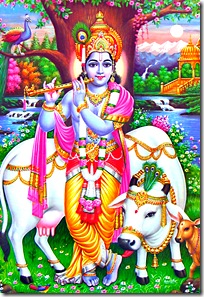


Lord Vishnu, though considered a presiding deity of material nature, is different from Brahma and Shiva in that He is a direct expansion of an even more powerful Vishnu of the spiritual world. That Vishnu is Himself an expansion of Lord Krishna, the Supreme Personality of Godhead. Lord Vishnu is generally more opulently adorned than is Krishna, for that is the wish of the devotees. Unlike those in the modes of passion and ignorance, those in the mode of goodness generally understand the differences between matter and spirit and the temporary nature of material life. Therefore when they worship Lord Vishnu, they offer nice items for His satisfaction. Vishnu is adorned with beautiful ornaments because that is how the devotees want Him to appear. “My dear Lord, please accept these offerings from me. You are the original owner of everything, so I am simply giving back to You whatever You have kindly lent me. I am in no need of material opulence, mystic power, or supreme knowledge. All I want is for You and Your eternal associates to be satisfied and for me to always be able to think of You.” In this way, those in the modes of goodness and pure goodness worship in a completely unique and superior way.


Vishnu never gives a devotee anything that will harm them. Narada had temporarily fallen down from his perch of elevated consciousness by seeing a beautiful woman. As a sannyasi he had no reason to get married, so the Lord instead decided to make Narada’s face appear like a monkey’s in front of the princess. Thus she didn’t end up choosing Narada, and he in turn became very angry at Vishnu. This shows yet another benefit of worshiping Vishnu. The devotee can get as angry as they want to at Vishnu, but there is nothing that will break their relationship of love. Narada angrily cursed Vishnu to come to earth in human form and be separated from His beloved wife. God can’t be cursed, but since He loves Narada so much, He agreed to the demand, coming to earth as the valiant warrior prince named Rama.


Through this kind oversight, the supremacy of Vishnu worship is firmly established. It is not surprising, therefore, to see that dedicated worship of Krishna, Vishnu, Rama, Narasimha, and other non-different Vishnu forms is not as popular as the worship of other divine figures or even worship of a God who is without a form. One who exclusively worships Vishnu is certainly the most intelligent, for they know that the Lord will not grant every single one of their wishes. Other demigods may be easily pleased to grant material benedictions, but not the Supreme Lord. Thus any person, regardless of which mode of material nature they find themselves in, is advised to worship Vishnu [Krishna] in all sincerity, as they will come out a winner in any scenario. If they ask Vishnu for something and get it, they will realize that the Supreme Lord is responsible for securing their possessions. If they don’t get what they want, they will either get angry at Vishnu or realize that what they wanted wasn’t necessary. In either case, there is association with Supreme Spirit, a connection which can only lead to a higher position in the future. Those who regularly associate with Vishnu are experts in the ancient art of divine love known as bhakti-yoga. In this day and age, the easiest method of Vishnu worship is the constant chanting of the holy names of the Lord, “Hare Krishna Hare Krishna, Krishna Krishna, Hare Hare, Hare Rama Hare Rama, Rama Rama, Hare Hare”. Even when chanted with contaminated motives, this mantra is so powerful that it will gradually cleanse the mirror of the heart, ultimately leading to the most favorable of circumstances, that of an unbreakable bond with the original Personality of Godhead in the spiritual sky.