


It’s natural to view religion as having a serious aura, a protective shield that requires visitors to check their jokes and kidding at the door. Spirituality is the real deal after all, as it touches on issues of life, death and the temporary nature of happiness and distress. But as the opening verse of the Shrimad Bhagavatam so nicely reveals, God is the source of everything in this world, janmady asya yatah, so even humor comes from Him. Therefore, in stories that describe Krishna’s activities and pastimes, along with teachings carrying tremendous import, there is also great humor to be found. And since everything related to the Supreme Personality of Godhead is in pure goodness, even the humorous stories can teach us valuable lessons.


While Shri Krishna is the most attractive form of pure spirit because He appeals to the most individuals, His expansion of Lord Vishnu is equally as potent, though He takes on a different form. Vishnu-worship, prayers and chants offered to Krishna or one of His non-different expansions, is the most unique system of spirituality in the world, one reserved exclusively for those who are interested in bhakti, or transcendental love. Bhakti is the pinnacle of religious practice, as all other systems of worship are ideally meant to lead to the stage where all actions are performed in concert with the Lord’s desires, where the sincere servants take direction from the kindest and sweetest of puppet masters, the Supreme Lord. Bhakti, or pure love, is meant only for Vishnu and His different forms and no other spiritual entity. All other forms of worship, including one where allegiance is professed to a generic individual referred to as “God”, are on the lower stages because the pure bliss evoked through bhakti is absent. Krishna has many forms, but only His Vishnu expansions are personal and thus capable of providing direct interaction to the jiva soul, which is naturally geared towards expressing individuality and free activity.


Yet in the arena of spirituality, the resulting behavioral patterns don’t always match up with the original professions of faith. Worshiping God for any other purpose than love cannot be classified as pure; hence the distinction between Vishnu-worship, or bhakti, and any other style of spirituality. The most common form of religious practice is the asking for benedictions. “God, please help me out. I’m in trouble. I’m suffering so much; I really need You to come through for me.” An individual certainly shouldn’t be criticized for such behavior. At least they have the knowledge to understand that things are out of their control. Yet, we offer similar types of service to other entities. We pay the utility companies so that we have electricity and water. We pay the cable provider so that our favorite channels come on television. We pay the grocer so that we can put food on the table. Worshiping God for the express purpose of receiving benefits, be they material objects or the alleviation of distress, is really no different than offering service to other entities. The method of paying tribute may be different, i.e. instead of writing a check we kneel down in a house of worship, but the end-result, the goal in mind, is the same.


Does this mean that Vishnu worshipers don’t ask God for anything? To nicely illustrate the difference between transcendentalists dedicated to bhakti and those hovering below the surface, we can study an analogy described by Goswami Tulsidas, the kind, humble and sweet Vaishnava poet and devotee of Lord Rama. Just as Krishna is considered to be the same as Vishnu, Shri Rama, the warrior prince incarnation of the Lord who appeared on earth during the Treta Yuga, is also the same Lord Vishnu but in a slightly different form. Rama is wholly dedicated to dharma, so He attracts those who take virtue, chivalry, kindness, shyness and other subdued features to be of utmost importance. Tulsidas, in his Dohavali, writes that through his worship of Rama he has essentially turned into a Chatak, a bird which only drinks rainwater. The analogy is very nice because the Chatak is very picky in its style of worship. Not only will it not drink anything except rainwater, but it will never divert its attention from the raincloud, which has the same complexion as Lord Rama, Vishnu and Krishna.


Yet the Chatak, or pure devotee, is always superior because it devotes itself to the Lord every single day, even though it has no desire for rainwater. This represents pure love, the highest level of devotion. The worship of Vishnu in pure bhakti is done for Vishnu’s benefit, and not for any other reason. Whether the raincloud brings water or not is of no importance to the Chatak. If the pure devotee gets tremendous riches or is constantly thrown into trouble, the dedication to worship doesn’t wane. Because of this unflinching vow, Vishnu Himself becomes wholly endeared to the pure devotees, taking them to be His best friends. One can spend an entire lifetime trying to measure the limits of Vishnu’s mercy reserved for His devotees, but the end would never be reached.


Bhrigu Muni, as the son of Lord Brahma, decided to test the three worshipable figures and report back his findings to the sages. He first went to Brahma’s realm and purposely refused to offer obeisances upon meeting his father. Even in the least cultured society, there is some greeting that is offered upon initial contact with a close relative; there is either a hug or at least a handshake. In the Vedic tradition the custom is to offer one’s obeisances in the proper manner, showing the highest level of respect. An elder or a spiritually important figure should be respected by falling at their feet. Even today this tradition is alive amongst Hindus when they meet their parents or elders. The child will touch the parents’ feet at the times of greeting and departing. Since his son refused to offer obeisances, Brahma was quite offended. Being in charge of the mode of passion, he was fortunately able to control his anger. Bhrigu Muni was his son after all, so out of affection Brahma decided not to act on his anger.


Thus far Bhrigu Muni had committed offenses by his mind and speech. Offenses of the body are far worse, so Bhrigu reserved this for Lord Vishnu. Reaching the Lord’s abode, the muni found Lakshmi Devi kindly massaging her husband’s feet. This time, Bhrigu decided to kick Lord Vishnu in the chest. In Lord Brahma’s case, there was anger that resulted from the insult, but there was nothing said or done about it. In Shiva’s case, the anger was also there and it almost manifested in violence. In Vishnu’s case, there wasn’t even the slightest hint of agitation. Lord Vishnu kindly arose and welcomed Bhrigu Muni as His most exalted guest. In fact, Lord Vishnu even apologized for having maybe caused harm to the brahmana’s foot due to His all-powerful chest. Bhrigu was certainly astonished. He had just committed the greatest offense, yet the Lord was treating him like a first-class citizen. Since that time, Vishnu keeps the imprint of Bhrigu’s foot on His chest as a sign of the meeting with His beloved devotee.
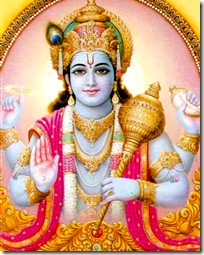
“My Lord, You are the well-wisher of the cows and the brahmanas, and You are the well-wisher of the entire human society and world.” (Vishnu Purana, 1.19.65)
The brahmana’s footprint on His chest proves without a doubt that Vishnu is the most merciful of all the forms of Godhead presiding over this and innumerable other planets. If there is sincerity in the mood of worship, the Lord’s mercy will always be there. Through this humorous incident with Bhrigu Muni, we learn that Vishnu has not a trace of any material mode of nature in Him; He is always in pure goodness. There is no offense that can cause Him agitation or deviation from His vow to always protect the saints. Therefore the path in life becomes quite obvious: become a devotee of the Lord and always enjoy His association and the umbrella of safety that it brings.