rāma nāma nara kesarī kanakakasipu kalikāla |
jāpaka jana prahalāda jimi pālihi dali surasāla ||
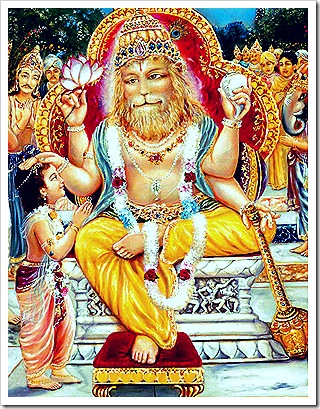
There was danger in the air. A sweet and innocent young child, who had no fault against him except a deep love and affection within his heart for his beloved Lord Vishnu, was about to be burned to death. Even in the strictest communities which employ the sternest of disciplinary measures, children are granted leniency for their transgressions. Should they break the law or fail to abide by the orders of the parents, punishment is rarely doled out, and if it is, it won’t be very severe. But in this particular kingdom a long time ago the situation was reversed. The pious, kind and honorable were persecuted for understanding that man has limitations and that the true benefit of human life is to understand God and take to His loving service. Though sensing the impending doom, this young boy held firm in his vows. He simply remembered the holy name, the sound vibration representing His beloved savior, his life and soul, and he was subsequently saved from all dangers. Though the nature of the rescue seemed like a miracle of mythological proportions, this real-life, historical event of the boy’s triumph over the forces of evil, a time when the holy name manifested in the form of a protective shield around a seemingly helpless soul who had no one else to save him, has been celebrated ever since as the occasion of Holi.


The annual celebration days help to organize and assemble masses of people in remembering and honoring the Lord. Though He is described by so many names in the multitudes of spiritual traditions around the world, His complete attractiveness forms His most important characteristic. For there to be an attraction that touches every individual and never dies, there must be a tangible form, one that is permanent. If God’s form constantly changed, He wouldn’t remain all-attractive. Since He is capable of luring in the kind-hearted souls in all the universes with His names, forms, pastimes and qualities, His most descriptive name is Krishna. Since He is capable of providing transcendental pleasure to others, He is also known as Rama. Since He is all pervading, in charge of the mode of goodness, and can be opulently adorned, He is also addressed as Vishnu. Indeed, the Vedas provide thousands of names for the original Divine Being, with each appellation capable of very effectively arousing the natural loving sentiments safely tucked away in the heart.


“Narada Muni delivered his instructions both to me, who was within the womb, and to my mother, who was engaged in rendering him service. Because he is naturally extremely kind to the fallen souls, being in a transcendental position, he gave instructions on religion and transcendental knowledge. These instructions were free from all material contamination.” (Prahlada Maharaja speaking to his friends, Shrimad Bhagavatam, 7.7.15)
Prahlada was all set to follow in his father’s footsteps, except for one small wrinkle. His mother had been instructed on the ancient art of bhakti, or devotional service, while she was pregnant with the boy. When Prahlada was born, he was able to remember everything Narada Muni, the celebrated devotee of Vishnu and tireless welfare worker, had spoken to his mother while he was in the womb. Therefore Prahlada wasn’t attracted to material affairs in any way. When he was sent to school, he would listen to what the spiritual master taught him, but remain ever devoted to Vishnu all the while. Bhakti, or pure love, can only be directed at Vishnu or one of His non-different forms. The love that we are normally accustomed to feeling and acting upon is not counted as bhakti because of the defects in the sentiment and the object of worship. All the identified strong emotions of the material world, even hatred, are derived from the natural penchant for bhakti within the soul. When the loving sentiment is directed at the proper recipient, not only is the true potential for experiencing bliss achieved, but the love and affection felt for our fellow man also increases.


“Prahlada Maharaja said: My dear King, the source of my strength, of which you are asking, is also the source of yours. Indeed, the original source of all kinds of strength is one. He is not only your strength or mine, but the only strength for everyone. Without Him, no one can get any strength. Whether moving or not moving, superior or inferior, everyone, including Lord Brahma, is controlled by the strength of the Supreme Personality of Godhead.” (Shrimad Bhagavatam, 7.8.7)
Hiranyakashipu first asked his son to stop worshiping and praising Vishnu, but when that didn’t work, the demon tried to kill his five year old boy many times. Holi relates to the specific attempt that involved placing Prahlada in a pit of fire with a female demon named Holika. Her unique ability was to withstand any amount of fire that would normally consume anyone else. The plan was pretty straightforward. Holika would take Prahlada into a pit of fire and be able to survive herself, thereby removing the greatest source of distress for Hiranyakashipu. The demon was so hateful of the Supreme Lord that he couldn’t even stand to hear the name of Vishnu, or Krishna. Of course the boy was just the opposite in behavior. He couldn’t go very long without describing the Lord’s glories. Prahlada tried to tell his father that Vishnu was his friend too, and that his tremendous abilities in fighting were due to Vishnu’s grace.


Goswami Tulsidas, the revered poet and sweetheart of a person, especially loved chanting the name of Rama. Though Lord Rama is a historical personality and an incarnation of Godhead, Tulsidas never made the mistake of separating Rama from His other forms and activities. Indeed, Tulsidas very fondly remembered the protections offered by the Supreme Lord to Prahlada Maharaja. The incident with Holika was just one of many attempts made by Hiranyakashipu to kill his son. Yet, each and every time Prahlada followed the same procedure to escape danger. The Lord finally appeared on the scene in a manifested form, but this time not just to protect Prahlada. He instead came to do away with the boy’s father. The name of God protected Prahlada at all times, and since the name is non-different from the Supreme Personality it represents, the Lord finally came to personally end Hiranyakashipu’s reign of terror.


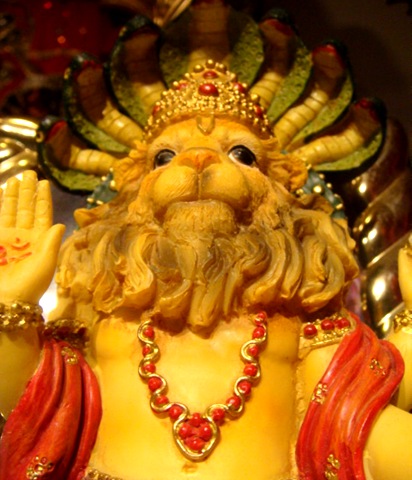
Holi gives us a chance to remember the magnificent protections that come from the Lord’s holy name and His divine appearances on earth in wonderfully brilliant forms like the half-man/half-lion. Tulsidas says that the Kali Yuga, the age we currently live in, can be likened to Hiranyakashipu. Just as the Daitya king was vehemently opposed to vishnu-bhakti, the makeup of society in today’s age of quarrel and hypocrisy is such that devotional service goes primarily ignored. The dark influences of material nature have found a safe and protected home in the activities of meat eating, gambling, intoxication and illicit sex. Indeed, these sinful behaviors can only have a strong presence wherever there is an absence of real religion, the practice of divine love.