


Samsara-chakra is known as the wheel of material existence, which continues in a cycle that is generally viewed in a negative light due to the perpetual suffering that accompanies each successive turn of the wheel, as each revolution brings about a variety of unpredictable fortunes. One who is not caught in this spinning, which is constantly working through the effects of time, is thus deemed liberated and free from any effects of material existence. The Supreme Lord, who resides in the spiritual sky and is the fountainhead of all energies, carries a different kind of chakra, one that is described as having an auspicious appearance, sudarshana. Material existence, or samsara, has just the opposite type of wheel, so in the matter of choosing between the two, a sober man would always opt for association with the more beautiful one, the wheel that does not impose any suffering or cause a grinding cycle of pain. Due to the living entity’s marginal potency, unless and until the proper choice is made, the suffering of samsara will continue.


In the most basic application, the operations involve the declaration of variables and functions, assignment of different values, calling of functions, and the use of looping constructs. The loop is where things get interesting, as it is especially necessary for dealing with iterative operations, wherein one must traverse through a set of commands or a string of values entering the program from an external source. At the foundational level, the value that requires traversal could be something as simple as user input. Say we have a command line program that takes user input and then echoes back the same value onto the screen with spaces in between the entered characters. Say the user opens the program and enters the word “Krishna” on the screen. The expected output would then be “K r i s h n a ”. Though there are several ways to tackle this problem, as a rudimentary programming exercise the word entered would be stored in a string field, or at least an array of characters.
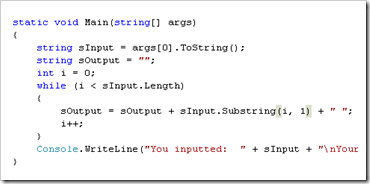

When the loop finishes traversing the user input, the resulting string value is then outputted to the screen and the program exits. This all seems well and good, right? But what if the loop doesn’t properly exit? What if there is no proper break condition accounted for in the loop declaration? Most popular programming languages utilized today have a “for” or “foreach” looping construct which makes it easier to break out of the loop at the proper time, but what if we used a “while” loop in this scenario? In a while loop at the beginning of each iteration a simple test condition is applied which tells the code whether or not to continue in the loop. This test condition must evaluate to “false” when the loop has finally iterated through all the values.


Since the beginning of time, man has pondered the reason for his existence and the justification for his being put on this earth. Though this inquiry can continue forever without a solid conclusion reached, through the submissive hearing process tied to the most authorized of sources we can actually find out the answers. The Vedas, the ancient scriptures of India passed down through an aural tradition, state that the jiva souls, which are marginal in their position, have a choice as it relates to association. They can either remain with pure spirit or with dull matter. Both energies, the spiritual and the material, are eternally existing and part of the Supreme Lord. Yet the material energy is considered a separated expansion, so the personal influence of the original storehouse of spiritual energy is absent. Matter is dull, lifeless, and temporary in its manifestations. Though the energy exists perpetually, the different forms that it takes and the influences that result are anything but permanent. Spirit, on the other hand, is directly tied to God, who is known as Krishna because of His all-attractive nature. The personal energy of God is never subject to destruction, ignorance, suffering, changes, or any type of pain.
“The Supreme Lord said, The indestructible, transcendental living entity is called Brahman, and his eternal nature is called the self. Action pertaining to the development of these material bodies is called karma, or fruitive activities.” (Bhagavad-gita, 8.3)


Though the human mind may not be able to trace out the initial date of its descent from the spiritual sky, the pathway leading out of the suffering of material existence is quite straightforward. One who thinks of Krishna at the time of death makes their choice of spirit over matter well known. The jiva’s wishes are always respected, so when the desire to be with Krishna is sincere, the association with matter ceases. In the absence of this firm attachment to the Supreme Spirit, the wheel of material suffering will continue. Even at the time of death, when the grossly foolish believe everything finishes, the pure spiritual entity, the spark of life, assumes another temporary dress and is thus given a renewed opportunity to play on the temporary playing field known as the material world.


“O son of Kunti, at the end of the millennium every material manifestation enters into My nature, and at the beginning of another millennium, by My potency I again create.” (Lord Krishna, Bg. 9.7)
In the most ideal situation, the wheel of material existence will spin only one time for the fallen soul. One lifetime’s worth of separation from Krishna in consciousness should be enough to set the mind straight. But just as the properly written program must account for all types of input, the wheel of material existence is ready to accept an infinite number of loop iterations, so many that even when the entire creation is destroyed, the wheel starts spinning again when the next creation manifests. Whether a particular jiva only wants one material life to live or millions of them, the hourglass of time must continue to pour its effects of change on the material bodies of the residents of the temporary and perishable realm.
So how do we get out from under the rolling wheel that continually causes us pain? How do we ensure that the next loop condition evaluates to “false” so that we can get out of the spinning wheel? The Vedas, though an intricate set of scriptures that delve into many different topics, are primarily about devotion to God. Indeed, that is the entire purpose behind supreme knowledge, to understand that Krishna is the original proprietor of everything, the greatest enjoyer and the best friend of the living entities. The Vedas and devotional service, or bhakti, are equivalent. In this respect, love of Godhead is even more powerful than the Lord Himself. One who is conditionally situated has to work under the dictates of nature and the wheel of material suffering. But one who is wholly dedicated to Krishna in thought, word and deed is so exalted that even Krishna Himself cannot influence them.


Obviously ascending to this highest platform of Krishna consciousness is difficult, if not impossible, but the jiva souls aren’t required to become the most sublime lovers, just sincere enough to turn their backs on the allures of material life, which constantly attack the open and vulnerable senses of the individual. In the lower species such as the animals, the intelligence is lacking to fight off the urges of the senses. The human being, however, due to its higher potential for knowledge, can take the necessary steps to not only control the senses, but to focus the spiritual consciousness on topics relating to Krishna. Of all the practices recommended by the devotees of the Lord, none is more powerful than the chanting of the holy names, “Hare Krishna Hare Krishna, Krishna Krishna, Hare Hare, Hare Rama Hare Rama, Rama Rama, Hare Hare”. This mantra contains the names of God and His pleasure potency, so the recitation of this sacred formula should never be abandoned or confused with any type of religious practice aimed at providing a temporary fruit. “Hare Krishna” is meant exclusively for the purpose of providing divine pleasure, one that transcends any and all fruits resulting from sense engagement.

When the wheel of material existence continues to roll, the living entities trapped underneath are not in very good conditions. The most debilitating effect of maya is that she continually deludes the jivas who are fully endowed with freedom into choosing matter over spirit. Therefore by regular chanting and adherence to the four regulative principles of abstention from meat eating, gambling, intoxication and illicit sex, the desire of the independent jiva can be altered. Chanting is the most effective method because it gradually brings about knowledge of the differences between Krishna’s three energies and our unique position within the grand scheme. Knowledge is power, and more powerful than knowledge is Krishna. One who has Krishna will never have to be trapped in an infinite loop ever again. Their life’s mission, that of thinking of God at the time of death, will be easily accomplished, thus allowing for a smooth and successful exit from the program of conditioned life.