


To be considered an outstanding philosopher, you have to come up with a new theory or postulate that is not currently in the field. This is what “outstanding” means after all, for if you simply copy what other people are saying how would you distinguish yourself? In the field of self-realization, however, the more appreciated scholars are those who best soak in and describe what they have learned from their predecessors. While the philosopher has to present groundbreaking research or prove a brand new theory that has been painstakingly concocted and tested, the sincere student of a bona fide guru, or spiritual master, just has to show that he has learned from his guru and not deviated from his teachings. Since the subject matter is fully encompassing, there is nothing that needs to be added on, subtracted, shaped, molded, or interpreted. Whoever is fortunate enough to meet such a philosopher – a sincere student who keeps the chain of information transfer rolling on schedule – will be benefitted in every way.
“The word muni means one who can agitate his mind in various ways for mental speculation without coming to a factual conclusion. It is said that every muni has a different angle of vision, and unless a muni differs from other munis, he cannot be called a muni in the strict sense of the term.” (Shrila Prabhupada, Bhagavad-gita, 2.56 Purport)


Living in ignorance is possible, otherwise animals, insects and fish couldn’t survive. Based on the atheist theory, the first generation of mankind would have had to have made observations of the world around them and then steadily built upon that foundation. Yet, based on how we treat our own children, we know that this method is flawed. From the very beginning of life, the young child starts the discovery process. They play throughout the day and find things they have never seen before. Little by little they add on to their knowledgebase.
Would a sane parent allow their child to continue discovering in this way, perpetually? Would they say, “Okay, son, you just go on discovering and noting down your observations. Pretty soon you’ll figure out how to live.” We send children to school to learn higher information, to be instructed on concepts and given tools that will allow them to grow into mature, self-sufficient adults. In a similar manner, the Supreme Lord, the fountainhead of everything, didn’t just leave us residents of the material world without an intellectual support system. He gave us the Vedas, the original scriptures for mankind, which provide guidelines and recommendations on how to make the most out of life. The keepers of the faith were the original spiritual masters, who passed on the same instruction through the hearing process. In this way papers, books and pencils weren’t even required. Simply by hearing one could acquire perfect knowledge.


Since the original knowledgebase is itself insufficient, or at least incomplete, future scientists must do research work and prove their theories that add new points of information. Since the human being, due to the limitations on the gathering of sense perceptions and the short duration of life, can hardly witness anything significant in one lifetime, the opportunities for new research work are endless. One person cannot possibly see all that there is to see, for they couldn’t live long enough to properly take everything in. Indeed, as soon as there is birth, automatically so much of past history is missed out on. Furthermore, even if we were given a guided tour of the universe, there is no way we could remember everything that we saw or even properly understand how everything works. This defect in man indicates that he is inferior to the superior person, the supreme person in charge of creating the nature that He is not even interested in.
“And yet everything that is created does not rest in Me. Behold My mystic opulence! Although I am the maintainer of all living entities, and although I am everywhere, still My Self is the very source of creation.” (Lord Krishna, Bhagavad-gita, 9.5)


With Vedic science, however, the starting point is completely different. Though the Vedas and their different branches don’t take up volumes and volumes of journals that line the library bookshelves, the knowledge necessary for fulfilling life’s mission is presented in full detail and without ambiguity. As brevity is the soul of wit, the greatest poet of them all, Shri Krishna, has nicely condensed brilliant philosophical points and recommendations into short, concise verses that can be sung, remembered and implemented in everyday life. The Vedas are so brilliant that they explain why material science exists in the first place. Every theory of life, every religion to have ever come into existence, and every type of idea that will ever be born in the future is explained in the Vedas, for its knowledgebase is complete.
“…Due to the great variety of desires and natures among human beings, there are many different theistic philosophies of life, which are handed down through tradition, custom and disciplic succession. There are other teachers who directly support atheistic viewpoints.” (Lord Krishna, Shrimad Bhagavatam, 11.14.8)


If the outfit is temporary and the field not meant to be exploited, what is the point to human life? Why are there even varieties in species? Why is there a field? The spirit soul, the essence of individuality, has full freedom in its choice of association and pursuit for enjoyment. Just as no two individuals are exactly the same in their tastes, no two spirit souls will follow the exact same path for enjoyment. Though there is full freedom, the exercise of it generally follows one of two paths. One roadmap lines up with the soul’s constitutional position, while the other does not. Therefore one path is eternal in its manifestation and the enjoyments that result, while the other brings numerous, temporary endeavors resulting in flickering happiness. Since we know that the outfits assumed in the material realm must be renounced at some point, it’s obvious that life on earth represents the latter choice, the one that doesn’t correspond with the soul’s constitutional position.
The very desire to reject Vedic wisdom and accumulate a knowledgebase formed exclusively off of sense perception is itself indicative of the choice made towards following the improper path, the one leading to inferior happiness. At its core, the soul is a lover of God, who is its life partner. When the freedom of association chooses in favor of God, there are no defects in anything, including knowledge. When the choice is made in the other direction, cycles of birth, old age, disease and death result. Imperfect knowledge that needs to be continuously compiled, researched and proven is required. Celebrations over temporary increases in the duration of life and the ability to enjoy occur, while in reality no further progress is made towards fulfilling life’s ultimate mission.


This is easier said than done, however. Concomitant with birth in the material realm is association with ignorance that envelops the otherwise knowledgeable soul. The proper path in the human form of body, therefore, is to slowly but surely dissipate this nescience and return to the original position of desiring to be with Krishna. The more knowledge that is acquired in this regard, the better the chances of being committed to the eternal path of devotional service, or bhakti-yoga. Instead of accepting new research work and showing how you have further advanced the cause of material science, it is more beneficial to simply accept a spiritual teacher, one who has already chosen in favor of service to Krishna.
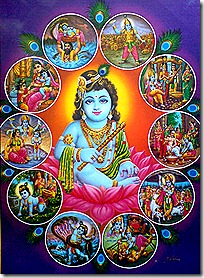

Another factor to consider is that as more time elapses from the start of creation, mankind’s brainpower and adherence to spiritual principles diminish. The field work in spiritual science has already been completed, by those who were much smarter than we are and who lived a life more conducive to contemplation on the Supreme Absolute Truth. The hustle and bustle of city life, the constant struggle to maintain one’s family and bare necessities, greatly inhibits the ability to accept spiritual wisdom and forge a change in consciousness. Nevertheless, simply accepting the foremost recommendation of the acharyas, the regular chanting of, “Hare Krishna Hare Krishna, Krishna Krishna, Hare Hare, Hare Rama Hare Rama, Rama Rama, Hare Hare”, is enough to shift our desires to the spiritual world. At the time of death, the governing body headed by Shri Krishna Himself will see that since our consciousness is fully fixed on God, we obviously took the words of the spiritual master to heart, that we didn’t get distracted by the temptation to supersede the guru’s authority or show that we are smarter than him. Krishna’s welcoming arms reward those who accept without reservation what has been handed down to them.