


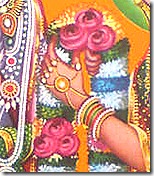
subha dina racyau svayaṃbara mangaladāyaka |
sunata śravana hiya basahiṃ sīya raghunāyaka ||
Goswami Tulsidas herein creates the setting for his poem called the Janaki Mangala, or the auspiciousness relating to Janaki, the daughter of King Janaka. She is also known as Sita Devi, for the good king found her one day while ploughing a field. She came out of the ground and then became his adopted daughter. The day of the svayamvara, or self-choice ceremony, was when Janaka would give her away to a suitable husband. Little did he know that the match would be Shri Hari Himself, the Supreme Lord roaming the earth in the guise of a warrior prince named Rama. From the opening stanza, Tulsidas also reveals the purpose for his composition.


Because of their extraordinarily brilliant qualities, Sita and Rama’s wedding story was well known in the land that Tulsidas lived in some four hundred years ago. Moreover, even during Sita and Rama’s time, the Treta Yuga, which was many thousands of years ago, the sequence of events relating to their marriage was famous throughout the land. The short version of the story is that Janaka held a self-choice ceremony, but it wasn’t as though Sita directly picked her husband. These ceremonies were called svayamvaras, or self-choice, because the groom wasn’t determined beforehand. Many times the princess would get to choose her husband, but in Sita’s case it was a little different. The ceremony still qualified as a svayamvara because the groom would be selected from a host of men vying for the beloved princess’ hand in marriage.
Instead of having Sita choose directly, Janaka decided that whoever could lift an extremely heavy bow belonging to Lord Shiva handed down in his family would be Sita’s husband. In this way the occasion of Sita’s marriage was quite auspicious; the svayamvara itself brought auspiciousness that day to the participants and onlookers, and the winner would gain the goddess of fortune’s hand in marriage.


“Another name for Lakshmi is Chanchala. She does not stay in one place for a long time. Therefore, we see that a rich man’s family sometimes becomes poor after a few generations, and sometimes we see that a poor man’s family becomes very rich. Lakshmi, the goddess of fortune, is Chanchala in this material world, whereas in the Vaikuntha planets she eternally lives at the lotus feet of the Lord.” (Shrila Prabhupada, Krishna, The Supreme Personality of Godhead, Vol 2, Ch 34)
The good fortune that one receives comes from Lakshmi, who is the same Sita. Since Sita is always with Rama, it means that God is the most fortunate person. The goddess of fortune is known as chanchala because she doesn’t stay in one place for too long, but when she is in God’s company, she behaves in just the opposite way. Even if during Sita’s time people didn’t know her real identity, just getting her as a wife was considered a terrific blessing. Aside from being very beautiful, she was Janaka’s daughter. As a king, there was no one more pious or more respected. He had mastery over mystic yoga and was therefore considered to be beyond personal desire. Strikingly enough, he had full affection for Sita, which started on the day he found her. This meant that his attachment to his daughter was not materially motivated; it didn’t break his status as Videha, or bodiless.
“Since he was childless, and due to affection for me, he placed me on his lap and said, ‘This is my child.’ Thus he developed feelings of love and affection for me.” (Sita speaking to Anasuya, Valmiki Ramayana, Ayodhya Kand, 118.30)

The same desire to hear was there in Tulsidas when he composed the Janaki Mangala. In the above referenced verse, he reveals that from hearing of what happened that day, Sita and Rama remain in the heart. In the beginning stages of practicing the highest form of religion, bhakti-yoga, there may be some requirement to follow rules and regulations that are passed on by the instructing or initiating spiritual master. Perhaps one forces themselves to chant mantras like, “Hare Krishna Hare Krishna, Krishna Krishna, Hare Hare, Hare Rama Hare Rama, Rama Rama, Hare Hare”, and abstain from sinful activities like meat eating, gambling, intoxication and illicit sex. This is all done to train the devotee on how to forge the proper consciousness, to be able to relish a higher taste in the future.
Once immersed in God consciousness, the devotee feels intense loneliness when not able to think about God and His activities. Therefore refuge is sought in outlets like hearing and reading books, for they help to alleviate the pain of separation. In even more extreme cases, the person will try to recount the Lord’s most notable pastimes within their mind. Expressing these thoughts down on paper is a great way to recreate the actual events, to bring to life the characters and their qualities. By mentally going back to that day of the auspicious svayamvara, Tulsidas wanted to bring Sita and Rama to his vision and keep them in his heart, a place where they would feel right at home.


It should be noted that during Rama’s time on earth, the Lord enacted many wonderful pastimes. The original accounts of these activities are given in the Ramayana of Valmiki. With so many important events in Rama’s life, why would Tulsidas choose to dedicate a specific song to the Lord’s wedding ceremony? For starters, who doesn’t enjoy a good love story? The plotline has been played out in movies and dramas since time immemorial, and with Sita and Rama we got the original love story, one which showed how transcendental love operates. As part of a play perfectly performed on the stage of real life, the setting was such that it looked like no one was going to win Sita’s hand in marriage. Many kings came to the scene, but none of them could even move the bow, let alone lift it.


The attention paid to this aspect of Rama’s life was well worth it from the poet’s perspective. It gave countless generations of sincere souls the chance to further discuss that day and sing about the glories of its main participants. As man is given to glorifying someone, why not direct that attention to the people most deserving of it? As Sita is the goddess of fortune, those who hear of her self-choice ceremony in the proper mood will gain the greatest fortune in life: Sita and Rama residing within their heart.
In Closing:
The poet to embark on writing marriage story,
Of Sita and Rama, endowed with every glory.
The self-choice ceremony held on a good day,
Auspiciousness with listener to stay.
Man to love stories given to hearing,
Which in mind creates visions worth seeing.
Apply same technique but to the Supreme Lord,
Reservoir for divine service in heart is stored.
Story of wedding where Rama did win Sita’s hand,
Was so known to everyone across the land.
Yet still Anasuya to hear it again wanted,
Love for divine couple in her heart implanted.
To have Janaki and Rama in his vision,
To write song Tulsidas made the decision.
Svayamvara is where the story does start,
Hearing of which Sita and Rama stay in the heart.