


Take the largest object you can imagine and then try to keep in mind its size. This exercise is a little difficult considering the fact that there are land masses so great in scope that you can’t appreciate the impression they make unless you have a bird’s eye view from an airplane or other vehicle flying high above. Not until you see something with your own eyes can you be truly awe-inspired. This explains the purpose for sight-seeing, travelling to landmarks and world wonders to see the scenes in question for only a few brief moments. The experience doesn’t last long, so one might even say that it is easier to just look at the same scenes in pictures, for in either case the association with the object will be temporary. But we like to experience awesome things in person so that their wonder can truly make an impression.


The wonder of space is noticed by the size and scope of physical objects, but there is also time. Look at old pictures of yourself and you can’t imagine how strange the time period shown in them was. Then see and hear about the period of time on earth prior to your birth. Again, the feelings are strange. “What did people do back then? What a great time it must have been? I would love to go back and live through that.” While it may seem interesting, the recent past, perhaps one hundred years ago, is nothing in comparison to the infinitely large time factor. It operates in both directions: past and future. Think of the environment around you right now. In one hundred years everything will seem strange to the people living on earth. They will yearn to travel back in time to what you consider the present.
Take the full breadth of time and space and you get a slight idea of Lord Krishna’s position with respect to the world. As the Supreme Personality of Godhead, Krishna is unmanifest. This means that from our perspective we cannot see how large and pervasive His energy is. It is said that the deity is the authorized object of worship for the fallen souls in the material world. The deity is made of earthly elements, and through authorized procedures it can accept the obeisances of those looking to see God and connect with Him. The deity is but a small replica of Krishna’s features. Say that the worshipable statue is one foot tall. Does this mean that Krishna is so short? Does this mean that we’re taller than Krishna? In actuality, the Lord is so tall that we could never find enough materials to dress Him properly. His transcendental belly has so much room that we could never properly fill it with sumptuous food preparations.

The Bhagavatam also touches on Brahman and its features, but as it is a bhakti-shastra, it spends more time describing the source of Brahman, Lord Krishna. Despite the fact that He is unmanifest, in His original feature God is still a person. His personality is indescribable; hence the common use of the term “neti neti”, meaning “not this, not that”, in the Vedas. If you took a label maker and went from object to object and noted its relation to the Supreme Absolute Truth, you would have to label everything as “Not God.” After all, how can even the sun, which is composed of the material element of fire, be considered beyond duality? Something which is created must be destroyed, thereby indicating that it is subject to the influence of time and space.
Krishna, on the other hand, is not bound by any force. Time never touches Him, as His spiritual body is always blissful and knowledgeable. He holds a flute in His hands and dazzles the ears of the liberated souls who take their only wealth in life to be Krishna consciousness, the steady stream of transcendental thoughts that can constantly flood the mind through recitation of the holy names, “Hare Krishna Hare Krishna, Krishna Krishna, Hare Hare, Hare Rama Hare Rama, Rama Rama, Hare Hare”.
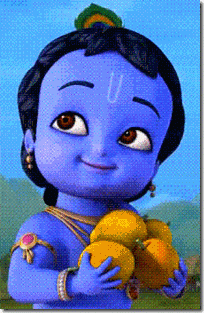
The inconceivably brilliant Krishna appeared on earth in the form of a human child, one that looked like it was subject to birth and death like everyone else. A child is the dependent of the guardians, be they parents or other elderly figures. As a child can be controlled by a loving guardian, so Krishna could be tied to a mortar by His mother, the sweetheart Yashoda, the wife of the king of Vraja, Nanda Maharaja. This incident was so cherished by the reciter of the Bhagavatam, Shukadeva Goswami, that in the shloka that presented it the juxtaposition to Krishna’s all-pervasive and beginning-less and endless position was made.


Krishna is the Supreme Father, so to allow for loving exchanges He agrees to play the part of a naughty child who needs to be punished for His transgressions. The ropes used by mother Yashoda were never long enough, as Krishna retains His amazing features even when in the form of a child. Therefore devotees rightfully look at the deity with the utmost respect. Though in the form of a statue made of resin, wood or stone, the deity is non-different from Krishna. It accepts the offerings of flowers, food and water made to it and returns them as prasadam, or the Lord’s mercy.
The rope became long enough once Krishna allowed it to be. The significance of the incident with mother Yashoda cannot be discussed enough. The beautiful Shyamasundara was more than just intentionally captured by Yashoda’s ropes of loving affection. Shri Krishna would do anything for His devotees, regardless of the time or circumstance. If someone’s only desire is to connect with God in pure innocence, why would the most powerful person deny their request? He will go out of His way to do whatever it takes to please them, even if it means transgressing the social standards He instituted as part of His Vedas. The rules are meant to bring one to Krishna after all, so someone who is already there need not worry about self-realization. We don’t see any mention of Yashoda’s having viewed her son with awe or reverence. She did not sit in meditation or study Vedanta. She had no interest for understanding Brahman, but from her sincerity of purpose, she got to love God without inhibition.


The loving spirit of devotion is best felt through separation, though we may not be fond of this method. Yashoda bound Krishna that day to the mortar, but eventually the Lord would have to be set free and then leave Vrindavana completely. Never to fear, though, as through reliving His pastime and chanting His holy names, that same butter thief can be bound up and remain in our consciousness forever. He can leave anytime He wants to, but since He is won over by pure love, He makes the heart and mind of the devotee His most comfortable residence.
In Closing:
As He has no end and no beginning,
His greatness there is no measuring.
Adhokshaja means His presence cannot measure,
Unmanifest also is Vrindavana’s treasure.
Yet from Yashoda He could not hide,
With ropes of love to mortar she tied.
That He let her only way to explain,
His loss in chase was mother’s gain.
Chant holy name with faith and confidence,
So in your heart Shri Krishna to make residence.