


athavā enam samutkṣipya upari upari sāgaram ||
rāmāya upahariṣyāmi paśum paśu pater iva |
With ancient texts that are written in the Sanskrit language and have descriptions of talking monkeys and seemingly ordinary human beings with extraordinary fighting prowess, the tendency to look for symbolism, to extract hidden meanings out of verses instead of actually just reading the texts and taking the explanations as they are given, is understandable. We have never seen a talking monkey, let alone one who is adept in mystic yoga. The greatest long jumpers in the world still can’t jump very far, certainly not far enough to cross over a massive ocean after launching from the top of a mountain. Shri Hanuman, however, did amazing things like this, and up until this point in his journey in the enemy territory of Lanka he had yet to show all of his capabilities. What was to come next would be more amazing, as simply with his tail he would lay waste to the entire opulent city. In the above referenced verse, we see that there is no need to strain to find symbolism, as the Vaishnava has the poetic ability to make such comparisons on the fly with their own thoughts. Their love for the Supreme Lord permeates every one of their activities, including their thinking.
A Vaishnava is simply a lover of God. Why the specific term then? The personal style of worship is preferred to all others because it best extracts the recessed emotions of the conditioned living entity trapped in an ever-changing body roaming a land where misery is guaranteed. How can we say this? Isn’t the birth of a new child a joyous occasion? What about graduating from school? How can there be misery in these events? If we look more closely, however, it is seen that the temporary elation at the beginning is followed by the strongest type of separation pain. The joy of birth is tempered by the sadness of death. The wonderful sense of accomplishment resulting from completing four years of college or twelve years of school is paired with the anxiety of having to look for a job, one that matches the field of study and expectations for self-satisfaction of the job-seeker.
“For one who has taken his birth, death is certain; and for one who is dead, birth is certain. Therefore, in the unavoidable discharge of your duty, you should not lament.” (Lord Krishna, Bhagavad-gita, 2.27)


How do we know that there is a loving propensity? The desire for pleasure drives every single activity. And we also see that the more one satisfies their own senses, the less happy they are. The wealthiest moguls in the world eventually turn towards philanthropy for this very reason. They have seemingly accomplished everything in life, but they don’t have satisfaction of the soul. Since they don’t know about the source of individuality, the presence of duality in every venture, and where to properly direct their service, they seek to please the senses of others through opening hospitals, schools and charitable organizations.
In addition to the behavior of philanthropists, the evidence of the spirit soul’s loving propensity is seen in the interaction with pets. The dog is adored because it offers unconditional love. It will never mature to the point that it will cause distress by using harmful words. It accepts whatever love you offer it and only asks to be cared for in return. The more you care for it the happier you will be. Though such outlets for the loving propensity seem harmless enough, guaranteed still is the endpoint to the service, a time when you will no longer be able to offer your love.
This property is not present in service to God. Hence the foremost occupational duty of the soul is referred to as sanatana-dharma, or the eternal occupation. Loving God is not something done in just one lifetime, and neither is it reserved for a specific class of individuals. As the soul is brimming with this potential for offering unadulterated love, when the qualities of the worthiest recipient are known, the potential can be met. A Vaishnava is one who understands that God is a personality, a spiritual entity with qualities that cannot be properly understood or described. Nevertheless, the qualities are honored, remembered and used for comfort. For example, in His spiritual manifestation as Lord Rama, God’s qualities of kindness, chivalry and dedication to protecting the innocent are remembered by the Vaishnavas.


Hanuman was chosen to go to Lanka for many reasons, the most important being his enthusiasm for service. It is often seen that young children have enthusiasm for doing things that the adults have either grown tired of or simply don’t want to do anymore. If a son or daughter is eager to go out and get the mail on a particular day, the parent will gladly allow them to do so. This takes care of the task of bringing in the mail and also allows the loving propensity in the children to be acted upon. For God, there is nothing He can’t do. He could rescue the entire world in one fell swoop. For instance, Lord Chaitanya, the preacher incarnation of the Supreme Lord, roamed the sacred land of Bharatavarsha some five hundred years ago and converted countless people to the bhakti cult. By conversion we refer to the transformation in worshipable objects. Not that they were changed from one religion to another; rather, instead of being religionists in name only who were engaged in material activities, the people Lord Chaitanya preached to were converted into following the real religion, devotional service.
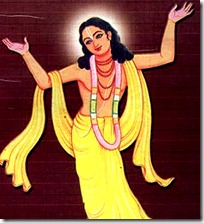
How did Lord Chaitanya preach this message? He asked everyone to simply chant Krishna’s holy names. Krishna is the same Rama, or God, but in His Shyamasundara form, the attractive youth with a bluish complexion holding a flute in His hands. The sacred maha-mantra, “Hare Krishna Hare Krishna, Krishna Krishna, Hare Hare, Hare Rama Hare Rama, Rama Rama, Hare Hare”, was Lord Chaitanya’s favorite slogan, His life and soul. He and His associates would sing it out loud and ask others to join in on the fun.

Hanuman, having the odd form of a forest dweller, was very anxious to act. Therefore Rama, through the proxy of Sugriva, the king of monkeys in Kishkindha, gave him the task of finding Sita’s whereabouts and returning to the camp with the information. Sort of like a scavenger sent to find the enemy, Hanuman was sent off with a singular purpose. Because of his divine qualities and his unmatched love for Rama, he eventually made his way to Lanka, searching practically every inch of space within for Sita.
But when he didn’t find the princess of Videha, he grew despondent. He even contemplated starving himself to death, as he could not bear to cause pain to his friends and family back home by telling them he had failed. Through enough sober thought, however, he was able to turn the tides. In the above referenced verse, we see that instead of feeling sorry for himself, Hanuman was determined to get revenge. “Why am I going to wallow in pity over something that’s not even my fault? Ravana is the one who took Sita. Therefore he should be the one to pay. As I have tremendous powers, I should be the one to deliver that punishment to him.”
It should be noted that this was not the task assigned to Hanuman. He was well aware of the fact that he could destroy Ravana in a fair fight, as he would actually note this many years later in a conversation he would have with his half-brother Bhima, one of the five Pandava brothers. Yet his wanting to punish Ravana was simply an outgrowth of his love for Rama. In this particular verse, we see a wonderful comparison made by Hanuman to illustrate what he would do to Ravana. Hanuman here says that he will grab Ravana and forcefully take him across the ocean and back to Rama, as an animal is brought before Pashupati, which is another name for Lord Shiva.
Lord Vishnu is considered the deity of the mode of goodness, which is the highest mode of material activity. Activities in goodness are meant to further knowledge. Think of pious behavior and good deeds, those things which aren’t sinful. These constitute the mode of goodness. Lord Vishnu is actually above the mode of goodness, so one who worships Him properly engages in bhakti, which carries no reactions in karma, either good or bad. As eating is one of the primary engagements of the living entity, if food can first be offered to Lord Vishnu before eating, the resultant items are known as prasadam, or the Lord’s mercy. Vishnu is the same God that the pious souls worship, except He is the personal form known only to the Vaishnavas.
“If one offers Me with love and devotion a leaf, a flower, fruit, or water, I will accept it.” (Lord Krishna, Bg. 9.26)


Lord Rama, being Vishnu Himself, obviously doesn’t accept animals in a sacrifice, but the comparison is made nonetheless to show Hanuman’s poetic qualities and his knowledge of the Vedas. Certain worshipers of Lord Shiva do offer him meat, as he is known as the lord of animals. Pashu can also refer to human beings, so Pashupati can also mean the protector of human beings. Lord Shiva is in charge of the mode of ignorance, the lowest rung of activity. Even the most sinful men in society are not denied religion in the Vedas. They are given a regulative system to follow that will hopefully provide advancement in consciousness.


His desire to offer up Ravana was always there, for he couldn’t help but want to please Rama in that way. Rama is never disappointed in Hanuman, for who could be angry at someone who acts out of pure love? Among other things, Hanuman is poetic, for he knows how to describe his actions using comparisons. Though he uses symbolism, his identity, his personal self, and his place in the famous Ramayana are real, and anyone who takes advantage of this will be forever benefitted.
In Closing:
On Ravana Hanuman wanted to get revenge,
Abduction of beautiful Sita to avenge.
Trouble in finding, now what to do,
Why get away, the evil king should pay too.
Perhaps pick up Ravana and go ocean across,
Like animal to Shiva, in sacrifice toss.
These options constituted Hanuman’s thoughts,
Did not want effort in search to go for naught.
Success to find because desire was right,
Located Sita to the eyes most pleasurable sight.