


Alright, it’s your time to get back at someone. They wronged you in the past, so you can’t wait for them to get theirs. They’ve had it coming too. They thought they would get away with their horrible behavior, the insults they threw your way, and the overall ill humor they showed to others. But now is the time for payback. And oh will it sting for them. And then you’ll be happy, no? Since they are meant to feel the misery, their pain will make you feel better?
The saints on the highest platform of transcendental knowledge don’t think so, and due to their intimate familiarity with the true properties of the individual, they tend to view things in the opposite way. They instead pity the fool for his mistakes, for the negative reaction rightfully due them will cause harm that could have been avoided. The saint thinks, “Why did they act this way? If they only knew about karma they would have avoided so much trouble for themselves. They insulted me, that’s for sure, but I too have done so many bad things in the past. In fact, you can’t count my sins; it would take too long. I have been quite fortunate actually, for I have still been favored by the most munificent Supreme Personality of Godhead. He should have given me more trouble, but I have been spared for some reason.”
Sentiments like these are found in Goswami Tulsidas’s Vinai Patrika. The famous Vaishnava poets are known for being extremely humble, and while it is easy to downplay one’s own achievements and personal qualities, in the case of the saints they really do think that they have not done that much. Tulsidas, a famous devotee of Lord Rama, says that his sins are too long to count for Yamaraja, the god of justice. There are so many gods in the Vedic tradition, and they each have a specific role. We create so many gods in our societies, large and small, and we do so on the basis of the ability to control a certain field.
The devas, or gods, defined in the Vedas are heavenly figures who actually do manage the creation. Yamaraja delivers justice to those who are deserving of it. Similar to a list of naughty and nice, Yamaraja has a scroll containing each person’s deeds, pious and impious. We see the negative reactions to our work in our own life, and sometimes they arrive much after the fact. They come at the proper season, though, like the flowers that blossom on the trees. The reactions also correspond to the original act in severity.


When the saint is that humble, how are they going to wish for revenge on others? They know that they have been spared personally due to the direct intervention of God, so their wish is to have the same fate for others. Another person who showed supreme humility was Prahlada Maharaja. When he was five years old his father Hiranyakashipu tortured him so much. And what was the boy’s crime? He simply worshiped Vishnu, which is another name for God. Day and night, Prahlada thought of no one else. He boldly preached about bhakti-yoga to his classmates during recess. He was not worried about what others thought of him, all the way up to his father, who was the most powerful king in the world at the time.
Hiranyakashipu’s anger at Prahlada eventually reached a boiling point, and so the father then tried to kill his son. The methods attempted were quite vile, but through remembering Vishnu Prahlada survived each attack. Finally Vishnu arrived on the scene in a strange yet terrible figure of a half-man/half-lion. He took Hiranyakashipu on His lap and then proceeded to tear him in half; a most cruel death delivered to the cruelest father in history. Prahlada should have been thrilled, no? “Yeah, my father finally got what he deserved! Good riddance.” But actually the boy wished for his father to be absolved of all sin. What room for hatred did Prahlada have anyway? He was going to continue his worship of God, who is full of bliss and knowledge, so the satisfaction from revenge couldn’t find residence in the boy’s consciousness, which was infused with transcendental pleasure day and night.
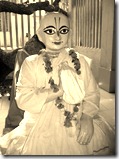
Yet he survived just like Prahlada by thinking of God the whole time. Afterwards, the people who had beaten him suffered in so many ways. But Haridasa did not feel any satisfaction from that. Rather, he pitied them for their original mistake. When an ignorant person does something stupid like place their hand into a fire, should we be pleased when the resulting burn arrives? Even if such a person didn’t listen to our warnings, still the burn inflicts great pain. Why would we wish that on someone else?
The perceived satisfaction from revenge is also limited by the time factor. If there is a superstar basketball player who suddenly jumps ship and joins another team specifically in search of a championship, the fans of the other teams might not be so happy. Therefore they will watch the games of the upcoming season in hopes that the “traitor” player doesn’t win their desired championship. The player can go all the way to the final round of the playoffs with his new team, only to lose in the end. There is of course some satisfaction for the many fans that rooted for his failure, but what will happen after that? The satisfaction lasts for maybe a day or two, but what to do later on? Life must be lived after all, and so some other outlets of attention must be found. In all likelihood someone else will be hated and their failure will be eagerly anticipated; thus repeating the cycle.
But from the example of the saints know that the life force inside is meant for positive action. What need is there for envy when every one of us is fallible? We had no control over where we took birth and we have no idea when the precise moment of death will arrive. Only the Supreme Lord is the most powerful, and thankfully He is also the most merciful. He makes devotion to Him the one practice that can be implemented in the most number of places. Prahlada practiced devotion while being thrown off a cliff. Haridasa Thakura remembered God while being whipped in the back. Just imagine then what can be done during times of peace, those times where we otherwise pray for revenge, a payback which is guaranteed to arrive regardless just based on the laws of karma.
In Closing:
I can’t wait for their payback,
For karma’s forces to attack.
The pain and misery they deserve,
For having into sinful life swerved.
But revenge not all it’s made to be,
From pain of others little pleasure to see.
Prahlada and Haridasa showed forgiveness,
Pitied others for their ignorance and haughtiness.
Life to serving God saints devote,
For their association may we all hope.

