


“Should I live in Vrindavana? I heard that Shri Krishna, the Supreme Personality of Godhead, perpetually remains there. He plays with the damsels of Vrajabhumi, calls out to the calves under His protection, and plays His flute to the delight of the forest animals such as the deer, birds and parrots. Though there is the Vrindavana of the spiritual world, in the Vaikuntha planets, there is the Vrindavana in this earthly realm as well. And even though one can’t see Krishna directly with their eyes, they feel His presence there nonetheless. In fact, through living there long enough and staying immersed in bhakti-yoga, one actually can see Krishna, while others cannot.”
“Should I read the Bhagavad-gita every day, trying to really understand the key verses, or should I move on to other Vedic texts like the Shrimad Bhagavatam, which are longer and thus more detailed? I’ve heard that the Bhagavad-gita is for beginners and that the Bhagavatam is for the more advanced. The Bhagavad-gita is a summation of Vedic teachings, which are the oldest known to man. They predate man himself, who took birth from the Supreme Lord after He decided there would be a creation. There is the total material substance, known as the mahat-tattva, and Krishna impregnated it in order to generate the population. The spirit souls existed before that impregnation, they exist now, and they will continue to exist in the future. That is the true meaning to eternal.”
“The total material substance, called Brahman, is the source of birth, and it is that Brahman that I impregnate, making possible the births of all living beings, O son of Bharata.” (Lord Krishna, Bhagavad-gita, 14.3)


Issues similar to those mentioned above exist with any type of spiritual practice. Should you be advancing to a different destination or should you remain where you are, content in your practice? Indeed, there are qualities one assumes when they take up devotional life, as it is inherently different from material life. The summit of material life is sexual relations. The famed “rock n roll” lifestyle involves drugs, drinking and partying, but the end-goal is always sex. The rock stars can get any woman they want, and thus they are envied by others. Yet this never provides lasting happiness, as even the most hedonistic rockers grow tired of such activity; at least in the case of those who become wiser as time goes by. In spiritual life, one sees everything properly, and an indication of the change is the shift in desires, wherein what one previously thought was important no longer remains so.
Surely there is a need for measuring progress, for gauging the effectiveness of practices in genuine, non-sectarian religious life, but this doesn’t necessarily mean that there are absolute requirements as they relate to the book of study or the place of residence. Indeed, such insistence goes against the very nature of the person being worshiped. By definition, God is all-pervading; so His residence is not exclusive to just one area. He has multi-forms, a truth described as ananta-rupam in the Brahma-samhita, a wonderful set of prayers offered by Lord Brahma to Krishna. Brahma is the original creator, the person everyone can trace their ancestry to. If you don’t believe in his existence, you can still accept the fact that there is an original creator. Since every person has a mother and father, there is always a higher link to ascend in the chain of creation. When you reach the original, you have your creator, who is known by the name Brahma in the Vedas.
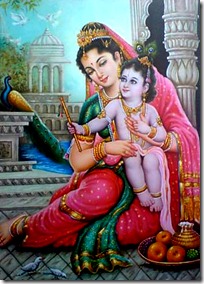

In addition to the land of Vrindavana, the holy name is non-different from God. This is a radical concept that one has great difficulty believing. Not to worry, though, as we can keep chanting the holy names, “Hare Krishna Hare Krishna, Krishna Krishna, Hare Hare, Hare Rama Hare Rama, Rama Rama, Hare Hare,” to see if the claim has merits. If you’re not sure after chanting a few times, keep on repeating the formula. The fact that so many people chant this mantra regularly, sometimes singing it for hours on end each day, proves that there is something special in the component words.
Think of your favorite song in the world. For starters, you would have difficulty making this identification, as your tastes change over time. And within a certain time period a specific song may grab your attention more than others. Nevertheless, let’s say that you could pick one song that you couldn’t live without. Now try playing that song over and over again during the day. Do that again day after day. Would you not get sick of it? For a better analogy, try just memorizing the lyrics and reciting those over and over again. This way you’re not getting sick of the tune. Would that suffice? Do you know of any person who does such a thing?


The power of the holy name shows that it is sufficient for proper bhakti-yoga practice. The tulasi plant, who is a pure devotee of God, can also be chanted in front of in an isolated area. Such a simple life is enough to bring spiritual advancement. Residence in Vrindavana, study of a specific famous work, and thoughts of Krishna’s pastimes are also bhakti-yoga, and they may result from chanting the holy names, but never are such things an absolute requirement. If they were, then the holy name would be deficient, as it wouldn’t completely represent God. But it most certainly does, and so it makes for the best and most efficient way to remain connected in spiritual life, bringing all good things to the person who honors it and fully depends on it for their sustenance.
In Closing:
For my spiritual intelligence to feed,
Residence in Vrindavana do I need?
If to read Bhagavatam book I get the chance,
Should I scrap Bhagavad-gita to advance?
Actually for from ignorance to be set free,
All that is needed is holy name and tulasi tree.
Try lyrics of your favorite song to daily chant,
And keep the spark of interest alive you can’t.
With holy name the same defect not to exist,
Wisest saints in path of chanting persist.

