


Download this episode (right click and save)
Vedic philosophy introduces the concept of liberation, which is a little different from salvation. There are too many sins to account for in a material existence. Even if we try to be nonviolent by not eating meat and respecting all forms of life, we still accidentally kill so many living things. Walking on the grass is an example.
There is the famous line from American history that George Washington never told a lie. Obviously, this is not true, as every person has at least misrepresented the truth at some point. To err is human, after all. Vedic philosophy is so nice that it puts the defects of man into four categories. Man is deficient because he commits mistakes, cheats, has imperfect senses, and is susceptible to illusion.
The greatest illusion is the idea of becoming supreme, Ishvara. This is a desire to compete with the real top boss. The state of conditioned life, also known as bondage, also known as suffering in the cycle of birth and death, results from succumbing to this illusion. The desire to enjoy separately from Ishvara the person is the original sin, if you will.
Salvation is a kind of atonement, being saved, but since there are so many other mistakes committed, salvation is a renewing process. Liberation is something entirely different. It is the elimination of the root problem. When a person no longer wishes to compete against God, there is release from the cycle of birth and death.
Liberation is the end of conditioned life, and it also signals the beginning of something else. That something is blissful. It doesn’t have to end, either. It is pure enjoyment, received through the individual’s dharma, their essence. The experience is not uniform, either. Each person can enjoy in their specific mood of choice, as they are in the company of the Supreme Lord. Since He is all-attractive and a distinct personality, He is known as Krishna.
1. Watch and appreciate Him
Time operates constantly. Its effects are noticed through changes. The changing of days, involving the calendar, occurs through time elapsing. The real change is not through mere seconds ticking; we see the sun rise in the morning. The seasons are an indication of a larger collection of changes.
With regards to peace, a person is at a tremendous advantage if they can forget about time. This seems impossible with the many responsibilities of modern-day life, but we get an idea from the spiritual world. Time exists there, but it has no effect. This means that a resident can continue to appreciate the proprietor without ever having to stop.

2. Offer service
Another way to pass the endless time in the spiritual world with Krishna is to offer service. If He needs water, you can fetch it for Him. If He requires transportation to some place, you can provide that as well. Whatever Krishna needs, you can offer some assistance. He is the Supreme Lord, so He is actually atmarama. He is fully self-satisfied. He is the master of mystic power, which includes prapti, which is the ability to get whatever you want at any time. Still, Krishna is so kind that He allows others to feel the enjoyment of dasya-rasa, or the mellow of transcendental service.
3. Be His friend
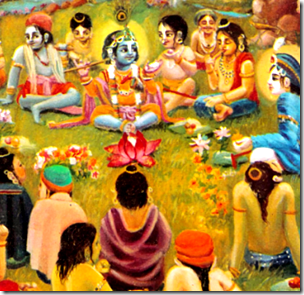
There is a simple test to determine if someone is your good friend or just a casual acquaintance. Can you make fun of them? Can you jest with them in such a way that they won’t get offended? If so, then the person is a friend. At the core, friendship develops through a shared interest and among equals. It’s difficult to become friends with my parents or grandparents, since they do so much for me. They are older and wiser, so it would be offensive to make fun of them.
4. Be His caretaker
Shri Krishna is nava-yauvanam. This means that His physical appearance is always like that of the person who has just become a teenager. The word nava means “new.” Though God the person can take any form He chooses, He is never old. His capabilities never diminish, and He is not bitter towards anyone. He is always enjoying, such as mentioned above with His friends and admirers.

5. Dance with Him
Any association with Krishna the person qualifies as liberation. It brings immunity from the cycle of birth and death, and there is full bliss experienced at every moment, while the ineffectual time continues to elapse. Relatively speaking, though, madhurya-rasa is considered the topmost interaction with the all-attractive Krishna. This is the mood of sweetness. It involves real love, known by such terms as bhakti and prema.
These terms don’t have adequate equivalents in the material world. Love as we know it is really lust, or kama. This kind of love has limitations, and it is always checked. Real love can never be stopped, and it is unmotivated. In prema there is no divorce. It is not dependent on reciprocation. Through this definition, we see that prema can only be offered to the Supreme Lord. Every other kind of affection and adoration is a derivative of prema.
One of the activities in madhurya-rasa is dancing with Krishna. The cowherd girls of Vrindavana, known as the gopis, do this with Krishna. They experience transcendental love with Krishna, who holds them very dear. The topmost gopi is Shrimati Radharani, who is actually the feminine aspect of the Divine. Radha and Krishna are two sides to the singular Divinity.
From the five rasas we see that there is endless and renewed opportunity to enjoy in the spiritual world. Central to that enjoyment is the association of Krishna. Time passes blissfully for the person who has achieved liberation, which is the objective of the precious experience offered in the human species.
In Closing:
Atonement for sins is salvation,
Root cause removed in liberation.
To the spiritual world then to go,
Where only Shri Krishna to know.
In shanta with distance appreciative to be,
Also servants and good friends there to see.
Parents for Him loving and caring,
Gopis dance while into His eyes staring.