On a material level, every living entity has certain qualities that they inherit at the time of birth. There are generalities that are attached to each body type, but pure devotees of God transcend these qualities.
At its core, the living entity is a spirit soul, or jivatma. The jivatma is equal in quality to God, but different in quantity. For example, the jivatma can only exist inside one body at a time, while God exists everywhere in His impersonal Brahman expansion. Higher than Brahman is Paramatma; this is God’s expansion as the Supersoul residing in the heart of every living entity. Thus God is conscious of the activities of every living entity, whereas we are only conscious of things relating to our own body. The other difference between us and God, is that God can never be controlled by material nature. He is the Creator after all, so how can one of His energies be superior to Himself? The jivatma, however, is subject to the control of material nature which forces it to repeatedly accept new bodies after death. The actual type of body the jivatma is placed into depends on guna and karma. Gunas are material qualities or modes: goodness, passion, and ignorance. Every material activity can be classified into one of these three modes. Karma is fruitive activity, or work. Qualities and desires determine what type of body we receive at birth.
Though the gross material body is subject to creation and destruction, it nevertheless exists for a set period of time. The length of time the soul spends inside the body is known as one’s lifetime. Guna and karma fructify in the type of body we receive, meaning the body itself has certain qualities that it inherits. For example, the animal species are prone to certain activities which human beings would never think of doing. A hog loves to roll around in mud, eating stool. The dog loves to have sex as often as it can, not having any discretion in picking a mate. A dog doesn’t even proposition other dogs, but rather takes to sexual activity in an aggressive manner. Monkeys behave similarly. They love to run around, making noise, and they too are known for their insatiable appetite for sex. In fact, some people have even tried to acquire the sex glands of monkeys through surgical means, all in hopes of enjoying sex life to the fullest extent.


“Whatever state of being one remembers when he quits his body, that state he will attain without fail.” (Lord Krishna, Bhagavad-gita, 8.6)
Lord Krishna, the Supreme Personality of Godhead, has definitively declared that one’s consciousness at the time of death determines their fate in the afterlife. This consciousness is developed over the course of our current lifetime and also previous ones. For example, if we engage in unrestricted sex life during our lifetime, we are more likely to think of sex at the time of death. The laws of karma are extremely fair, so the result will be that we will likely end up in the body of a dog or a monkey in the next life.
“The living entity in material nature thus follows the ways of life, enjoying the three modes of nature. This is due to his association with that material nature. Thus he meets with good and evil amongst various species.” (Lord Krishna, Bg. 13.22)


Sex is considered the highest form of material sense gratification. This is the primary reason for the living entities coming to and remaining in the material world. Wanting to falsely enjoy nature themselves, the living entities are allowed to take birth in various types of bodies. To allow human beings to enjoy sex, God created two genders, male and female. One is the dominator and the other is the dominated. Because of this, there are inherent qualities exclusive to each gender. Males are generally stronger, while females are weaker and thus known as the fairer sex. As far as attraction for a mate goes, women are generally drawn towards men of power and strength. The phenomenon of groupies is an outgrowth of this trait. Rock stars and other famous celebrities have no trouble finding beautiful female sex partners. Usually they have trouble limiting themselves to only one woman. Hollywood actors are always jumping from one girl to another, with divorce being quite common.
“Oh Rama, since the beginning of creation it has been the nature of women to stand by their husbands during good times, and to abandon them during adversity. Women imitate the insatiability of lightning, the sharpness of weapons, and the celerity of Garuda and the wind. But Your wife, Sita, is devoid of all these faults and, just like Arundhati Devi, she is worthy of being glorified. (Agastya Muni speaking to Lord Rama, Valmiki Ramayana, Aranya Kand, Sec 13.5-7)


On one particular occasion, Lord Rama was ordered to renounce ties to His kingdom of Ayodhya and live in the forest for fourteen years. Rama was the eldest son of the king of Ayodhya, Maharaja Dashratha, and He was next in line to be king. Due to His exalted status, both Rama and His wife lived a life of complete luxury. Rama was awakened every day to the chanting of Vedic hymns and the beating of mrdanagas. By renouncing the kingdom, Rama instantly went from being a prince to a pauper. As Agastya points out, Sita was free from any defects born of her gender. During this tumultuous time, she stood by her man with great courage and strength. Rama asked her to remain in the kingdom, but she steadfastly refused.
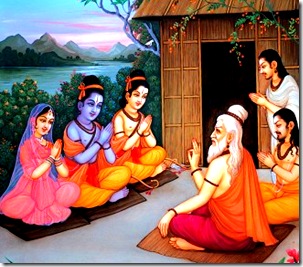
Forced to take His young brother Lakshmana and Sita with Him, Rama traversed the forests of India. He used the exile as an opportunity to visit all the great sages who had set up hermitages in the woods. Agastya was one such sage, and a very exalted one to boot. Upon meeting Agastya, the group all bowed before him and offered their humble obeissances. Agastya was quite astute however, and He knew full well Rama’s divinity. Amazingly, upon first meeting them, Agastya immediately took to praising Sita. This means that Sita’s devotion to Rama was well known throughout the world at the time.
“O son of Partha, those who take shelter in Me, though they be of lower birth-women, vaishyas [merchants], as well as shudras [workers]—can approach the supreme destination.” (Lord Krishna, Bg. 9.32)