


As soon as a child is born, the discovery process begins. Infants love to look around and take in the new world they have been placed into. They quickly discover activities which they find enjoyable. When visiting the homes of parents with young children, it is very common to find a playroom full of toys and other such things. The child is usually quite happy in this room. While the children play, the parents get a much needed break and are able to take care of other household responsibilities. If the child could, it would play the entire day, but we see that is not the case. Good parents, mothers in particular, institute rules and regulations that the children must follow. They must wake up at a certain time, eat at certain time, and go to sleep much earlier than the parents do. These rules and regulations represent real love, for the parents’ aim is to increase the child’s enjoyment of life.


When children get older, they love to go out and play with their friends. When Lord Krishna personally appeared on earth around five thousand years ago, He enjoyed many such childhood pastimes in Vrindavana. Growing up under the care of His foster parents, Nanda Maharaja and Mother Yashoda, Krishna would go out and play with the other cowherd boys of Vrindavana every day. They did all the typical things you would expect children to do. They ran around, wrestled with each other, and even went on picnics. Mother Yashoda would have to call Krishna and His brother, Balarama, to come home to eat every day. If not for her attention, the children would have stayed out all night simply playing.
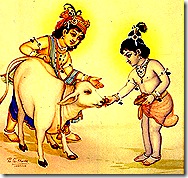

During the winter, mothers have to redouble their efforts. Before their child runs out the door and into the harsh cold, a good mother makes sure that the child is properly dressed. Gloves, a hat, and a scarf are a must, otherwise the child is not let out of the house. This is done to prevent the child from getting sick while playing out in the cold. These regulations are imposed to increase the child’s enjoyment.


What happens is that as soon as the spirit soul enters the material world, it assumes a body composed of material qualities. In the conditioned state, the living entity becomes bewildered by maya, God’s illusory energy. Maya has many tricks up her sleeve, but her most potent power is her ability to trick the living entity into thinking that it will be happy engaging in all activities except those relating to Krishna, or God. Hence we see that most people are either engaged in fruitive activity, karma, or in mental speculation where they try to negate material attributes.
The living entities are distracted most by the four pillars of sinful life. Intoxication is very seductive for it tells a person that they will be happy by escaping the senses. This escape is false however, and once a person returns to sobriety, there are many harsh side effects. Gambling has a similar allure. It keeps one’s mind agitated. “Just gamble some more, maybe you’ll win. Once you win, you’ll be happy.” But we see that this is rarely the case. Even those who amass large amounts of wealth are still unhappy, thus they take to acts of philanthropy and charity. Meat eating is very damaging to our karma. Unnecessarily killing innocent animals simply to satisfy the tongue represents unintelligent activity. Karma is only fair, so if we cause unneeded harm to others, we are sure to have the same thing happen to us. Meat eating also keeps us away from eating Krishna prasadam, vegetarian food which is considered holy since it has first been offered to God. Illicit sex is the mother of sinful life. Sex represents the highest material pleasure and also the cause of the greatest distress. Illicit sex provides temporary pleasure but can lead to many problems such as divorce, teenage pregnancy, sexually transmitted diseases, and emotional heartbreak.


Along with the abstention from sinful life, Vaishnava spiritual masters recommend that one chant the maha-mantra, “Hare Krishna Hare Krishna, Krishna Krishna, Hare Hare, Hare Rama Hare Rama, Rama Rama, Hare Hare”, at least sixteen rounds a day on a set of japa beads. One round consists of 108 recitations of the mantra, so sixteen rounds means over 1700 recitations of this sacred mantra every day. Again, on the surface this may seem like a punishment. “So I have to sit there and chant this much every day? That sounds boring. I thought life was meant to be fun.” This chanting recommendation is actually more important than the restrictions on sinful activity. The maha-mantra addresses God and His energy in a loving way. At first, recitation of this mantra may seem like a burden, but it actually brings about tremendous bliss. At worst, we get to think about God for an hour or so a day. Chanting by itself is enough to reward liberation, but the other regulative principles are required to keep a person from falling back into conditional life.

