


Rama Navami celebrates the appearance of Lord Shri Ramachandra, an incarnation of God who descended to earth many thousands of years ago in Ayodhya, India. The holiday is named as such because of the specific day in the lunar cycle on which Lord Rama appeared. The Vedic calendar is based on the lunar cycle, with certain days being more auspicious than others. Lord Rama appeared on the ninth day of the waxing moon in the month of Chaitra, thus His birthday is celebrated as Rama Navami. It is similar to the concept of the Christmas Holiday where Christians celebrate the birthday of Lord Jesus Christ. Vedic holidays are a little different in that there are many Christmas-type celebrations each year since God takes unlimited forms, anata rupam. Many of these forms appear on earth. God, being the original person, adi purusham, never actually takes birth, so His birthdays are more aptly referred to as appearances. Since the Lord descends from the spiritual world in an eternally existing form, His appearances are known as avataras. Lord Rama is one God’s primary avataras.


Dashratha pretty much had it all. He was wholly dedicated to dharma, or his occupational duty. Dharma actually means “that which constantly exists with the particular object”. Thus dharma is that which sustains one’s existence. Since the living entity’s existence is defined by its relationship with God, dharma usually refers to religiosity or religious duty. When applied to specific areas, such as government, it refers to the code of conduct or righteousness. Dashratha’s citizens were very happy, and he personally enjoyed life with his three wives. The Vedas tell us that those in the mode of passion, the warrior class, are allowed to marry more than once provided that they can guarantee the complete protection of their wives. The tongue and the genitals are two of the hardest organs to control, so they represent the two biggest stumbling blocks towards advancing in spiritual life. All the Vedic guidelines are put in place so as to help the living entity achieve pure Krishna, or God, consciousness in their lifetime. Only with this mindset can the soul break free of the perpetual cycle of birth and death. We shouldn’t mistakenly think the Vedas and the gurus who follow them are unnecessarily punishing us with their rules and regulations. The complete set of Vedic guidelines represents a form of tough love. Since sex desire is very difficult to control, it is advised that one get married at a very young age, and then only indulge in sex life for the purpose of having children.
From this injunction, we can logically conclude that sex life can only be allowed during one period in every month, when the wife is fertile. The warrior class lives mostly in the mode of passion, meaning they perform work for the purpose of receiving material gain. An outgrowth of living in the mode of passion is that one’s sex desires remain very high. To allow kings to indulge in sex life but still remain committed to dharma, they were allowed to keep more than one wife. This way the women of society were still protected, and the kings could still make spiritual progress.


The Bible tells us that God created everything in the beginning. The Vedas give a similar description of the events at the time of creation, including the names of great personalities. The kings are known as rajarishis in the Vedic tradition because they are meant to act as God’s representatives on earth. No one can protect better than God, so He decided that societies on earth would need one of His representatives to provide a similar level of protection on a micro scale. To this end, two lines of famous kings were started at the beginning of creation. One line took birth from the moon-god, Soma, and the other from the sun-god, Vivasvan. The Ikshvakus were part of the solar dynasty, and they were famous throughout the world. If Dashratha didn’t beget a son, he would be doing a great disservice to the family name.


Dashratha performed the Ashvamedha sacrifice, and a subsequent Putrakameshti yajna, as was recommended to him. A great deity came out of the sacrificial altar and handed some payasam to Dashratha. He in turn divided the payasam up and distributed it to his three wives. Very quickly they all became pregnant, with Queen Kausalya eventually giving birth to Lord Rama. Dashratha’s two other wives, Kaikeyi and Sumitra gave birth to Bharata, Lakshmana, and Shatrughna. Thus the king was blessed with four beautiful sons, but Rama remained his favorite. Lord Rama was Dashratha’s prananatha, or the lord of his life air.
Rama was the son that Dashratha had longed for. Like father like son, Rama too was extremely dedicated to dharma. Never did He speak an ill word to Dashratha, for He loved His father very much. The driving force behind Rama’s activities was His dedication to maintaining the good name of His father. Rama viewed Dashratha as His foremost deity, setting a great example for future generations to follow.
“Whenever and wherever there is a decline in religious practice, O descendant of Bharata, and a predominant rise of irreligion-at that time I descend Myself.” (Lord Krishna, Bhagavad-gita, 4.7)


Since Ravana hadn’t directly attacked Ayodhya, there was no way for Rama to go after him and still remain on the virtuous path. Being God Himself, Rama could have easily done whatever He wanted to, but at the same time, He wanted to set a good example for how a king should behave. To secure Ravana’s demise, the demigods set forth a plan whereby Lord Rama would have an excuse to take him on in battle. The first piece of this puzzle was Rama’s exile to the forest. Dashratha wanted Rama to succeed him on the throne, but plans got changed at the last minute due to a fit of jealousy thrown by Kaikeyi. She requested that Bharata become king and Rama be exiled. Dashratha couldn’t ignore these requests because he had granted her any two boons of her choosing on a previous occasion.
For His part, Lord Rama didn’t want to His father turn out to be a liar, so He gladly accepted the exile punishment. Rama’s beautiful and chase wife, Sita Devi, insisted on accompanying Him, as did Lakshmana. While they were in the forest, Sita was kidnapped by Ravana after a diversion was set up whereby both Rama and Lakshmana were drawn away from the group’s cottage. The demigods were quite pleased by this, for they knew that Ravana had met his end. Lord Rama and Lakshmana eventually marched to Lanka, with the help of a huge band of monkeys, and defeated Ravana in battle. Sita was rescued and the group triumphantly returned to Ayodhya, where Rama was crowned as the king.
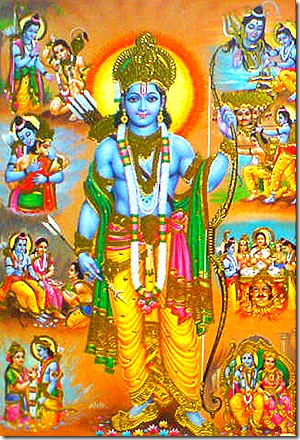


As spirit souls, part and parcel of God, we are meant to be His energy; we are meant to please Him in the same way that Sita, Hanuman, and Lakshmana do. Celebrating festivals like Rama Navami and Janmashtami are great ways to get into the spiritual mindset. Taking it one step further, we should all try to remember God and His devotees every single day of the year. This can easily be accomplished by regularly chanting, “Hare Krishna Hare Krishna, Krishna Krishna, Hare Hare, Hare Rama Hare Rama, Rama Rama, Hare Hare”.