


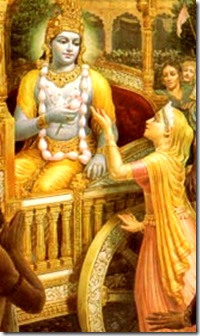

“I wish that all those calamities would happen again and again so that we could see You again and again, for seeing You means that we will no longer see repeated births and deaths.” (Queen Kunti speaking to Lord Krishna, Shrimad Bhagavatam, 1.8.25)
A living entity is a spirit soul that assumes a body for the purpose of performing activities in the material world. There are three modes that govern material nature: goodness, passion, and ignorance. Because these modes can exist in varying degrees, we see up to 8,400,000 different species in the material world, with each species having specific characteristics and a penchant to perform certain activity. Human beings are only one species, but the Vedas tell us that there are many other species which have human-like characteristics, with the Rakshasas being one of them. They are demons by nature, meaning they are devout atheists, primarily engaged in sinful life.
"In whatever condition one quits his present body, in his next life he will attain to that state of being without fail." (Lord Krishna, Bhagavad-gita, 8.6)


In order to return to the spiritual world, we living entities must think of God at the time of death. The time of death is usually quite painful and also a time of great panic. The spirit soul is leaving the body, meaning that all vital functions, including breathing, must stop. There is no way to guarantee that we will be able to think of a particular thing during our last moments. Therefore the Vedas tell us to adjust our actions over the course of our lifetime, because these activities will determine our consciousness at the time of death.
This is where sinful activity comes in. Technically, any material activity is considered sinful if it causes us to remain in the material world. However, four primary activities are considered most sinful, for they are most effective in causing one to remain in the material world. These activities are meat eating, illicit sex, gambling, and intoxication, and collectively they are known as the four pillars of sinful life. Meat eating is bad for our karma since it involves unnecessary violence towards animals. If we live off needless killing, we are sure to suffer for it in the afterlife. Illicit sex is probably the most detrimental to our karma since it represents the highest form of material pleasure. If we want to enjoy material nature, God will not stand in our way. If we want to have unregulated sex, He will gladly keep giving us new bodies so that we can enjoy. Gambling is a good way to kill time, but it also causes great agitation of the mind. Gamblers are never at peace, meaning that at the time of death, they will be thinking of what game they can play next or how much money they can win. Intoxication leads one to the mode of ignorance or darkness. Drinking and drugs take away one’s ability to think clearly, thereby making it much harder to think of God at the time of death.
During the Treta Yuga, the second time period of creation, the Rakshasa population was higher than normal. The four pillars of sinful life represented their religion in a sense. Their leader at the time, Ravana, was a poster child for sinful life. He ruled an island kingdom of Lanka, which had many great palaces all decked with gold. He had an insatiable desire for sex, so he kept many wives who were always drinking. When Lord Hanuman went to Lanka searching for Sita, he went through many of Ravana’s palaces and found that all the women were drunk. They were so out of it that many of them were sleeping on top of one another in the wee hours of the night. Rakshasas also enjoyed eating meat. Regular animal flesh wasn’t enough, for they would kill humans and then eat them.


One of Ravana’s chief deputies was a demon named Maricha. The above referenced statement is actually part of a narration given by Maricha to Ravana. Lord Rama, an incarnation of Krishna, eventually came to earth at the behest of the demigods to kill Ravana and the other Rakshasas. On one particular occasion, Rama killed 14,000 of Ravana’s associates who had come to attack Him. Upon hearing the news, Ravana wanted to get revenge on Rama by kidnapping His wife, Sita Devi. Ravana proposed the idea to Maricha, and in response, Maricha informed him that Rama was undefeatable in battle. To illustrate this point, Maricha recalled an incident from the past.


Vishvamitra would not leave without Rama. This is the true nature of a devotee. There are many systems of religion and spiritual practice, but for pure devotees, they only take to bhagavata-dharma, or devotional service. God, in His original form, is known as Bhagavan, meaning one who possesses all fortunes. Bhagavata means anything that directly associates with Bhagavan. Therefore Bhagavata can refer to the book, Shrimad Bhagavatam which describes Krishna’s glories, and it can also refer to Krishna’s pure devotees.
Vishvamitra was a great ascetic who had a great history of his own which is described in detail in many Vedic literatures. He wasn’t a brahmana by birth, but he preformed many great austerities to become one. Though he was expert at performing sacrifices, at meditating, and even studying Vedanta, Vishvamitra abandoned all these practices in favor of pure devotional service. He knew that all other processes of religion are meant to be stepping stones that elevate a person towards achieving pure love for God. He knew that Rama was all he needed for protection from all calamities. Rama and His younger brother, Lakshmana, would eventually accompany Vishvamitra and protect the great sage from the demons.

