


In the Vedic tradition, marriages are arranged by the parents of both the bride and groom. Marriage itself is known as the grihastha-ashrama, meaning it is meant to be a spiritual institution. For this reason, the covenant of marriage is not something that should be entered into lightly. Great care must be taken to ensure that the bond will be a lasting one.
For marriage arrangements, the primary instrument used by parents of the Vedic tradition is the horoscope. Today the idea of horoscopes and astrological charts bring justifiable skepticism from the general public, but real astrology has its origin in the Vedas. The original scriptures for mankind come from India and they are referred as the Vedas, which mean knowledge. The primary purpose of the Vedas and religion in general is to give mankind a set of guidelines which can help them fulfill their true destiny in life, that of returning back home, back to Godhead. This earth is not our actual home. All the planets of the solar system and even those of other universes constitute the material creation.
“The whole cosmic order is under Me. By My will it is manifested again and again, and by My will it is annihilated at the end.” (Lord Krishna, Bhagavad-gita, 9.8)


Since marriage is an institution where regulated sex life is allowed, an unmarried person desirous of sexual activity should enter into it as soon as possible. The current model where men and women freely intermingle is not recommended by the Vedas. God doesn’t want to explicitly punish us in any way, for having to live here is cause for misery by itself. The Lord would much rather help us along in our journey towards self-realization. In the Vedic tradition, parents are required to get their children married as soon as there is any inkling for sex desire. This way other problems such as single-parenthood, sexually transmitted diseases, adultery, etc. are all eliminated. When searching for a suitable husband or wife for their child, parents compare the astrological chart of both their own child and that of the potential spouse. The alignment of the planets at any given time signifies certain characteristics of the people born during such a time. There are auspicious signs and inauspicious signs. Expert brahmanas can predict the future of a young child simply by studying their astrological signs.
“After the birth of a child, the astrologers calculate the moment of the birth and make a horoscope of the child’s future life. Another ceremony takes place after the birth of the child: the family members take baths, cleanse themselves and decorate themselves with ornaments and garlands; then they come before the child and the astrologer to hear of the future life of the child.” (Shrila Prabhupada, Krishna, The Supreme Personality of Godhead, Vol 1, Ch 5)


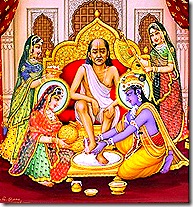

Many thousands of years ago, there was a great king by the name of Janaka who ruled over Mithila. One day while ploughing a field for the purpose of performing an elaborate religious sacrifice, he found a little girl coming out of the ground. He picked her up and immediately accepted her as his daughter. This girl was none other than the goddess of fortune, Lakshmiji. Janaka immediately felt affection for her. He named the girl Sita since she was born of the ground. Being a pious king, Janaka knew that some day he would have to find a suitable husband for Sita. When the time came, he was in a quandary. Knowing that Sita had no parents, he couldn’t find a suitable husband for her. Simply based on her qualities as a person, he knew that there was no ordinary man who was worthy enough to receive her as a wife.


As it turned out, only Lord Rama, the prince of Ayodhya, could lift and string the bow. He not only lifted it, but He broke it in half. This wasn’t surprising since Rama was an incarnation of Lord Krishna, God Himself. The fact that Rama was chosen as Sita’s husband definitively reveals her true identity as God’s wife. As the Lord’s eternal consort, Sita can never have any other husband except God. Most of the world’s major religions give us some conception of God. They tell us that He is great. This is most certainly true, but the Vedas go one step further by enlightening us as to just how great He is. The Vedas tell us that Lord Krishna has thousands of names. Actually the entire list of names is impossible to count since God is all-powerful and all-attractive. Nevertheless, each of the provided names describes a specific personal feature. These names also prove that God is a person. An impersonal spirit can never be classified by different names because something that is impersonal, by definition, must be free of attributes. God has attributes, but they are not of this material world. He is completely spiritual, possessing an eternal body full of bliss and knowledge, sach-chid-ananda-vigraha. A few of Krishna’s names are Shripati, Madhava, and Shridhara. These all reference His eternal bond to Goddess Lakshmi. In Sanskrit, the word for husband is pati, which directly translates to lord or master. Krishna is the lord and master of Lakshmi.


Sita and Rama both had specific duties to perform during Their time on earth. One can only imagine how exalted a person Janaka was to have to Sita as a daughter. Through his piety and devotion, he had the wisdom and foresight to figure out how to find just the right husband for Sita Devi. Nothing makes devotees happier than to see Sita and Rama always together. Even though they were separated from each other several times due to the course of events, God actually never lives apart from His devotees.
“For one who sees Me everywhere and sees everything in Me, I am never lost, nor is he ever lost to Me.” (Lord Krishna, Bg. 6.30)

