


Many advanced transcendentalists and religious scholars downplay the need to perform Vedic rituals and sacrifices. To back up their position, they point to various statements in the Vedas that openly declare that simply performing rituals is not enough. This is indeed true in many instances since simply going through the motions of religious functions is a waste of time if it doesn’t lead one towards devotion to God. In truth, Vedic rituals can prove to be an invaluable tool in the arsenal of spiritual activities available to an aspiring transcendentalist. For this reason, these sacrifices and religious functions should not be neglected.


Most television shows don’t stay on the air for very long. There is fierce competition between the major networks, which means that if a new show doesn’t garner high ratings in the beginning stages, it is likely to be cancelled very quickly. Even the shows that prove to be successful only last at most eight to ten years. One of the most popular television sitcoms in history, Friends, ran for ten seasons; Seinfeld and Everybody Loves Raymond for nine seasons, and Cheers for eleven. The typical television season spans twenty-two episodes, which means that a long lasting show will likely eclipse the two hundred episode mark. Taking the sum total of all the episodes of all the famous television shows will leave a fan with a lifetime’s worth of television viewing. Most of these shows are available on DVD now, meaning that we can watch all our favorite episodes over and over again.


“Never was there a time when I did not exist, nor you, nor all these kings; nor in the future shall any of us cease to be.” (Lord Krishna, Bhagavad-gita, 2.12)
The Vedas, the original scriptures for mankind, help us answer these questions. Since Vedic wisdom emanates from Lord Krishna, the Supreme Personality of Godhead, it represents the most authorized form of knowledge. Unlike scientific theories and hypotheses, the Vedas represent undeniable truths of life expounded by the Supreme Lord Himself. To help future generations of man, the Lord kindly imparted this wisdom to several exalted living entities in the past, who subsequently passed down the same knowledge to their disciples. Thus the Vedic literature that we see today, consisting of the Puranas, Mahabharata, Ramayana, etc., contain the same information that God Himself spoke to Lord Brahma at the beginning of creation.
“Brahma, it is I, the Personality of Godhead, who was existing before the creation, when there was nothing but Myself. Nor was there the material nature, the cause of this creation. That which you see now is also I, the Personality of Godhead, and after annihilation what remains will also be I, the Personality of Godhead.” (Shrimad Bhagavatam, 2.9.33)


To break free of this cycle, we have to simply change our desires. This is the benefit of human life. Other species have no ability to understand desires and work. They simply act off their animal instincts. A pig, cow, or bird has no idea that it is going to die. It has no understanding of the difference between matter and spirit. Only human beings can understand this fact. We are so smart that almost all of us eventually realize that life is short and that we will be forced to die on day. However, knowing this fact and acting on it are two different things.
Many of us choose to deal with the death issue by ignoring it. “Sure, I’m going to die, but so what? Why do I want to obsess over something so grim? Let me just live my life and enjoy every possible moment.” This mindset may appear to be logically sound, but its major flaw lies in the fact that death doesn’t represent the end. God is very nice. If we want to stay here in this material world and enjoy, He will gladly let us do so. Once our current body becomes old and useless, He lets us assume another one and start our activities all over again.
“As the embodied soul continually passes, in this body, from boyhood to youth to old age, the soul similarly passes into another body at death. The self-realized soul is not bewildered by such a change.” (Lord Krishna, Bg. 2.13)


There are various transcendental mellows that one can experience with Krishna, but before we can associate with Him, we must purify ourselves. Karmic activity is very hard to break free of, for it is what we have been accustomed to throughout our many lifetimes on earth. This is where Vedic rituals come into play. Knowing that loving God is the true purpose of life is one thing, but actually realizing this fact is another. Theoretical knowledge serves as a good foundation, but this knowledge is worthless if we don’t use it for our benefit.
“Regulated activities are prescribed in the Vedas, and the Vedas are directly manifested from the Supreme Personality of Godhead. Consequently the all-pervading Transcendence is eternally situated in acts of sacrifice.” (Lord Krishna, Bg. 3.15)


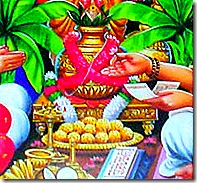

It is very difficult to control the mind and to have it constantly focused on spiritual matters. By engaging in religious activities, we give the mind more events and experiences to use as reference points when contemplating matters relating to the soul and God. Religious leaders around the world advise their members to visit church every Sunday. This certainly isn’t a bad thing since going to church helps a person think about God. If it’s a good thing to think about God once a week, wouldn’t it be that much better to think about Him every day? This is the opinion of the Vedas. To help us think about God every day, the scriptures provide us a multitude of religious rituals and other rules and regulations to follow.


This chanting should be taken up by every person. It is a great way to spend our time. His Divine Grace A.C. Bhaktivedanta Swami Prabhupada advised everyone to chant the Hare Krishna mantra at least sixteen rounds a day on a set of japa beads. Chanting, along with visiting temples, adhering to regulative principles, reading Vedic literature, and eating Krishna prasadam are enough to secure liberation in one’s current lifetime. These activities, which collectively make up the discipline known as devotional service, are all aimed at pleasing the Supreme Lord. Devotional service helps us use our time constructively. By following the regulative principle in the beginning stages, we are sure to be rewarded one day with pure love for God, or Krishna-prema.