


Download this episode (right click and save)
The kidnapping of Sita Devi, the wife of Lord Rama, is one of the more troubling incidents to hear about for devotees. Sita Devi was beautiful, kind, chaste, and never bothered anybody during her time on earth. She was the embodiment of the perfect woman. Simply hearing about her being forcibly dragged into the aerial car of the demon Ravana and made to sit on his lap, is enough to make devotees cringe. This incident leads many to scorn God Himself for allowing such an insult to take place. On the flip side, however, Sita’s kidnapping was a very joyous occasion for the demigods.


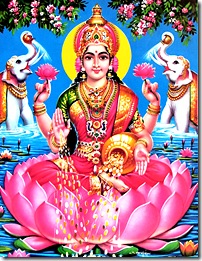
God is not alone in the spiritual world. Just as we have our own family members in this world, the Lord has eternal associates in the spiritual world. Krishna is the energetic, and His pleasure potency expansions represent His energy. God derives pleasure from His devotees through their engagements in different transcendental mellows, or rasas. The most advanced devotees know how to give the most pleasure to God, thus they are classified as hladini-shakti, or pleasure potency expansions. Krishna’s pleasure potencies are the gopis of Vrindavana, the chief of whom is Shrimati Radharani. In a similar manner, Lord Narayana’s eternal consort is Goddess Lakshmi, a beautiful devi who provides wealth and good fortune to her devotees. Since she is God’s wife, it makes sense that Lakshmi would be in charge of fortune. No one is more fortunate than God due simply to the fact that the goddess of fortune serves Him.

The human beings aren’t the only species on earth. Scientists posit various theories about creatures who previously lived on the earth but that are now extinct, like the dinosaurs. We also see that scientists always seem to discover new species that they never heard of before. The Vedas, which serve as the original knowledge base for all things material and spiritual, tell us that there are 8,400,000 different species. This number is so high because the living entity can possess the three qualities of material nature [goodness, passion, and ignorance] in various combinations and permutations. One species can be in 50% goodness, while another may be in 25% goodness and 75% ignorance. The human being mostly lives in passion, but there is a catch. We have a choice as to which mode we want to associate with. Not only can we choose to act in goodness, passion, or ignorance, but we also have the option to rise above these three modes and engage in pure goodness, known as shudda-sattva. The lower species don’t have this choice due to their lack of intelligence.
“The Vedas mainly deal with the subject of the three modes of material nature. Rise above these modes, O Arjuna. Be transcendental to all of them. Be free from all dualities and from all anxieties for gain and safety, and be established in the Self.” (Lord Krishna, Bhagavad-gita, 2.45)


Acting in the mode of goodness allows one to take birth in a pious family in the next life, or even in the body of a demigod, an elevated living entity. The mode of passion allows one to remain a human being, thus it is essentially a mode of neutrality. The mode of ignorance causes one to descend to a lower species in the next life. This mode is characterized by excessive eating, sleeping, intoxication, and a general disregard for the laws of dharma. The Rakshasas of the Treta Yuga fit right into this mold. Their leader was Ravana, a ten-headed monster who ruled over the kingdom of Lanka. He was always drinking wine and having sex with his innumerable wives. He loved to eat meat, especially the flesh of sages that he and his Rakshasas had personally killed.
Ravana was very powerful and a staunch enemy of the demigods. Krishna and Vishnu represent the Supreme God, and the demigods represent His chief deputies. The demigods are in charge of various departments of the material creation. Though they are also very powerful, they are still fallible living entities. This means that they too are subject to the forces of material nature as manifested through birth and death. Since the beginning of time, the demigods have been engaged in a battle with the demons. The demigods, or godly people, are referred to as suras and the demons as asuras. Ravana was an asura who regularly fought with the demigods. Since he was too strong for them, the demigods were deathly afraid for their lives and also for the future condition of the earth. As a last resort, they sought the shelter of Lord Vishnu. They begged Him to come to earth and kill Ravana, and thereby relieve their suffering.
There was a catch to this though. Lord Brahma had granted Ravana several boons due to austerities he had performed. God is never forced to answer anyone’s prayers since He is aloof from the day-to-day affairs of the material world. The demigods, on the other hand, are duty-bound to grant benedictions to anyone who pleases them properly. Ravana took advantage of this by performing great austerities to please the demigods. They in turn granted him several boons which boosted his strength. They also granted him immunity in battle against all the demigods and other celestial beings. Thus Ravana thought he was immortal. He made a costly mistake, however, in that he forgot to ask for immunity from human beings. Ravana thought that if a celestial couldn’t defeat him, surely no lowly man could.


At the same time that Vishnu was appearing on earth as Rama, Goddess Lakshmi was appearing as Sita Devi, the daughter of King Janaka of Mithila. Sita and Rama were eventually married, as was their destiny. After twelve years of marriage, the pair roamed the forests of India along with Lakshmana. Ravana, hearing of this beautiful woman staying in the forest of Dandaka, decided that he had to have her. He set up a diversion which lured Rama and Lakshmana away from their cottage, leaving the door open for Sita’s abduction.


The pious never attack without just cause. Even in today’s world, the police are never allowed to search someone’s property without probable cause. Police officers and FBI officials must obtain warrants prior to searching someone’s house. If evidence is obtained without following the proper protocol, it becomes inadmissible in the court of law. This may seem unfair, as it leads to criminals getting off on technicalities, but these laws are put into place to protect the innocent. Lord Rama, being especially dedicated to dharma, believed in these laws as well. His younger brother Lakshmana once noted that not even the people punished by Rama could find anything bad to say about Him. This was because even the criminals knew that Rama didn’t hold any personal grudges and that He always adhered to the righteous path.
The lesson here is that there is no need to become distressed from hearing of Sita’s kidnap. Lord Rama’s wife was certainly delicate, beautiful, and full of class, but she was by no means weak. Ravana was an extremely powerful demon who could not be defeated by even the greatest celestials. It was his addiction to illicit sex that led to his downfall. In this way, Sita Devi proved to be the secret weapon, the ticking time-bomb so to speak. She singlehandedly took down one of the greatest demons of all time.

