Due to man’s fallible nature, he will always search after God, even if he has no information about Him. The results of such attempts will always fail unless one is directed to the proper source, an authorized representative of the Lord who can accurately describe His features, names, and occasions for His appearances. Without such a consultation, one will be prone to mentally speculating about God, concocting their own theories about who the Lord is and what He looks like, and worst of all, coming up with the flawed notion that man is God or that man can somehow become God.


Vedic information states that all problems and all distresses in life are caused by one’s forgetfulness of the Supreme Lord. One can think of it in these terms: Suppose that we are extremely wealthy and possess millions of dollars in the bank. This wealth was acquired through honest means and is at our disposal. Those who are forgetful of God usually view everything through this prism of material wealth. Those who are wealthy are viewed as being extremely happy and full of greed, while those who are not are viewed as unhappy and always wanting. Continuing with the hypothetical situation, suppose that we were forgetful about our wealth. Suppose that we forgot about all the money that we have in the bank. The resulting situation would be one of distress, involving constant hankering and lamenting. We would constantly worry about what will happen to us in the future, how will we feed our families, how will we meet our obligations, pay off our debts, etc. In addition, there would also be concern over something bad happening to us and how we would meet the basic demands of the body after such an occurrence.


Spiritual benedictions are what God grants to the kind-hearted devotees, those who realize that they are descendants of the richest person in all the universes. A spiritual benediction can be thought of as a reward which allows a person to constantly be connected to God. This connection is considered the highest benediction because it completely eradicates all other problems. If one is in constant connection with the Supreme Pure, they are considered to be in yoga, or union. This union allows one to focus on spiritual activities which ensure the sustenance of this wonderful bond. The Supreme Lord, through His appearances on earth, fortifies this holiest of bonds by granting His darshana to His greatest devotees.
How do we know that the Lord has appeared on earth before? Those who saw Him kindly wrote down their experiences in books. Actually these experiences were first described in an oral tradition. Veda means knowledge, and this knowledge was first transmitted through aural reception. For this reason, another name for the Vedas is the shrutis, meaning that which is heard. As time went on, mankind’s mental abilities diminished, thus the written word became necessary. Since this written word was required in order for people to remember Vedic wisdom, the resulting books became known as smritis, or that which is remembered. The Puranas were originally part of the oral tradition, but then later on they were put into book form. Though there are many Puranas, the Bhagavata Purana, or Shrimad Bhagavatam, is considered the foremost because it focuses solely on Lord Krishna and His incarnations.


Why is this information required? As mentioned before, if mankind doesn’t know about God, they are likely to speculate on the nature of the divine. This speculation will always have disastrous results because the human mind is incapable of conceiving of its creator. Anyone who conjures up a notion of God in this way will certainly be doomed, and moreover, they will doom whoever follows them. In order to protect the innocent from being fooled in this way, the Supreme Lord descends to earth from time to time to establish the real principles of religion. An example of the attempts at trickery of the mental speculators was seen during the nineteenth century in India. One of the most famous Vaishnavas in recent times was alive during that time period in India. His name was Shrila Bhaktivinoda Thakura. Though he was a householder and worked as a magistrate, he was an authority on religion and especially devotion to Krishna. He authored many wonderful books which described Krishna’s glories and also compared and contrasted almost every religious system that has ever existed.


Bhaktivinoda Thakura ordered the yogi to be locked up. Ironically, shortly after this, Bhaktivinoda Thakura and his family members all contracted a fever. People started worrying that the yogi was maybe applying a curse to everyone, and that if he was able to do this, maybe he really was Vishnu. Bhaktivinoda Thakura held firm in his belief and ordered that the yogi’s hair be cut off, for maybe that was the source of his mystic power. A short while after being put in jail and having his hair cut, the yogi eventually killed himself, thus settling the affair. Because he was an expert on Vaishnavism as expounded in the Shrimad Bhagavatam, Bhaktivinoda Thakura knew all along of the yogi’s trickery . In that wonderful book, all of the primary incarnations of Godhead are listed as well as their features and attributes.


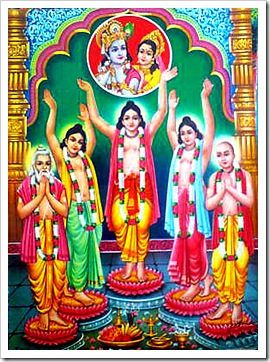
Krishna’s most recent incarnation to appear on earth was Lord Chaitanya some five hundred years ago. On the surface, this may seem like another instance of creating an incarnation of Lord Vishnu where there isn’t one. However, based on Lord Chaitanya’s actions, we can see that He could be none other than Krishna Himself. Lord Chaitanya played the part of the most exalted brahmana, a pure devotee of Krishna who spread love for God throughout India. His closest associates knew He was God, but the Lord never wanted to be praised in this way. He would pretend to be greatly offended whenever anyone would address Him in such a manner. This behavior is in stark contrast to the other cheaters who claim to be God, all the while espousing their own made up method of self-realization. Lord Chaitanya’s formula of bhakti-yoga, pure love for God, is the only worthwhile religious system because it speaks to the natural desire of the soul to offer service to its creator.