


antarajāmī rāma marama saba jāneu |
dhanu caḍhāi kautukahiṃ kāna lagi tāneu ||
Sugriva put all his faith in this one person and got everything he could want in return. Vibhishana trusted the same person and was also duly rewarded. Shabari, the boatman named Kevata, the residents of Ayodhya, King Janaka and so many others also invested full faith in the same man and were not disappointed. One time Janaka’s daughter was frantic in fear over the uncertainty of her future, over how she might miss the chance to spend the rest of her life with someone very special. Not surprisingly, faith was extended in the same person, who can hear and answer innumerable simultaneous prayers. He responded to her faith by effortlessly lifting up an object of a massive weight. On the day of Rama Navami, we celebrate His name, fame and glories.
It’s nice to have faith in someone else to do something extraordinary. It’s like knowing that the job will get done despite all the formidable obstacles present. If you can’t solve a math problem, you can at least say: “I may not be able to do it, but my friend can. He’s so smart. He’s smarter than all of you people. Watch when he sees this equation. He will put everything together in mere moments, making fools of us all.” We have the same mentality with pretty much any issue of ability, such as with alluring members of the opposite sex, making sales, cooking, and fixing cars.

Faith in the higher power may be invested with a similar attitude, but the difference is that the higher power never fails to deliver. In the material land there is competition over worship. The statists want the citizens to worship them instead of God:
“Put your faith in us. Why worship an imaginary figure? Tell you what, let’s take these two plants. Give one of them to us and the other leave to God. See what happens in a few weeks. Our plant will come out just fine and the one left to God will wither and die. This proves that there is no God. Either that or He doesn’t answer all of your prayers. We’ll listen to you, while He, if He exists at all, won’t.”
If faith in Him is dependent on His ability to deliver on orders, like an online retail outlet, then the faith will not last very long. Since not all orders are fulfilled, one thinks that the faith is meaningless. But in actuality sometimes not getting what we want is better for us. In fact, this is the case many times. The faith in ordinary living entities, including the godless regimes, is different because the object worshiped is not capable of doing everything. They cannot even hear all of the faith extended to them, so how could they possibly respond to everything?


Sita Devi, the daughter of King Janaka, saw Shri Rama at the assembly and wanted Him as a husband. This was an ancient time, the Treta Yuga, which is the second of the four time periods of creation. A wife in such a time was a faithful servant. Sita was especially pious since she was the daughter of Janaka, who was the host of the ceremony. So in hoping to have Rama as a husband, she desperately desired the opportunity to serve Him without motivation and without interruption. Indeed, through her actions after marriage she would prove to be the most chaste wife, an example of fidelity for all relationships based on trust.
Rama is God. He is the Supreme Lord in His manifestation as a warrior prince. The Supreme Lord is all-pervading. Some part of Him is always visible. If you can’t see His personal form, you can at least see His influence. One who cannot perceive the influence thinks that He doesn’t exist. In such cases, especially when there is a decline of religious practice and a sharp increase in irreligion, the Lord manifests in a personal form. Even then there is doubt over His existence, but those who have a pure heart can see Him and take further pleasure in attachment to Him. Rama is one such personal manifestation of Godhead. His body is spiritual. He doesn’t take birth, though He emerges from the womb of Queen Kausalya, one of the beloved queens of King Dasharatha of Ayodhya.


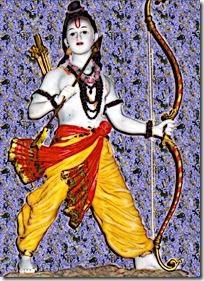
The toys for a child are not complex. They are not that heavy, either. This way the child can curiously look at the toy and do with it as they please. This bow was treated in the same way by Rama. “Hmm, what’s this? This bow looks interesting. Let me pick it up to get a further look. Hmm, there‘s a string on here. I wonder what happens if I draw this string back to my ear.” And just as the child may take their curiosity too far from time to time, Shri Rama drew the string back so far that the bow snapped in half. That object which was too heavy for even the mightiest of princes to move was easily broken by the beautiful and youthful Shri Rama.


Sugriva was troubled by his brother Vali, who had driven him out of his kingdom. Vibhishana was also driven out of his kingdom by his brother. Bharata, one of Rama’s younger brothers, had the guilt of knowing that his mother had caused Rama to leave the kingdom for fourteen years, when the kingdom rightfully belonged to Rama. In all such cases, the faith extended in Rama was rewarded with the removal of the obstacles. At other times, Rama descends in different forms, but He still shows the same ability to make child’s play of a difficult situation. As Shri Krishna, He turned a massive hill into a pastime umbrella. As Lord Varaha, He lifted the earth planet with ease and saved it from a deluge. He invests similar potency in His devotees. Shri Hanuman, Rama’s greatest servant, once lifted a mountain when he was in panic over saving Lakshmana.


In Closing:
Real faith in Rama the only way,
Who made lifting of bow child’s play.
When over future put into fear’s state,
In prince of Ayodhya Janaki put all faith.
Gave to her the most desired gift,
When bow in His hands in air to lift.
Faith so many others have given the same,
Bring Him to the rescue by saying His name.

