


kāñcanāni ca citrāṇi toraṇāni ca rakśasām |
laṅkāmuddyotayāmāsuḥ sarvataḥ samalaṃkṛtām
It’s ironic that the entryway into a city filled with some of the most ghoulish and hellish creatures was lined with gold. The archways to the majestic city welcomed the guest by providing a sense of happiness, peace, prosperity, and overall enjoyment. Sadly, these allurements were simply illusion, with a built-in clause accompanying entry; every guest had to check their tendencies towards spiritual life at the door. The pious and spiritually inclined were not allowed to enter this particular kingdom. If they did happen to infiltrate the sturdy fortress protecting the city of gold, they would have to hide their natural tendencies or face constant harassment. Indeed, the one entity from whom all wealth and fortune emanate, the goddess of fortune, was a prisoner in this city. Despite her exalted status, the surroundings forced upon her were anything but golden. Refusing to cavort with the sinful ruler of such a feverish land, that supreme goddess, who had assumed the spiritual form of Sita Devi, the wife of Lord Rama, was forced to remain by herself in a garden, with the ultimatum of impending death looming over her should she not change her unwavering devotion to her husband.


“The foolish cannot understand how a living entity can quit his body, nor can they understand what sort of body he enjoys under the spell of the modes of nature. But one whose eyes are trained in knowledge can see all this.” (Lord Krishna, Bhagavad-gita, 15.10)
One who is ignorant of both their impending death and the eternal nature of the soul takes objects of illusion, which are known as maya, to be reality. Ravana, the king of Lanka, figured that if he amassed enough gold, material opulence, female companionship, animal flesh for eating and wine for beverage he would never be without discomfort. In one sense, he can’t be blamed for crafting this priority system, for it is the nature of the animal to seek out the engagements of eating, sleeping, mating and defending. Ignorance envelops the pure spiritual entity, the spark of life, at the time of birth. Without a proper education on spiritual matters provided by a bona fide guru, one who knows the Truth and how to approach Him, the animalistic tendencies will reign supreme. Ravana knew of the Vedas, the ancient scriptures of India, through and through, but he nevertheless could not overcome the illusory aspect of material nature. Therefore he was always in the heat of passion looking for the next opportunity for sense enjoyment.


When allured by the forces of maya, the individual driven by an animalistic mindset essentially takes himself to be God. “Look at what I have. Look at all my palaces. Look at how many beautiful queens I have. Who out there is greater than me?” One who has achieved great things surely will have justification for feeling pride, but the more valid approach is to acknowledge the original owner of everything, the proprietor who has the rightful claim to every piece of property, developed or otherwise, in all the universes. Not surprisingly, only one person holds this position, and His abilities never diminish, nor does He ever cease to be the Supreme Master.


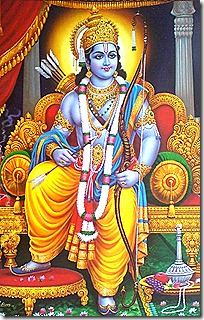
Similarly, simply worshiping matter will bring no spiritual benefit. Since matter is a separated energy of the Supreme Divine Entity, those who are attached to it will remain apart from the all-blissful Personality of Godhead. The original form of the Lord or one of His non-different expansions – which include the deity manifestations – serve as the authorized objects of worship, those spiritual entities that can provide direct contact with God and thus also bring unmatched bliss and excitement. One such non-different form of Godhead descended to earth during the Treta Yuga. He was known by the name of Rama because of His ability to provide transcendental pleasure to others. He was also known as Raghunandana for being a descendant of King Raghu and one who gave pleasure to those in the family line. This divine prince was also known as Dasharathi, for He was the son of Maharaja Dasharatha, the ever pious and kind king of Ayodhya.

Hanuman, the faithful warrior serving the king of monkeys, Sugriva, followed the path of bhakti. All of Hanuman’s actions were dedicated to serving Rama and His interests. To allow Hanuman to continue his service without interruption and to also secure his position as one of the greatest all-stars of the spiritual world, Rama created a situation that required the help of others. Rama’s wife Sita Devi was taken by Ravana seemingly in Rama’s absence. Acting out the part of an ordinary human being, Rama went searching for Sita with His younger brother Lakshmana. The two eventually made their way to Kishkindha, where they met up with Hanuman, who then brokered a deal between Rama and Sugriva. The agreement was that Rama would help Sugriva regain his lost kingdom, and the monkey-king would then help Rama find Sita.


After putting his abilities to good use by assuming a massive size and flying through the air, Hanuman found himself on the outskirts of Lanka. He then used his unmatched intelligence to accurately note that entering the city of the Rakshasas while in his original form would not be a good idea. Just as a priest would stand out while walking through the streets of a gambling city like Las Vegas, Hanuman, as the most faithful servant of Shri Rama, would certainly get noticed right away in the land where illusion reigned supreme. For this reason, the intelligent monkey decided to assume a diminutive stature, one that would allow him to carefully survey every inch of space for Sita’s location while remaining unnoticed.
Though Hanuman was fully aware of Rama’s worthiness of service and His supreme capabilities, he was still a little taken aback by the exquisite opulence that beamed off the outskirts of Ravana’s city. The demoniac try their best to cloud the minds of the pure-hearted souls who are wholly dedicated to chanting the Lord’s names on a regular basis and singing His glories. Logic and reasoning alone won’t convince anyone of a philosophy based on ignorance. The news media are especially popular and well patronized because all they sell is illusion, with one alarm story after another aiming to allure the innocent public into paying attention to topics which are more or less meaningless. If these issues were actually presented as they are, with the illusion removed, no one would pay any attention to them. If Ravana didn’t have his ignorance and sinful nature masked by the exquisite opulence of his city, others would easily decipher that he was nothing more than a pretender, a figure not confident of any of his beliefs. The grossly foolish always live in fear, for they know that once their current life ends, so will their opulence, wealth and fame.

His business complete, Hanuman set fire to Ravana’s city as a parting shot, giving the king a warning of what was to come when Rama and the entire army of monkeys headed by Sugriva would return. External objects in this world should not be rejected outright; everything should be assessed in terms of its ability to either further increase our God consciousness or hamper it. For Ravana, his gold and other items of opulence only served to further delude him into a hellish mindset. Hanuman, though he harbored no hatred for the wonderful opulence of the city of Lanka, saw no utility for it in his sublime mission.

