


In this passage, Shri Hanuman is receiving the highest praise one could ever hope to get: a personal testimony of character given by the Supreme Lord’s direct representative. The representative of God is known as the guru, or spiritual master. In this instance, the guru takes the form of Shri Lakshmana, the younger brother of Lord Rama. From Vedic authority, we understand that Lakshmana is an incarnation of Lord Ananta Shesha Naga, God’s protector in the spiritual world. Lord Anantadeva also appears in other eras in different forms such as Lord Balarama and Lord Nityananda, but regardless of the time or circumstance, he is considered the eternal representative and protector of the interests of the Supreme Lord. Anantadeva’s representative is the bona fide guru, one who follows the same dedication to devotional service as that shown by Shri Lakshmana. Bearing this in mind, Hanuman’s high character is substantiated, for he received great praise from someone as exalted as Lakshmana.


In this regard, the guru, the spiritual master and wielder of the heaviest knowledge, is the person we must approach in order to receive God’s favor. In the conditioned state, we are incapable of conceptualizing the nature of the Supreme Lord; therefore we must take knowledge from someone who has already seen Him. More than just seeing God, the guru dedicates their life to serving the Supreme Lord. Lakshmana is the origin of the guru system, and all other bona fide gurus can trace their spiritual ancestry to him. Just as we have our own biological ancestry which dates back many generations, one’s spiritual lineage, in order to carry any weight, must trace all the way back to God. If a spiritual guide is lacking such a connection in relation to the teachings they offer, their system of spiritual life must have been concocted by someone other than God or one of His direct representatives.
“Just try to learn the truth by approaching a spiritual master. Inquire from him submissively and render service unto him. The self-realized soul can impart knowledge unto you because he has seen the truth.” (Lord Krishna, Bhagavad-gita, 4.34)
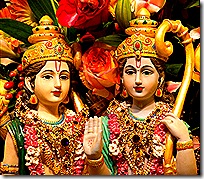

Just as Lakshmana was an incarnation of Anantadeva, Rama was an incarnation of Lord Vishnu, whom Anantadeva gives comfort and protection to in the spiritual world. Vishnu is a plenary expansion of Lord Krishna, the Supreme Personality of Godhead, the one and only God that all of us look to in times of trouble. As part of Rama’s pastimes on earth, He roamed the forests of India for fourteen years. One particular event, the kidnapping of His wife Sita Devi, led Rama to the Kishkindha forest, which was inhabited by Vanaras at the time. In Sanskrit, vana refers to a forest, so a vanara is one who dwells in the forest. Naturally, in order to live in the forest, one needs a body which is made to live in the outdoors and the wilderness. Therefore the Vanaras possessed bodies similar to those of monkeys, though they were also quite human-like. A Vanara isn’t a mythological figure, but rather an advanced form of monkey which existed on earth many thousands of years ago.


Hanuman was quite pleased to hear this, for Sugriva had been thrown out of his own kingdom by his brother Vali. Therefore he could also use Rama’s help in regaining his own kingdom. The two kings could end up helping each other, a sort of “I scratch your back, you scratch mine” deal. Hanuman eagerly and kindly apprised Rama and Lakshmana of this potential mutually beneficial relationship. Upon hearing Hanuman’s words, Lakshmana spoke the above referenced quote to Rama. From his words, we see that Lakshmana was quite impressed by Hanuman, and he could tell right away that the Vanara possessed the highest character.


Lakshmana’s statement also tells us that Hanuman is both heroic [viro] and truthful. In fact, one of Hanuman’s other names is Mahavira, which means one who is very heroic and powerful. How great must Hanuman be for Lakshmana to decipher these characteristics from only meeting him for a few minutes? It is no surprise that Hanuman today is regarded as the most celebrated figure of the Vedic tradition, for the original spiritual master himself, Shri Lakshmana, vouches for his character. If we take Hanuman’s eagerness to serve Rama, along with his inability to tell a lie, what we get is the most exalted servant of the Supreme Lord. Truthfulness is important because if a person is dishonest, all of their associated attributes are put into doubt. By stating that Hanuman was incapable of telling a lie, Lakshmana declares that it is impossible for Hanuman’s eagerness to be fake or conjured up. Prior to this, Hanuman noted that Sugriva and the other Vanaras would surely help the two brothers find Sita. Combining this with Lakshmana’s assessment of Hanuman’s honesty, we see that success of Rama’s mission was guaranteed simply from the words of Hanuman.

